


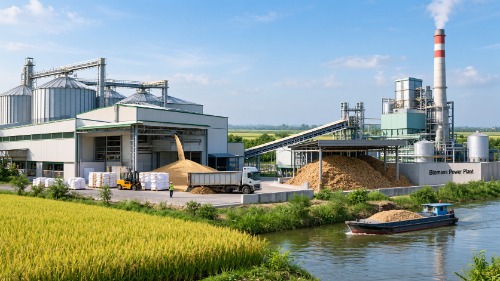
Construction has started on a 500,000-tonne-per-year rice processing complex and biomass fuel supply centre in Vietnam’s Mekong Delta, establishing a supply chain that will channel rice milling residues into renewable energy generation.
The facility, developed by Green CT Company in Can Tho City, began construction on October 3. It is one of five integrated rice processing and biomass supply complexes that Green CT plans to develop across the Mekong Delta.
The project is designed to combine modern rice processing with the recovery and utilisation of rice husks, a major by-product of rice milling. Husks collected from Green CT’s processing facilities will be supplied as biomass fuel to the Hau Giang Biomass Power Plant, an Erex-backed project.
The development links agricultural production, processing and renewable power generation within the same regional supply chain, potentially improving the utilisation of a residue that would otherwise require separate handling.
Rice husks to feed Hau Giang biomass power plant
Rice husks generated during rice milling will form the primary biomass feedstock for the energy component of the integrated model.
Erex Senior Executive Officer Tomoki Kakuta said the Hau Giang Biomass Power Plant consumes more than 100,000 tonnes of rice husks each year. According to Kakuta, the facility supplies electricity to around 50,000 households and is described by Erex as Vietnam’s first commercial biomass power project supplying electricity directly for local use.
The arrangement gives the rice-processing complex an outlet for its agricultural residues while providing the biomass power facility with a dedicated source of fuel.
Erex also plans to invest in 18 biomass power plants in Vietnam, Kakuta said, indicating that the company intends to expand its biomass generation footprint beyond the Hau Giang facility.
Green CT plans five integrated complexes
Green CT General Director Nguyen Minh Tuan said the combination of modern processing technology and better utilisation of agricultural by-products is becoming increasingly important as economies move towards greener growth.
The company is developing five rice processing complexes combined with biomass supply centres in the Mekong Delta. The approach is intended to improve the quality of rice prepared for export while creating an organised pathway for rice husks to enter the energy supply chain.
For the agricultural sector, the model places greater emphasis on the value of processing residues rather than treating them solely as waste. It also creates a direct connection between rice production volumes and the availability of biomass feedstock for power generation.
Regional supply chain could support farmers and cooperatives
Le Cong Ly, deputy chairman of the Can Tho City People’s Committee, said integrated processing chains using agricultural by-products could increase the value of rice and other agricultural products produced in the region.
He called on Green CT and its partners to maintain the construction schedule and establish a transparent raw-material supply area. According to the official, the supply system should provide tangible benefits to cooperatives and farmers while ensuring stable fuel availability throughout the year.
That supply-chain requirement will be important for biomass facilities because electricity generation depends on consistent access to suitable feedstock. For rice-husk-based systems, the connection between milling operations, residue collection and power generation can help establish a more structured fuel supply network.
Mekong Delta provides a large agricultural feedstock base
The Mekong Delta is Vietnam’s largest rice-producing region, covering about 3.6 million hectares and producing more than 24 million tonnes of paddy annually, according to the supplied source.
The scale of rice production provides a substantial agricultural residue base for processing and biomass applications. However, the source does not provide an estimate of how much rice husk will be generated by the new Green CT complex or what proportion will ultimately be supplied to the Hau Giang plant.
The project therefore represents an integrated model in which rice processing and biomass energy are connected through the utilisation of milling residues, rather than operating as separate agricultural and energy activities.
Bioenergy Business Analysis
The Green CT development highlights the potential for biomass projects to be integrated directly with agricultural processing infrastructure. In this case, the same regional rice value chain can support both food production and renewable electricity by directing rice husks towards a biomass power plant.
The commercial relevance of the model will depend in part on the reliability and transparency of the feedstock supply chain. The call from Can Tho authorities for stable year-round fuel supplies and clear arrangements involving farmers and cooperatives underlines that biomass development requires coordination beyond the power plant itself.
For biomass developers, rice processors and agricultural stakeholders, the planned five-complex model also illustrates how agricultural residue can become an organised industrial feedstock when processing infrastructure and energy demand are connected.
The next stage for the Green CT development is construction of the complex and establishment of the associated raw-material supply network. The supplied source does not specify a completion or commissioning date.