


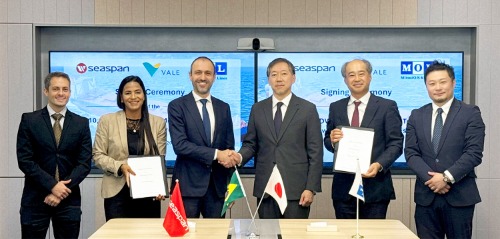
MOL Ocean Bulk Pte. Ltd. has signed a 25-year iron ore transport contract with Vale International S.A. covering two new 210,000-metric-tonne ore carriers capable of operating on ethanol, methanol and conventional heavy fuel oil, in a project described by Mitsui O.S.K. Lines (MOL) as the world’s first involving ore carriers of this size with tri-fuel propulsion.
The vessels are scheduled for delivery in 2030 and will primarily transport Vale’s iron ore from Brazil to destinations worldwide, particularly China. The project forms part of Vale’s shipping decarbonisation strategy and expands the potential role of ethanol and methanol as marine fuels in long-haul bulk shipping.
Two 210,000-tonne ore carriers to use three fuels
MOL Ocean Bulk, the Singapore-based company responsible for MOL Group’s overseas Capesize bulker business, will operate the two vessels under the long-term agreement with Vale International, a subsidiary of Brazilian mining company Vale S.A
According to MOL, the vessels will measure 299.95 metres in length and 50 metres in breadth, with a cargo capacity classification of 210,000 metric tonnes. Their expected operating route involves transporting iron ore loaded in Brazil to destinations around the world, primarily China.
The ships are scheduled to be delivered in 2030.
LNG and ammonia-ready design adds future fuel flexibility
Beyond their three-fuel propulsion capability, the vessels will incorporate an LNG- and ammonia-ready design, allowing for potential use of either fuel in the future.
MOL said the ships will also incorporate energy-saving technologies available for next-generation newbuildings. The combination of multiple fuel options and efficiency technologies is intended to allow fuel selection according to availability, emissions performance and economic considerations.
The approach differs from designing a vessel around a single alternative fuel. Instead, the vessels are being configured to provide operators with several pathways for managing fuel supply and emissions over their operating lives.
Ethanol emerges as a marine fuel option
The project is particularly significant for the ethanol industry because it places ethanol alongside methanol as a fuel option for large ocean-going bulk carriers.
MOL said ethanol could potentially reduce carbon emissions by up to approximately 90% compared with heavy fuel oil on a full lifecycle basis, citing information provided by Vale. The figure is therefore dependent on the lifecycle emissions characteristics of the ethanol used and should not be interpreted as a universal emissions reduction for all ethanol fuels.
Ethanol’s established handling characteristics are also cited by MOL as a factor supporting its potential use in marine applications.
The development comes as shipping companies and cargo owners explore alternatives to conventional marine fuels, with fuel availability, lifecycle emissions, vessel technology and economics all influencing the choice of alternative fuel.
MOL targets wider ethanol and methanol supply-chain collaboration
MOL said the project will extend beyond vessel operations. The company plans to work with customers and partners across the ethanol and methanol supply chains, including procurement, supply and bunkering.
This creates an additional requirement for the project: the availability of suitable alternative marine fuels at the locations and volumes required by large bulk carriers.
For ethanol in particular, wider maritime adoption will depend not only on compatible engines but also on reliable fuel supply, bunkering infrastructure and access to fuels with sufficiently low lifecycle emissions.
Project supports Vale and MOL decarbonisation goals
MOL said the vessels are intended to support its own decarbonisation objectives while helping reduce Vale’s marine-transport-related Scope 3 emissions.
Under its BLUE ACTION 2035 Phase 2 environmental vision, MOL has set a target of achieving net-zero greenhouse gas emissions by 2050. The company said the new vessels form part of its efforts to advance that target while contributing to lower emissions associated with Vale’s iron ore transportation.
Vale has also been developing a multi-fuel approach for its maritime logistics. Its 2025 sustainability reporting noted an earlier agreement for triple-fuel Guaibamax vessels using ethanol, methanol and fuel oil, indicating that ethanol is becoming part of a broader alternative-fuel strategy for the company’s maritime supply chain.
What the tri-fuel design means for shipping
The project’s main significance lies in fuel flexibility. A vessel capable of using ethanol, methanol and conventional fuel can potentially adjust its fuel choice as alternative-fuel availability, emissions performance and economics change.
However, the environmental performance of such vessels will ultimately depend on the fuels actually used during operations. A multi-fuel engine provides technological flexibility, but it does not by itself guarantee a particular emissions reduction.
The 25-year transport contract also gives the vessels a long-term commercial application rather than positioning them solely as demonstration ships.
Bioenergy Business Analysis
The MOL-Vale project creates a potentially important new demand pathway for ethanol beyond road transport. Large bulk carriers have significant fuel requirements, so the successful deployment of ethanol-capable propulsion at commercial scale could broaden the market for renewable ethanol into maritime transport.
The project’s 25-year contractual structure is also notable because it connects alternative-fuel vessel technology with a defined cargo requirement. However, the long-term impact on ethanol demand will depend on how frequently ethanol is selected over methanol or conventional fuel, the availability of competitively priced low-carbon ethanol, and the development of bunkering infrastructure.
For the biofuels sector, the more significant question is therefore not simply whether ships can run on ethanol, but whether sustainable ethanol can be supplied consistently at the scale, cost and lifecycle carbon intensity required by international shipping. The LNG- and ammonia-ready configuration also indicates that vessel owners and cargo interests are retaining flexibility as the marine-fuel market develops.