


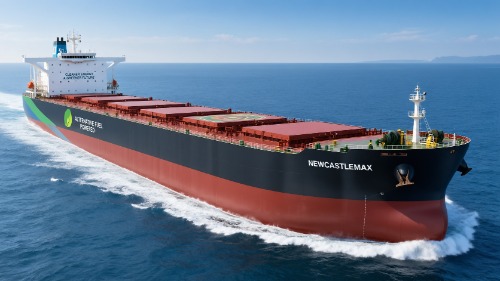
Swiss marine power company WinGD has secured an order to supply four dual-fuel X72DF-M-1.0 engines capable of operating on both methanol and ethanol for Polaris Shipping’s new Newcastlemax ore carriers.
The engines will power four 210,000 DWT vessels being built for Polaris Shipping at Qingdao Beihai Shipbuilding Heavy Industry in China. Delivery of the vessels is scheduled for 2031, giving the South Korean shipping company flexibility to select between two alternative fuels as fuel markets and maritime regulations evolve.
The order highlights a growing focus in shipping on propulsion systems capable of accommodating multiple lower-carbon fuels rather than committing vessels to a single alternative fuel over their operating lifetimes.
Four Newcastlemax vessels to use alcohol-fuel engines
WinGD’s X72DF-M-1.0 engine is designed to operate on both methanol and ethanol. The dual-fuel configuration allows the vessels to switch between the two alcohol fuels depending on their availability, economics and applicable regulatory requirements.
The engines will be installed in four Newcastlemax-class ore carriers, each with a deadweight capacity of 210,000 tonnes.
The ships are being constructed at Qingdao Beihai Shipbuilding Heavy Industry in China, with deliveries planned from 2031.
For Polaris Shipping, the engine selection provides an alternative to making a long-term commitment to one specific fuel before the future availability and economics of different marine fuels become clearer.
Fuel flexibility becomes a strategic consideration
The maritime industry is facing increasing pressure to reduce greenhouse-gas emissions while alternative-fuel supply chains remain at different stages of development across regions.
Methanol has already emerged as one of the alternative fuels being adopted for newbuild vessels, while ethanol is another alcohol-based fuel that can be used in marine combustion systems.
By selecting an engine capable of using both fuels, Polaris Shipping can retain the ability to adjust its fuel strategy during the vessels’ operating lives.
Polaris Shipping said that fuel availability and economics would continue to change over the lifetime of the vessels. The company said the dual-fuel platform would allow it to offer charterers greater choice without having to determine today which fuel will be most competitive in future years.
The approach effectively places fuel optionality at the centre of the vessels’ propulsion strategy.
WinGD to provide lifecycle support
WinGD will also provide dedicated service and lifecycle support for the new alcohol-fuel engines.
The support is intended to help the shipowner and operators develop operational experience with the technology while managing maintenance and optimising vessel performance.
WinGD said its support would also assist customers in adopting methanol and ethanol propulsion in a safe and economically sustainable manner.
The requirement for dedicated support reflects the operational changes involved in introducing alternative fuels. Fuel handling, engine operation and maintenance requirements need to be incorporated into vessel operations as shipowners gain experience with the technology.
Alternative-fuel engine portfolio expands
The Polaris Shipping order adds to WinGD’s wider portfolio of alternative-fuel propulsion technologies.
The company’s engine orderbook now covers LNG, methanol, ethanol and ammonia, according to the supplied source.
The Qingdao Beihai Shipbuilding Heavy Industry shipyard is also collaborating with WinGD on the installation of an ammonia-fuelled engine for new 210,000 DWT dry bulk carriers being built for CMB.TECH.
The combination of projects illustrates the widening range of alternative-fuel propulsion technologies being considered for large commercial vessels.
Rather than relying on a single fuel pathway, engine manufacturers and shipowners are developing and ordering propulsion systems around several potential fuels as the maritime sector works towards lower-emission operations.
Newcastlemax fleet points to long-term fuel decisions
The 2031 delivery schedule gives Polaris Shipping’s new vessels a long operating horizon during which fuel markets and maritime regulations could change significantly.
The ability to operate on either methanol or ethanol therefore provides a degree of flexibility around future fuel procurement decisions.
For WinGD, the contract also represents another step in the transition of alternative-fuel engine technologies from development into commercial vessel construction.
Bioenergy Business Analysis
The significance of the Polaris Shipping order extends beyond the four vessels themselves. By selecting engines capable of using both methanol and ethanol, the shipowner is effectively avoiding a single-fuel bet at a time when alternative marine-fuel markets are still developing.
That flexibility could become increasingly valuable as shipping companies assess not only fuel prices but also availability, infrastructure and regulatory requirements across different routes. However, the commercial value of dual-fuel capability will ultimately depend on the availability and economics of suitable methanol and ethanol supplies when the vessels enter service.
For the biofuels sector, the order is notable because it creates another potential maritime application for ethanol alongside its established roles in road transport and other markets. The development also reinforces the broader trend towards propulsion technologies designed to accommodate multiple lower-carbon fuel pathways rather than relying on one technology alone.
The key milestone ahead will be the construction and delivery of the four vessels from 2031, followed by their operational experience with methanol and ethanol fuels.
Read also: