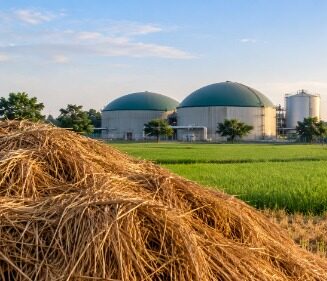
A community-based biogas plant installed at a gaushala (cow shelter) in Kharawar village, Rohtak district, Haryana, has completed its construction and initial trial run, with gas connections provided to 80 households in the first phase. The project, initiated by the District Council under the Swachh Bharat Mission, is expected to provide residents with a lower-cost alternative to liquefied petroleum gas (LPG).
The plant has a reported production capacity of 400 cubic metres of biogas per day and is designed to use cow dung as its primary feedstock. Approximately 10 tonnes of solid feedstock are required daily for gas production, according to the project details.
The project was initiated around three years ago but faced several controversies and implementation delays. With the installation work now largely completed, preparations are underway to operationalise the facility and extend gas supply to connected households.
2.5-km Pipeline Connects Biogas Plant to Households
A pipeline spanning approximately 2.5 kilometres has been laid across Kharawar village to transport biogas from the gaushala to residential connections.
Around 80 households have received connections in the first phase. A trial run was also conducted, during which cooking stoves in connected homes were successfully operated using the supplied biogas.
The plant is expected to provide beneficiaries with a continuous gas supply throughout the day at prices considerably lower than LPG. The project authorities have also indicated plans to extend connections to additional households as the facility’s capacity is expanded.
Plant to Generate 20,000 Litres of Bio-Slurry Daily
Alongside biogas production, the facility is expected to generate approximately 20,000 litres of bio-slurry, a nutrient-rich liquid by-product of anaerobic digestion, every day.
The bio-slurry can be used by farmers as an organic fertiliser, providing an additional agricultural benefit from the cow dung processing facility. Its use could help improve nutrient recycling, reduce dependence on some chemical fertilisers and support soil fertility management.
The integration of household gas supply with bio-slurry production also creates an opportunity to utilise livestock waste for both energy generation and agricultural applications.
Project Cost Stands at Rs 66.84 Lakh
The biogas plant at the Kharawar gaushala has an estimated project cost of Rs 66.84 lakh. Work worth approximately Rs 50 lakh has been completed, while the remaining work, valued at Rs 16.84 lakh, is still underway.
District Council Chairperson Manju Hooda said the facility had been established to provide affordable gas to local households. She confirmed that 80 connections had been provided in the initial phase, with plans to extend the service to other households in the village.
Sandeep, who is responsible for maintaining the plant, said the facility was ready and that the trial had confirmed gas delivery to connected homes. He added that beneficiaries would receive gas around the clock at rates substantially lower than LPG.
Plans to Expand Biogas Infrastructure Across Rohtak
The Kharawar project is expected to serve as a model for decentralised biogas deployment in other villages across Rohtak district. The District Council is considering the installation of similar facilities in additional villages to address household cooking fuel requirements.
By processing cattle waste into biogas and bio-slurry, the project combines decentralised renewable energy generation with organic waste management and agricultural resource recovery.
Bioenergy Business Analysis
The Kharawar biogas project highlights the potential of community-scale biogas infrastructure to connect livestock waste management with rural household energy access. Unlike larger commercial biogas facilities focused on compressed biogas (CBG) production and grid injection, the project is designed around direct household gas distribution through a local pipeline network.
Its reported daily production capacity of 400 cubic metres, combined with 80 initial household connections, provides an example of how gaushalas can serve as decentralised feedstock collection and energy production centres.
However, the project’s longer-term viability will depend on consistent feedstock availability, reliable plant operations, gas distribution infrastructure and an affordable pricing structure for beneficiaries. The proposed expansion to additional households will also require adequate production capacity and operational performance.
The generation of approximately 20,000 litres of bio-slurry per day adds an agricultural dimension to the project, creating a potential outlet for digestate while supporting nutrient recycling.
If the facility maintains reliable operations and delivers the anticipated cost savings, the Kharawar initiative could offer a replicable approach for rural biogas deployment in Haryana and other livestock-intensive regions.