


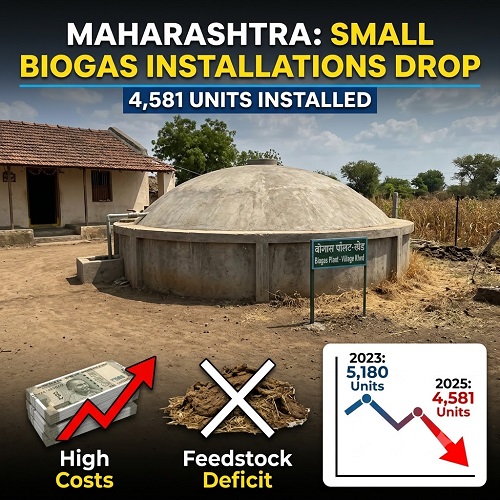
Small biogas plant installations across Maharashtra dropped to 4,581 units in FY 2024-25, continuing a multi-year decline driven by escalating capital expenditure, shrinking household livestock holdings, and persistent operational challenges, according to parliamentary data released by the Ministry of New and Renewable Energy (MNRE).
Key Takeaways
- Downward Trajectory: Annual small biogas installations in Maharashtra fell from 5,180 in FY 2022-23 to 4,707 in FY 2023-24, reaching 4,581 in FY 2024-25 under Phase-I of the National Bioenergy Programme.
- Key Growth Inhibitors: High construction costs, reduced household cattle dung availability, technician shortages, and water scarcity are primary drivers behind the slump.
- Toilet-Linked Deployment: A total of 2,730 toilet-linked biogas units (3 cu. m/day capacity each) were deployed over the last five fiscal years, with Kolhapur securing 1,725 plants—representing 63.1% of the state total.
- Policy Support: Central Financial Assistance (CFA) remains active for high-potential agricultural districts including Solapur, Nandurbar, Bhandara, Sangli, and Dhule.
Structural Headwinds Hits Decentralized Biogas
The installation figures reflect growing friction in the execution of Phase-I of the National Bioenergy Programme within Maharashtra. Data submitted in the Lok Sabha reveals a consistent year-on-year drop in decentralized bioenergy capacity.
According to state government assessments, higher raw material and construction expenses have pushed initial setup costs beyond the reach of many rural households. Furthermore, a decline in domestic livestock ownership has constrained feedstock supply, while the expanding penetration of alternative cooking fuels has lessened the immediate demand for domestic biogas generation.
Government Response and Targeted Interventions
Addressing parliamentary queries regarding the slowdown, the Ministry outlined ongoing interventions aimed at reviving adoption across livestock-dense regions.
“The lower number of installations during 2024-25 was mainly due to increase in the construction cost of biogas plants, reduced availability of cattle dung owing to decline in livestock at the household level, increasing use of alternative cooking fuels, water scarcity in certain areas, shortage of trained technicians, and reduced interest among beneficiaries in operation and maintenance,” stated Shri Shripad Yesso Naik, Minister of State for New & Renewable Energy and Power.
To counter this decline, MNRE continues to distribute Central Financial Assistance (CFA) while coordinating state-level technical training, public awareness drives, and beneficiary identification programs. Priorities are focused on agricultural districts with dense cattle populations, including Solapur, Nandurbar, Bhandara, Sangli, and Dhule.
District-Wise Breakdown: Toilet-Linked Biogas Distribution
Over the five-year period spanning FY 2021-22 to FY 2025-26, Maharashtra recorded 2,730 toilet-linked biogas plant installations, each operating at a standardized capacity of 3 cu. m per day. However, adoption across the state’s 34 reported districts remains severely skewed.
Kolhapur leads the state by a massive margin with 1,725 installations, followed by Palghar (168), Bhandara (78), Nagpur (76), Chandrapur (75), and Sangli (74).
In contrast, 10 districts—including Dhule, Jalna, Hingoli, Nanded, Dharashiv, Latur, Buldhana, Washim, Yavatmal, and Wardha—recorded zero toilet-linked biogas installations during the five-year period. MNRE confirmed that separate tracking data for faecal sludge generation and utilization rates is currently not maintained.
Bioenergy Business Analysis
The ongoing contraction of household-scale biogas in Maharashtra illustrates a broader structural transition taking place in the bioenergy sector. As individual cattle ownership fragments and rural labor dynamics shift, the traditional, unorganized micro-digester model is facing severe operational hurdles.
For technology providers and project developers, this downturn highlights a growing commercial opportunity: pivoting from standalone household digesters to cluster-based or centralized Compressed Biogas (CBG) infrastructure. Centralized assets aggregate waste streams more reliably, absorb escalating CAPEX through economies of scale, and eliminate individual beneficiary maintenance fatigue. Policy frameworks must adapt by linking capital subsidies with long-term Operation and Maintenance (O&M) service agreements to prevent asset abandonment.
District-Wise Toilet-Linked Biogas Plants in Maharashtra (FY 2021-22 to FY 2025-26)
| Sl. No. | District | Number of Biogas Plants |
| 1 | Thane | 17 |
| 2 | Palghar | 168 |
| 3 | Raigad | 12 |
| 4 | Ratnagiri | 61 |
| 5 | Sindhudurg | 43 |
| 6 | Nashik | 9 |
| 7 | Dhule | 0 |
| 8 | Nandurbar | 25 |
| 9 | Jalgaon | 46 |
| 10 | Ahilyanagar | 15 |
| 11 | Pune | 55 |
| 12 | Satara | 55 |
| 13 | Sangli | 74 |
| 14 | Solapur | 2 |
| 15 | Kolhapur | 1725 |
| 16 | C.Sambhajinagar | 5 |
| 17 | Jalna | 0 |
| 18 | Parbhani | 72 |
| 19 | Hingoli | 0 |
| 20 | Beed | 14 |
| 21 | Nanded | 0 |
| 22 | Dharashiv | 0 |
| 23 | Latur | 0 |
| 24 | Amravati | 32 |
| 25 | Buldhana | 0 |
| 26 | Akola | 7 |
| 27 | Washim | 0 |
| 28 | Yavatmal | 0 |
| 29 | Nagpur | 76 |
| 30 | Wardha | 0 |
| 31 | Bhandra | 78 |
| 32 | Gondiya | 16 |
| 33 | Chandrapur | 75 |
| 34 | Gadchiroli | 48 |
| Total | 2730 |
Also read: Goa Biogas Plants: State plans 200 new units under 90% subsidy scheme




[…] Small Biogas installations in Maharashtra drop to 4,581 units as costs and feedstock deficits mount […]