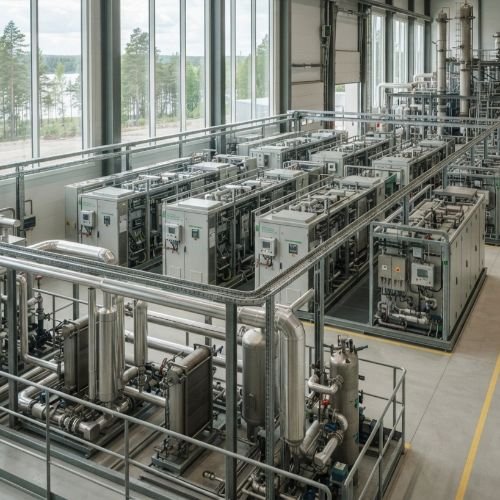
Siemens Energy has been selected to supply approximately 200 MW of electrolysis capacity for Alby PtX’s planned synthetic sustainable aviation fuel (e-SAF) facility in Alby, Sweden. The supply agreement is conditional on the project reaching a final investment decision, currently targeted for 2028.
The proposed facility is designed to produce approximately 66,000 tonnes of e-SAF annually using renewable electricity, water and captured carbon dioxide. The electrolyser system will produce the renewable hydrogen required for the Power-to-Liquid production process.
The agreement marks another development milestone for the Alby PtX project, which is being developed by Alby PtX AB, jointly owned by Norwegian Power-to-Liquid developer Norsk e-Fuel and investment manager Prime Capital. Renewable energy company RES is also supporting the project’s development.
Electrolyser supply linked to investment decision
The planned 200 MW electrolyser capacity is intended to support hydrogen production for the e-SAF facility. However, the agreement should not be interpreted as an unconditional equipment order or confirmation that construction has begun.
The value of the electrolyser agreement and its delivery schedule have not been disclosed in the available reporting.
Alby PtX advances engineering and technology arrangements
Alby PtX appointed Spanish engineering company Técnicas Reunidas to carry out front-end engineering design (FEED) for the facility in November 2026. The contractor will integrate the engineering design of the production process, providing the technical basis for the project’s next development stage.
The project has also selected Topsoe and Sasol as technology licensors. Topsoe will provide its eREACT and hydroprocessing technologies, while Sasol will contribute its low-temperature Fischer-Tropsch technology. Their combined process solution is intended to convert renewable hydrogen and captured carbon dioxide into synthetic hydrocarbons that can be upgraded into aviation fuel.
The facility will use a Power-to-Liquid process involving hydrogen production through electrolysis, carbon dioxide conversion, Fischer-Tropsch synthesis and subsequent hydrocarbon upgrading.
Project targets final investment decision in 2028
Alby PtX’s project information identifies 2028 as the target year for the final investment decision, with operations planned to begin in 2031. These remain development targets rather than confirmed construction or commissioning dates.
The project is intended to supply e-SAF to the European Union and UK markets. Its progress will depend on completing engineering, securing the required investment and advancing commercial arrangements, including carbon dioxide supply and fuel offtake.
The selection of Siemens Energy for the planned electrolysis capacity adds a key hydrogen-production component to the project’s developing technology and engineering structure. However, the project has yet to reach its final investment decision.