


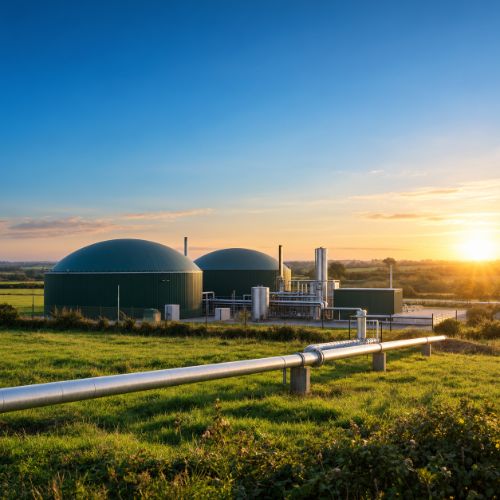
Ireland has connected its first two major biomethane plants to the national gas grid, marking an early milestone in the country’s efforts to establish a domestic renewable-gas industry. The connections of Bia Energy’s facility in Huntstown, County Dublin, and College Group’s plant in Nobber, County Meath, took place in August 2026 as Ireland works towards a 2030 target of 5.7 TWh of biomethane production.
Bia Energy’s €90 million Huntstown facility, with annual renewable biomethane capacity of 120 GWh, was connected to the Gas Networks Ireland grid on August 12. College Group’s €30 million Nobber facility followed several weeks later, becoming the second major producer to connect directly to the national network.
Ireland biomethane plants mark first grid connections
The two projects provide the first major examples of biomethane being injected into Ireland’s gas network at commercial scale.
David Kelly, CEO of Gas Networks Ireland, said the connection of another producer demonstrated Ireland’s ability to develop and utilise indigenous renewable gas. He added that biomethane could contribute to energy security while helping decarbonise sectors where gas remains part of the energy system.
The network operator said it is committed to developing the infrastructure required to support the expansion of Ireland’s biomethane industry.
The grid connections are significant because biomethane can be distributed through existing gas infrastructure once it has been upgraded to the required quality. This potentially allows renewable gas produced from organic feedstocks to serve existing gas demand without requiring an entirely separate distribution network.
Ireland targets 5.7 TWh of biomethane by 2030
The new plants are being developed against a substantially larger national ambition. Ireland’s latest Climate Action Plan sets a target of 5.7 TWh of biomethane production by 2030, equivalent to around 10% of the country’s total gas demand.
The two facilities connected in August therefore represent an initial step towards a target that will require considerably more production capacity and supporting infrastructure.
The government has acknowledged that Ireland’s biomethane industry remains at an early stage compared with several other European Union markets. A clearer policy framework and strategy are intended to encourage investment and provide developers with greater visibility over the future market.
Grass biorefinery adds another dimension to Ireland’s bioeconomy
The expansion of renewable gas infrastructure coincides with developments in Ireland’s wider bioeconomy.
On September 1, Agriculture, Food and the Marine Minister Martin Heydon officially opened a €3 million integrated grass biorefinery and anaerobic digestion demonstration plant at Shinagh Estate’s demonstration farm in County Cork.
The facility forms part of the Farm Zero C project and is designed to process fresh grass into several products. These include high-protein animal feed, a grass fibre fraction for potential use in packaging and livestock feed, bioenergy and biofertiliser.
Heydon described the opening as a significant milestone for Ireland’s bioeconomy.
Unlike a conventional AD facility focused primarily on energy production, the integrated approach seeks to extract multiple products from the same biological feedstock. The demonstration project therefore reflects a broader focus on maximising resource utilisation alongside renewable-energy generation.
Developers focus on efficiency and digestate value
The emerging Irish market is also attracting interest from technology suppliers.
Matt Hale, Global Business Development Director at HRS Heat Exchangers, said the company was receiving more enquiries from both the Republic of Ireland and Northern Ireland as anaerobic digestion capacity expands.
Hale pointed to Ireland’s biomethane strategy and its measures to encourage investment, arguing that the clearer roadmap is giving developers greater confidence.
He also highlighted the growing focus on plant efficiency, energy output, greenhouse-gas savings and the use of biofertiliser produced from digestate.
Digestate is the nutrient-rich material left after anaerobic digestion. When properly processed and managed, it can provide an agricultural fertiliser product, allowing AD projects to generate value from both their renewable gas and residual organic material.
Grid infrastructure becomes critical to biomethane growth
The connection of Huntstown and Nobber demonstrates that Ireland’s biomethane market is moving from policy planning towards physical infrastructure and production.
However, reaching 5.7 TWh by 2030 will require the development of many more projects, alongside sufficient feedstock, grid capacity and processing infrastructure. The early projects will therefore provide important evidence of how Ireland’s renewable-gas market operates as additional producers enter development.
For Ireland, the combination of biomethane production, grid access and integrated bioeconomy projects points towards a model in which agricultural resources can support renewable energy, fertiliser production and wider emissions-reduction objectives.
With the first two major biomethane plants now connected and further facilities in development, the next phase will be scaling production sufficiently to move Ireland closer to its 2030 renewable-gas target.
Bioenergy Business Analysis
Ireland’s major biomethane grid connections signal that the country’s biogas sector is moving from policy ambition towards commercial-scale deployment. With a 5.7 TWh biomethane target by 2030, the immediate challenge will be scaling project development, securing reliable feedstock and expanding grid infrastructure while maximising value from biomethane and digestate.
Read also: Waga Energy, Casella start commercial operations at US Biomethane Plant