


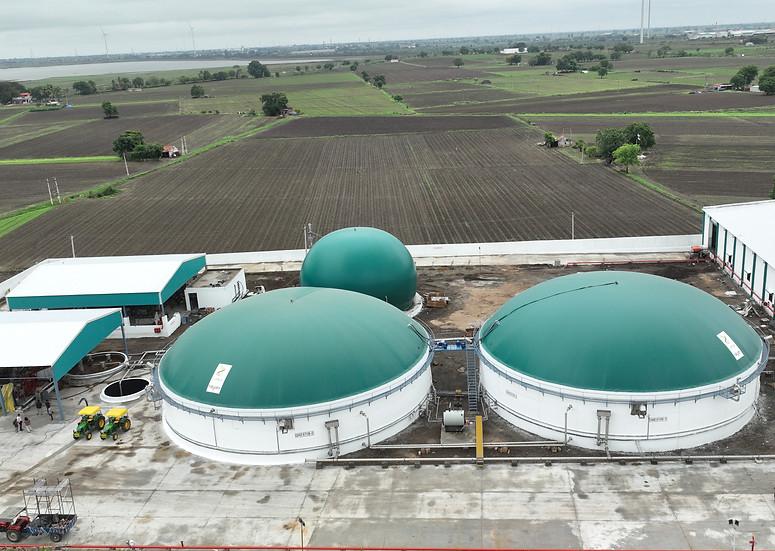
India could theoretically produce 62 million tonnes per annum (mtpa) of compressed biogas (CBG) from its estimated annual feedstock base of 472 million tonnes, potentially replacing its projected liquefied natural gas (LNG) imports by 2030, according to a report by the Confederation of Indian Industry (CII) and EY-Parthenon.
The report, estimates that the country’s CBG production potential could meet around 80% of its projected natural gas demand in 2030. One example of planned domestic capacity is Reliance Industries’ plan to build 100 biogas plants.
At this production level, domestic CBG could theoretically substitute the entire projected LNG import volume of approximately 40 million tonnes in 2030. Such substitution could avoid around US$20.6 billion in annual LNG import expenditure, calculated using 2025-26 import prices, the report said.
However, the estimate represents the potential of India’s available feedstock resources rather than an established production outlook. The report identifies project execution, feedstock availability, infrastructure and market development as key challenges to converting the resource base into commercially viable CBG capacity.
CBG project pipeline faces commissioning challenges
Despite the sector’s expansion over the past six years, a significant gap remains between project registrations and plants reaching construction and commissioning, according to the report.
A separate summary of the CII report published by ETEnergyWorld said that, as of 2 November 2026, India had 838 registered CBG projects. Of these, 210 had been commissioned, 255 were under construction and 373 had not yet begun construction.
The commissioned plants had a combined production capacity of approximately 1,946 tonnes per day. The report summary also noted that only 24 of the 210 operational plants were connected to gas pipelines, highlighting infrastructure constraints that could affect the evacuation and commercial distribution of CBG.
The figures underline the difference between the country’s estimated resource potential and the production capacity currently available to the market.
CBG blending obligation to support demand
India’s CBG Blending Obligation (CBO) is expected to provide a structured demand base for domestic producers. The obligation requires city gas distribution (CGD) entities to blend specified proportions of CBG with natural gas supplied through the compressed natural gas (CNG) transport and piped natural gas (PNG) domestic segments.
The blending requirement is set at 3% for FY2026-27 and 4% for FY2027-28, rising to 5% from FY2028-29 onwards.
However, the report’s estimates indicate that compliance-led demand alone would not be sufficient to absorb the sector’s full production potential. ETEnergyWorld reported that demand under the 5% obligation could reach approximately 0.62 mtpa by FY2030, equivalent to around 1.5% of projected LNG imports. This level of substitution could generate annual savings of approximately US$320 million.
Developing additional demand beyond the blending mandate will therefore be important if India is to realise a larger share of the potential import-substitution benefits.
Policy support and commercial viability remain critical
The report said India’s evolving policy framework has strengthened the investment case for CBG by improving pricing visibility, offtake assurance and access to financing. Support for pipeline infrastructure and feedstock availability is also expected to address operational constraints.
Nevertheless, it cautioned that commercial expansion will depend on translating policy support into reliable project execution.
“Nevertheless, commercial scale-up will depend on translating policy support into reliable execution, particularly through secure year-round feedstock supply, timely project commissioning, sustained plant utilisation, competitive delivered costs, adequate pipeline and cascade connectivity, and viable markets for FOM and LFOM,” the report said.
FOM and LFOM refer to solid and liquid fermented organic manure, respectively, which are by-products of CBG production. Developing viable markets for these products can help improve the overall economics of biogas plants.
The report also highlighted the need to strengthen feedstock supply chains, ensure consistent plant utilisation and improve access to end-user markets.
India’s estimated feedstock resources provide a substantial opportunity to expand domestic renewable gas production and reduce exposure to imported LNG. However, the scale of potential savings will depend on how quickly registered projects become operational, whether plants can secure reliable feedstock and market access, and how effectively infrastructure and demand develop alongside production capacity.