


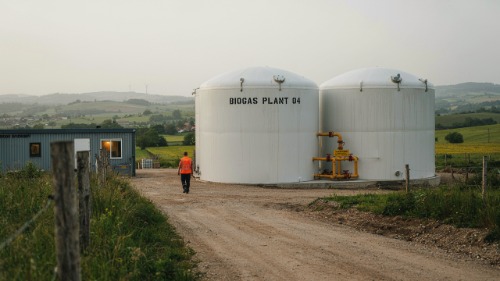
VNR Vignana Jyothi Institute of Engineering and Technology (VNRVJIET) has commissioned a 1 tpd biogas plant at its hostel complex in Hyderabad, Telangana, converting food waste from campus kitchens and canteens into renewable cooking fuel and organic manure.
The facility can process up to 1,000 kg of organic waste daily and is designed to address the substantial volume of food waste generated by the institute’s hostel and canteen operations. The resulting biogas is being supplied to dedicated burners at the Vignana Jyothi hostels, allowing the canteens to use renewable fuel for cooking.
The project was developed through a collaboration between VNR VJIET and KPMG, with total investment of INR 60 lakh. KPMG supported the initiative through its corporate social responsibility programme, while Vignana Jyothi contributed through Saahas, an organisation focused on circular-economy solutions. Ahuja Waste and Energy was responsible for the plant’s design, installation and commissioning.
Plant converts food waste into biogas and manure
The facility has been sized around the institute’s food-waste stream, with approximately 800 kg of food waste generated each day from hostel kitchens and canteens, according to the project information.
At full utilisation, the plant is expected to produce approximately 48 kg of biogas per day, equivalent to about 2.5 commercial LPG cylinders. This translates to roughly 750 commercial LPG cylinders annually based on the stated production estimate.
The project documentation estimates the resulting annual energy value at around INR 22 lakh, while the organic manure produced during the process will be used for plantation and green-cover development across the campus.
Saahas, which lists the initiative as a wet-waste management and circular-economy project, says the plant is intended to convert food waste into biogas and nutrient-rich organic manure while reducing the amount of waste sent to landfill.
Waste management and emissions benefits
The project is expected to process approximately 180 tonnes of food waste annually, helping divert organic waste from landfill disposal.
Project estimates indicate that the initiative could avoid approximately 550 tonnes of CO₂ emissions annually, alongside savings of about 1,040 LPG cylinders and recovery of approximately 480 kilolitres of water each year.
At 100% utilisation, the project information gives a higher potential figure of approximately 600 tonnes of CO₂ emissions mitigated annually. These figures are project estimates rather than independently verified emissions measurements.
The replacement of part of conventional LPG consumption with biogas also provides the campus with a locally produced renewable fuel source, linking food-waste management with energy generation.
Campus to use plant as sustainability learning centre
Vignana Jyothi plans to develop the facility as a Centre of Excellence in Sustainable Waste Management, extending its role beyond waste treatment and energy production.
Engineering students are expected to gain practical exposure to renewable energy, waste-to-energy systems, environmental engineering and circular-economy applications. The facility will also provide a learning platform for school students associated with Vignana Jyothi Society and other institutions in Hyderabad.
Durga Prasad Kode, IPS (Retd.), General Secretary, Vignana Jyothi, said the institute wants to demonstrate how educational campuses can recover resources and generate energy locally.
The organisation is also exploring replication of the approach at the Dr. Rama Naidu Vignana Jyothi Institute of Rural Development, according to the project announcement.
KPMG CSR support and future expansion
KPMG described the project as an example of converting an everyday waste-management challenge into renewable energy while reducing reliance on conventional fuels.
The initiative forms part of Vignana Jyothi’s wider environmental programme, which includes solar energy, sewage treatment, rainwater harvesting, green-cover development and waste-management measures.
The institute’s longer-term objective is to move towards a zero-waste and carbon-neutral campus, with future work expected to strengthen collection, segregation, treatment and recycling systems for plastics and other waste streams.
Bioenergy Business Analysis
The VNRVJIET project demonstrates how relatively small-scale anaerobic digestion facilities can integrate waste management and energy use within institutional campuses. Instead of treating food waste solely as a disposal issue, the facility creates two usable outputs: biogas for cooking and organic manure for campus landscaping.
The project’s potential as a replicable model will depend on factors including consistent source-separated food waste, plant utilisation, operating performance and the economics of replacing conventional cooking fuels. Its planned role as a training and demonstration facility could also give the project value beyond its direct energy output, particularly for engineering education and campus-scale circular-economy applications.
Read also: India rolls out GOBARdhan guidelines with assured CBG offtake and 10-year pricing framework