


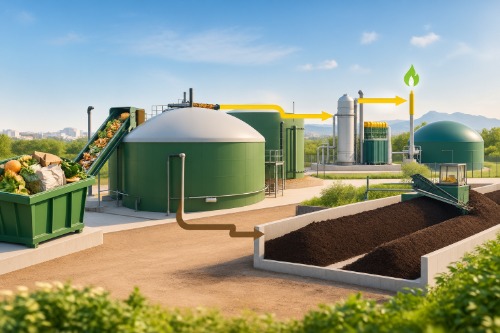
Emirates Biotech and United Arab Emirates University (UAEU) have launched a two-year pilot project in Al Ain to test an integrated system for converting mixed organic waste into renewable biogas and nutrient-rich compost.
The project, located near the UAEU campus, will process up to 40kg of organic waste per day, including food waste mixed with compostable packaging. Running from August 2026 to August 2028, the pilot is intended to generate technical, environmental and economic evidence for a potential pathway to divert organic waste from landfill.
Installation and commissioning are expected to be completed by August 2027.
Integrated approach combines digestion and composting
The pilot will combine anaerobic digestion with composting. Anaerobic digestion will break down the organic fraction of the waste to produce biogas, while the resulting digestate will undergo composting to produce nutrient-rich compost.
Researchers will also examine whether the biogas produced through the process could subsequently be converted into renewable hydrogen at laboratory scale.
Dr Aman Kulshrestha, Chief Technology Officer of Emirates Biotech, said the project will demonstrate an integrated biorefinery approach to organic waste management in the UAE.
According to Kulshrestha, anaerobic digestion provides the route to renewable biogas, while digestate processing could produce a usable soil amendment. The project will also assess the role of compostable packaging within the integrated waste-treatment process.
The pilot therefore brings several resource-recovery routes into a single system rather than treating food waste solely as a disposal challenge.
UAE food waste provides a significant feedstock stream
The project partners said food waste accounts for nearly 40% of daily municipal solid waste in the UAE, with a substantial proportion currently going to landfill.
The pilot will investigate whether food waste and compostable packaging can be handled together to recover energy and organic nutrients while reducing the volume of material requiring disposal.
Professor Zafar Said Sher, the UAEU project lead, said the research would assess a practical end-of-life route for food waste and compostable packaging while contributing to the UAE’s circular economy, food security and Net Zero objectives.
The project will also create training opportunities for students and researchers working on waste-to-resource technologies.
From laboratory evidence to potential modular deployment
The partners intend for the two-year project to generate operational and technical evidence that could support the design of larger modular facilities.
Dr Rami, Associate Provost for Research at UAEU, highlighted the role of collaboration between academic institutions and industry in moving research towards scalable applications.
The project’s potential environmental performance is also a key area of investigation. The partners said that, if successfully scaled, an integrated organic waste valorisation plant could eventually reduce CO2 emissions by 89% compared with landfilling.
That figure is a project-partner claim and represents a potential outcome rather than a demonstrated result from the pilot at this stage.
Bioenergy Business Analysis
The UAE pilot illustrates how organic-waste projects are increasingly being considered as resource-recovery systems rather than single-purpose disposal facilities. Its combination of anaerobic digestion, composting and potential hydrogen production creates multiple value pathways from the same feedstock, while the inclusion of compostable packaging tests an issue that conventional organic-waste systems may not always address.
For developers and technology providers, the key value of the project will be the evidence generated at pilot scale. Feedstock handling, process performance, environmental outcomes and economics will determine whether the concept can move towards larger modular facilities. The project’s two-year timeframe should therefore be viewed primarily as a validation phase rather than a commercial deployment.
The pilot is scheduled to operate through August 2028, with installation and commissioning targeted for completion by August 2027.
The research is expected to produce technical evidence and operating guidance that could inform the development of larger organic-waste valorisation facilities in the UAE and potentially other markets. The source material does not specify a subsequent commercial project or confirmed deployment beyond the pilot.