


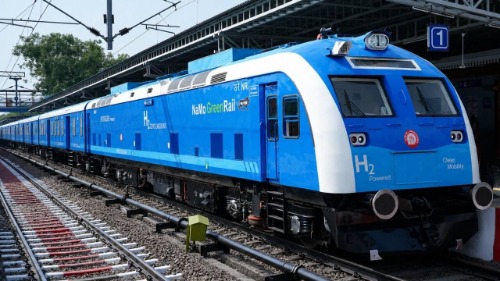
India is expanding its clean energy and low-carbon infrastructure across transport, power, water conservation, agriculture and waste management, Prime Minister Narendra Modi said while outlining the country’s environmental priorities at an international conference on climate and environmental governance in New Delhi.
Speaking at the “The Future of Environment and Climate Dynamics” conference organised by the National Green Tribunal on September 19, Modi highlighted developments including hydrogen-powered rail transport, renewable energy expansion, electric mobility, railway electrification, water conservation and the conversion of organic waste into useful resources.
The two-day conference, being held at Vigyan Bhawan on September 19–20, brings together environmental experts, policymakers and judicial representatives from India and other countries to discuss climate change, environmental governance, sustainable energy and the circular economy.
Hydrogen train signals new clean mobility push
Modi pointed to India’s first hydrogen-powered train as an example of the country’s efforts to develop alternative low-carbon transport technologies.
India’s hydrogen train was flagged off between Jind and Sonipat in Haryana in July 2026. According to the Press Information Bureau, the train is among the world’s longest and most powerful hydrogen-powered trains and uses fuel-cell technology, with water vapour as its by-product.
The train comprises 10 coaches and was developed using indigenous technology. The initial service operates on the 89-km Jind–Sonipat section.
Modi described the deployment as part of a new phase of clean mobility.
Wind and hydro capacity expand
The Prime Minister said India’s wind energy capacity has increased threefold over the past 12 years, while hydropower capacity has also recorded significant growth.
He also highlighted nuclear energy as another component of India’s future energy mix, saying the government is opening greater opportunities for private-sector participation in these areas.
According to Modi, India’s non-fossil energy capacity has increased substantially during the period. The broader expansion of renewable and other non-fossil generation forms part of the country’s efforts to diversify its electricity system away from fossil fuels.
Electric mobility scales up
India’s electric vehicle market has also expanded sharply, according to figures cited by Modi.
He said that before 2014, annual EV sales were around 3,000 vehicles, compared with approximately 2.5 million electric vehicles sold last year.
The Prime Minister also linked digital toll collection and expanding public transport infrastructure with lower fuel consumption. He said India had fewer than 250 km of metro network across five cities before 2014, whereas metro systems now operate in more than 20 cities and the country has crossed 1,000 km of metro network.
Railway electrification reduces diesel dependence
Railway electrification was another area highlighted during the address.
Modi said the completion of 100% railway electrification has reduced diesel consumption by millions of litres, contributing to lower environmental impacts from rail operations.
The comments underline the broader role of electrification in reducing direct fossil-fuel use in transport, particularly as India’s railway network increasingly relies on electricity-based traction.
Water conservation and climate-resilient agriculture
The Prime Minister also highlighted water conservation initiatives, saying that more than 70,000 Amrit Sarovars have been created across the country.
Under Catch the Rain initiative, he said approximately 15 million water-harvesting structures have been created.
Agriculture was another component of the environmental agenda outlined at the conference. Modi said clusters covering around 1.25 million hectares have been developed under the National Mission on Natural Farming.
He also cited the development of nearly 3,000 climate-resilient crop varieties and said agroforestry is being promoted as a means of reducing carbon footprints.
Forest cover and circular economy remain key priorities
Modi said India’s very dense forest cover has increased by 22% over the past 12 years.
On plastic waste, he pointed to India’s restrictions on single-use plastics and the government’s focus on the reduce, reuse and recycle approach as part of a wider circular-economy strategy.
The waste-to-resource approach also extends to organic waste, with the Prime Minister highlighting the GOBARdhan initiative. The programme seeks to process cattle dung and other organic waste into useful products and resources, including biogas and bio-based outputs.
For the bioenergy sector, the use of agricultural and livestock waste as feedstock is particularly relevant because it links waste management with renewable gas production, rural resource recovery and potential reductions in unmanaged organic waste.
Bioenergy Business Analysis
The environmental priorities outlined by Modi span several areas relevant to India’s energy transition, but the expansion of hydrogen, electrification and organic-waste utilisation has different infrastructure and commercial requirements. Hydrogen rail remains an emerging technology application, while the conversion of cattle dung and organic waste into biogas and other useful resources offers a more direct connection between India’s rural economy and the bioenergy sector.
The focus on circular economy and waste-to-resource systems could also create opportunities for decentralised biogas, compressed biogas and other waste-processing projects. The scale-up of these technologies will depend on feedstock availability, project economics, infrastructure, policy support and the ability to develop reliable markets for the resulting fuels and by-products.
Read also: MEDA invites bids for Rs 90 lakh green hydrogen laboratory in Pune