


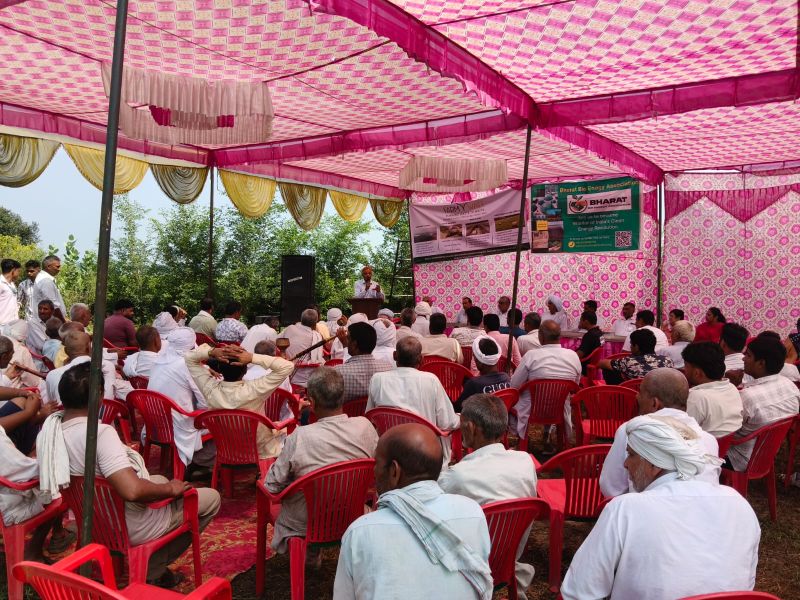
FarmWatt Innovations Pvt. Limited has inaugurated its third Farm Urja Kendra at Shahpur in Haryana’s Jind district, expanding its network of facilities focused on agricultural residue management and biomass utilisation.
The centre was inaugurated on September 18, 2026, according to an announcement by the company. FarmWatt said the facility is intended to strengthen the connection between farmers, crop-residue management and the clean-energy sector by supporting the productive use of agricultural biomass.
The inauguration was attended by Dr. Parveen Dhamija, Advisor to the Bharat Bio Energy Association; Abhilasha Jha, CEO of the Bharat Bio Energy Association; Ajmal Singh Kathat, retired General of the BSF and Chief Administrative Officer at FarmWatt Innovations; as well as village leaders and farmers from the surrounding area.
Farm Urja Kendra targets agricultural residue management
The Shahpur centre is designed to provide a local link between farmers and the agricultural biomass supply chain.
FarmWatt describes its Farm Urja Kendras as centres for the collection, storage, processing and supply of agricultural residues for bioenergy applications. The company’s published information says the centres are intended to help reduce residue burning while creating opportunities to convert crop waste into resources such as bioenergy and organic manure.
This model places residue aggregation closer to agricultural areas, addressing one of the logistical challenges associated with moving dispersed crop residues from farms to downstream biomass and biogas facilities.
Linking crop residues with bioenergy
FarmWatt has positioned the Farm Urja Kendra network as part of a broader agricultural waste-to-energy model.
The company says agricultural residues collected through its network can be processed and supplied to biogas plants as feedstock, while nutrient-rich material generated after the biogas process can return to agricultural fields.
The approach creates a potential circular pathway in which crop residues move from farms into the bioenergy supply chain rather than being treated solely as waste.
FarmWatt’s broader business model includes agricultural waste management, biogas plant development and organic manure production. Its website says the company is focused on integrating agricultural waste management with bioenergy production and rural infrastructure.
Jind centre adds to wider residue-management network
Jind is already identified by FarmWatt as one of the locations where it is developing agricultural residue-management activities. The company says its centres provide farmers with tools and support for managing crop residues and improving resource utilisation.
The latest inauguration comes ahead of the peak period for crop-residue management in northern India, when the availability of paddy and other agricultural residues creates both a logistics challenge and a potential biomass feedstock opportunity.
In a separate recent company update, FarmWatt said its Farm Urja Kendra model involves aggregating residue from smaller farms, storing and processing it, and supplying the material to biogas plants.
Focus on farmer participation
The Shahpur inauguration brought together farmers and village representatives alongside professionals from the agriculture and bioenergy sectors.
FarmWatt said the objective is to develop a more organised and farmer-oriented agricultural residue ecosystem, with local centres serving as points of interaction between farmers and the wider clean-energy value chain.
The company has also said that its broader network is intended to provide economic opportunities from agricultural residues while supporting renewable energy generation and organic fertiliser production.
Building the biomass supply chain
For the bioenergy sector, the development of local residue-collection infrastructure is significant because the availability of biomass alone does not guarantee a reliable feedstock supply. Collection, baling, transportation, storage and seasonal management are all necessary to move agricultural residues from dispersed farms to energy facilities.
FarmWatt’s expansion of Farm Urja Kendras therefore represents an effort to build this upstream portion of the biomass supply chain closer to the point of residue generation.
Bioenergy Business Analysis
The Shahpur centre illustrates the growing emphasis on agricultural residue aggregation as a critical link in India’s bioenergy supply chain. For biogas and compressed biogas projects, establishing reliable access to crop residues can be as important as the downstream conversion technology itself. Local collection and storage centres can potentially reduce logistical barriers while giving farmers a structured route for managing biomass.
The commercial significance of the model will ultimately depend on consistent residue volumes, efficient collection and storage, farmer participation and reliable offtake from downstream bioenergy facilities. If these elements develop together, Farm Urja Kendras could provide a decentralised infrastructure layer connecting agricultural production with India’s expanding biomass and BioCNG ecosystem.