


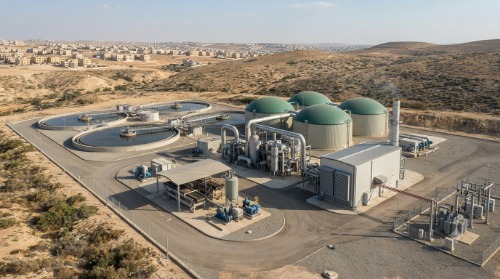
Jordan has signed a €3.3 million (about JD2.7 million) consulting agreement to advance the use of biogas for electricity generation at wastewater treatment plants, with the programme targeting facilities in West Jerash, East Jerash and Kufranja.
The Ministry of Water and Irrigation signed the agreement on 23 September with a consortium comprising Germany-based Fichtner Water and Transportation GmbH (FWT) and Jordanian engineering company Engicon, according to the Jordan News Agency, Petra.
The consultancy forms part of Phase II of Jordan’s Results-Based Financing (RBF) programme, supported by Germany’s KfW Development Bank. The wider programme has €20 million in German bilateral financing, supplemented by a €10 million European Union grant, according to Petra.
The initiative is designed to improve wastewater treatment performance while capturing biogas from sludge treatment for electricity generation, creating a combined water, energy and resource-recovery approach.
West and East Jerash, Kufranja facilities targeted
The project focuses on upgrading wastewater infrastructure at West Jerash, East Jerash and Kufranja.
A KfW-related tender notice confirms that the West Jerash project is being developed alongside the East Jerash and Kufranja facilities as part of the first cluster of wastewater treatment plants. Previous feasibility work identified the potential for upgrading treatment processes to incorporate anaerobic sludge digestion and electricity generation from biogas.
The broader RBF II programme was established to support small- and medium-scale investments aimed at improving the performance of existing water-sector infrastructure. KfW documentation divides the second phase into investment measures and operational support for existing wastewater treatment plants.
The new consultancy will help advance the technical and implementation requirements for the targeted wastewater facilities.
Biogas to provide electricity for wastewater operations
At the centre of the project is the recovery of biogas generated through wastewater treatment and its use for electricity production.
Anaerobic digestion of sewage sludge produces biogas containing methane, which can be captured and used in power-generation equipment rather than being wasted. For wastewater utilities, this can create an opportunity to recover energy from an existing treatment by-product while reducing electricity requirements from the grid.
Jordan’s programme is specifically focused on electricity generation from biogas, rather than the production of compressed biogas (CBG) for vehicle fuel.
Petra reported that the project is intended to reduce reliance on grid electricity, lower operating costs and cut greenhouse-gas emissions.
KfW-linked project documentation also describes the wider programme as an effort to improve energy efficiency through electricity generation from biogas at wastewater treatment plants.
Construction followed by 15 years of operation and maintenance
The project model extends beyond engineering design and construction.
According to Petra, the eventual winning contractor will be responsible for construction as well as operation and maintenance for 15 years. This approach links the design and implementation of the upgrades with longer-term plant performance.
That structure is particularly relevant for biogas-based wastewater projects because the economic performance of anaerobic digestion depends not only on the installation of digesters and power-generation equipment, but also on sustained sludge management, process control, gas capture and equipment maintenance.
The consultancy stage is therefore expected to help establish the technical and commercial framework before implementation proceeds.
Wastewater reuse adds a second resource-recovery benefit
The project is also linked to Jordan’s efforts to increase the reuse of treated wastewater.
Improved treatment performance is expected to produce effluent suitable for agricultural irrigation, potentially reducing pressure on conventional water resources. Petra reported that the initiative is intended to provide a safe and sustainable water source for agriculture alongside the energy benefits of biogas recovery.
This creates a broader resource-recovery model in which the same wastewater infrastructure can deliver treated water for reuse and renewable electricity from sewage sludge.
Jordan’s National Water Strategy 2023–2040 identifies improved energy efficiency, increased renewable-energy use and greater private-sector engagement among the strategic directions for the water sector.
€30m financing framework supports the programme
The announced consultancy sits within a larger international financing framework.
The RBF II programme has a €20 million commitment through German bilateral cooperation, while the EU is providing an additional €10 million grant, according to the Jordan News Agency.
German climate-finance records independently list the RBF II programme for Jordan at €20 million, with KfW as the implementing development-finance institution and Jordan’s Water Authority as the project partner.
The €3.3 million consulting agreement should therefore be viewed as a component of the wider programme rather than the total value of the wastewater biogas infrastructure investment.
Biogas project supports Jordan’s water and energy priorities
Jordan’s water sector faces the dual challenge of securing water supplies while controlling the energy requirements associated with water and wastewater treatment.
The government’s Economic Modernisation Vision Executive Programme for 2026–2029 includes projects and initiatives covering sustainable resources, environmental sustainability and public-private partnerships. The government says the second phase of the programme contains 392 projects with an indicative cost of about JD3.8 billion.
The wastewater biogas initiative fits within this broader policy direction by combining energy recovery, wastewater treatment and water reuse.
For Jordan’s utilities, the model also offers a route to reduce the operating-energy burden associated with wastewater treatment while making better use of organic material already present in the sewage system.
Bioenergy Business Analysis
Jordan’s wastewater biogas programme illustrates why anaerobic digestion is increasingly relevant to water utilities as an energy efficiency measure as well as a renewable-energy technology. The value proposition is not limited to electricity generated from methane, improved sludge management and treated-water reuse can provide additional operational benefits from the same infrastructure.
The critical test will be long-term performance. Biogas output depends on sludge characteristics, digestion efficiency and plant operating conditions, while electricity savings depend on how much generation can reliably be integrated into wastewater operations. The decision to combine construction with a 15-year operations and maintenance obligation could help keep those performance considerations central to project implementation.