


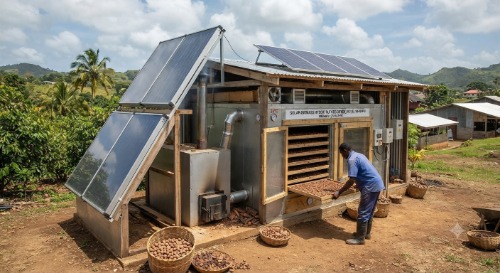
A solar-biomass hybrid dryer developed by students from Hasanuddin University has reduced the time required to dry nutmeg for farmers in Fakfak District, West Papua, Indonesia, from around seven days to two days.
The Smart Solar Biomass Dryer was developed by the university’s Patriot Expedition Team 15 for farmers in the Weri-Saharey Transmigration Area. The technology is intended to address one of the key post-harvest challenges faced by nutmeg producers: dependence on weather conditions during drying.
According to Indonesia’s Transmigration Ministry, the dryer can maintain temperatures of around 60°C and process up to 1,000 nutmeg seeds per cycle. More controlled drying conditions are intended to reduce the risk of mould formation when rain interrupts conventional drying.
Hybrid solar and biomass drying system
The dryer combines solar energy with biomass as a supplementary heat source. It is designed to operate without electricity and uses locally available materials, allowing farmers to deploy it in different locations.
The system also incorporates Internet of Things (IoT) technology to support its hybrid drying mechanism.
When the temperature falls below 50°C, biomass can be added to maintain the required drying conditions. When temperatures rise above 60°C, the quantity of biomass burned is reduced.
This approach allows solar energy to provide the primary drying input while biomass can supplement heat when solar availability is insufficient.
Five-tray drying configuration
Michel Obrien, a representative of Hasanuddin University’s Patriot Expedition Team, said the dryer includes five trays for placing nutmeg, with another dedicated space above containing five additional trays.
The upper section can accommodate around 1,000 nutmeg seeds, according to Obrien.
Farmers have welcomed the technology as a way to reduce their exposure to unpredictable weather during post-harvest processing.
Aher Samai, head of the Rangkum Farmers Group, said farmers need drying equipment that can reduce concerns about rain during the drying process.
Samai also called for a larger-capacity version of the dryer that could process more nutmeg in a shorter period.
West Papua nutmeg production
Agriculture Ministry data cited by the Transmigration Ministry shows that West Papua has approximately 32,440 hectares of nutmeg plantations, producing about 1,555 metric tonnes of nutmeg annually.
For farmers operating in areas where drying traditionally depends on favourable weather, reducing the drying period could help lower post-harvest risks and improve the reliability of processing.
The development also forms part of the 2026 Patriot Expedition Team’s broader focus on appropriate technology, alongside downstream processing, industrialisation, the productive economy, digitalisation and renewable energy.
Bioenergy Business Analysis
The Fakfak project illustrates how biomass can complement solar energy in decentralised agricultural processing. Rather than relying on biomass as the sole heat source, the hybrid configuration uses solar energy as a primary input and introduces biomass when temperatures fall below the required range.
For agricultural communities without reliable electricity access, such systems could provide an alternative route to controlled thermal processing while using locally available resources. The reported reduction in nutmeg drying time—from seven days to two—also highlights the potential value of renewable-energy-based drying technologies in reducing weather-related post-harvest risks.
Read also: Japan’s biomass demand raises deforestation risks in Indonesia