


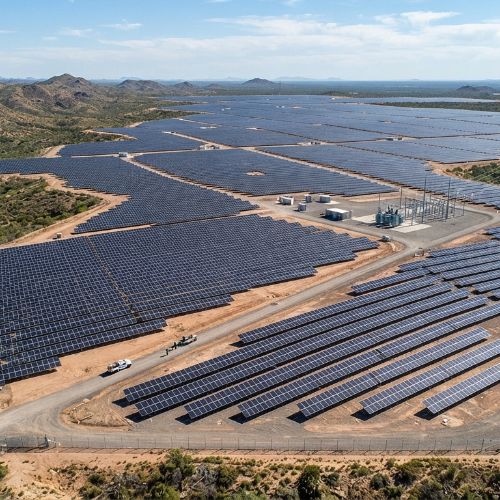
NTPC Green Energy Limited (NGEL) has commissioned 81.34 MW of solar capacity from the Kalasar Solar Energy Project in Bikaner, Rajasthan, adding to the renewable power assets operated by the NTPC group.
The first part capacity of the project was declared on commercial operation on 26 September 2026, according to the company’s disclosure. The 81.34 MW capacity forms part of the 650 MW solar component associated with the 500 MW Renewable Energy Round-the-Clock (RTC) project being developed through NTPC Renewable Energy Limited (NTPC REL), a wholly owned subsidiary of NGEL.
Following the commissioning, the commercial capacity of the NTPC Green Energy group increased from 10,977.23 MW to 11,058.57 MW, the company said.
81.34 MW forms part of larger Kalasar solar development
The newly commissioned capacity represents an initial portion of the Kalasar Solar Energy Project rather than the entire solar component linked to the project.
The wider development includes 650 MW of solar capacity under the 500 MW REMCL RTC project of NTPC Renewable Energy. The latest commercial operation declaration therefore marks another staged addition to NGEL’s expanding renewable generation portfolio.
The use of staged commercial operation declarations is consistent with NGEL’s approach to bringing large renewable projects into service in individual capacity blocks. NTPC’s corporate disclosures in 2026 have recorded several such additions from its solar portfolio, including projects in Gujarat and Rajasthan.
NTPC Green Energy expands renewable operating base
NGEL was incorporated as a wholly owned subsidiary of NTPC in April 2022 and serves as the group’s dedicated renewable-energy platform. NTPC identifies NGEL as a vehicle for developing and managing renewable assets alongside NTPC Renewable Energy Limited and other clean-energy businesses.
The latest commissioning comes as NTPC continues to expand its renewable generation portfolio. The parent company has stated a longer-term objective of reaching 149 GW of total generation capacity by 2032, including 60 GW from renewable energy, reflecting a significant expansion of its clean-energy portfolio.
Solar has been a major component of this expansion, with NGEL and its subsidiaries commissioning capacity through multiple large projects across Rajasthan and Gujarat.
Rajasthan remains a major solar development region
Rajasthan continues to host a substantial portion of India’s utility-scale solar development because of its high solar resource and availability of large areas suitable for renewable-energy projects.
NGEL’s portfolio has already included commercial-operation milestones from solar projects in Rajasthan. NTPC’s corporate disclosures record, for example, the commercial operation of 75 MW from the 500 MW Bhadla Solar PV Project in Phalodi, Rajasthan, as well as other solar capacity additions in the state during 2026.
The addition of the Kalasar capacity further increases the group’s operational exposure to Rajasthan’s utility-scale solar market.
RTC projects add a broader system dimension
The Kalasar capacity is linked to a round-the-clock renewable-energy project, making the development relevant beyond the addition of conventional standalone solar generation.
RTC renewable projects are designed to combine renewable generation and other balancing resources or generation profiles to provide a more continuous electricity supply than solar generation alone. For utilities, this model can become increasingly relevant as variable renewable capacity expands and the need for firmed or more predictable clean power increases.
NGEL has also been progressing with energy-storage infrastructure. NTPC has disclosed investment activity around battery energy storage, while an NGEL tender in 2026 covered development of 3,300 MWh of battery energy storage capacity at its Khavda solar plant.
Bioenergy Business Analysis
The commissioning of 81.34 MW at Kalasar illustrates the continued shift in NGEL’s operating portfolio towards large-scale renewable generation. While the individual addition is relatively small compared with the group’s overall capacity, its significance lies in the staged build-out of a much larger solar component connected to an RTC-oriented project.
For the broader renewable-power market, the development also highlights the increasing importance of combining solar generation with mechanisms that can improve supply availability across different hours. The remaining capacity associated with the larger project, together with storage and other balancing infrastructure being developed across India’s renewable sector, will determine how effectively RTC projects can translate variable solar generation into more predictable power supply.
The key near-term consideration is therefore not only the pace at which additional solar megawatts are commissioned, but how these assets are integrated with transmission, storage and other firming resources. The latest Kalasar commissioning provides another incremental step in that larger transition.