


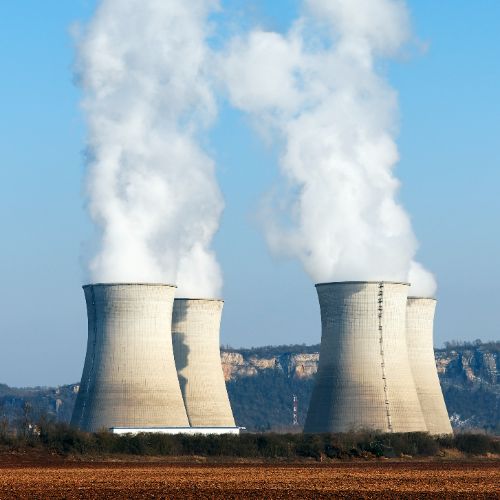
Construction of four indirect air-cooling towers supporting a coal-fired power project at the northern section of China’s Kubuqi renewable energy base in Inner Mongolia has reached a key construction milestone, with all four towers now topped out, according to China Three Gorges Corporation.
The development forms part of China’s first group of large-scale renewable energy bases being built across desert, sandy and barren land areas. The Kubuqi project has a planned capacity of 10 million kilowatts (10 GW) and is designed to combine multiple renewable and supporting energy technologies within one large-scale energy infrastructure system.
Four-tower integrated design
The supporting power project uses an integrated structure that combines the indirect air-cooling tower, chimney, flue gas desulfurisation absorption tower and wastewater concentration tower.
Under the “four-tower-in-one” design, the project does not require a separate chimney. The indirect air-cooling tower is designed to perform two functions: cooling circulating water and discharging purified flue gas following the desulfurisation process.
The topping out of all four cooling towers marks the completion of a major structural phase of the construction programme.
Wind, solar and storage projects under construction
The northern section of the Kubuqi renewable energy base is being developed as a multi-technology energy hub.
According to China Three Gorges Corporation, wind power, photovoltaic power, concentrated solar-thermal power and supporting energy storage facilities are being constructed simultaneously. An ultra-high-voltage direct-current (UHVDC) transmission project is also under construction as part of the wider development.
The combination of generation and transmission infrastructure is intended to enable renewable electricity produced in the region to be delivered to major demand centres.
10 GW renewable energy base in Inner Mongolia
The Kubuqi project is located in north China’s Inner Mongolia Autonomous Region and is part of the country’s first batch of large-scale wind and photovoltaic power bases in desert, sandy and barren areas.
The base has a planned capacity of 10 million kilowatts, or 10 GW. Its development brings together renewable generation, energy storage, supporting thermal power infrastructure and long-distance electricity transmission.
Once completed, the base is expected to transmit approximately 40 billion kWh of electricity annually to the Beijing-Tianjin-Hebei region.
That transmission link is intended to support the supply of electricity to one of China’s major economic regions while contributing to its stated transition towards greener economic and social development.
Bioenergy Business Analysis
The Kubuqi development illustrates the scale at which China is combining renewable generation, storage and transmission infrastructure in large desert-based energy projects. The simultaneous construction of wind, photovoltaic, concentrated solar-thermal and storage facilities indicates an integrated approach rather than development around a single generation technology.
The project also highlights the role of supporting infrastructure in large renewable-energy bases. The UHVDC transmission system is central to moving electricity from the generation region to the Beijing-Tianjin-Hebei demand centre, while the supporting coal-fired power project forms part of the broader infrastructure at the northern section of the base.
For energy developers and infrastructure providers, the development demonstrates the importance of coordinating generation, storage, thermal support and transmission capacity at the same project site. The eventual performance of the system will depend on the completion and operation of these interconnected components.
The next major development milestone will be the continued construction of the generation, storage and transmission facilities within the northern section of the Kubuqi renewable energy base.