


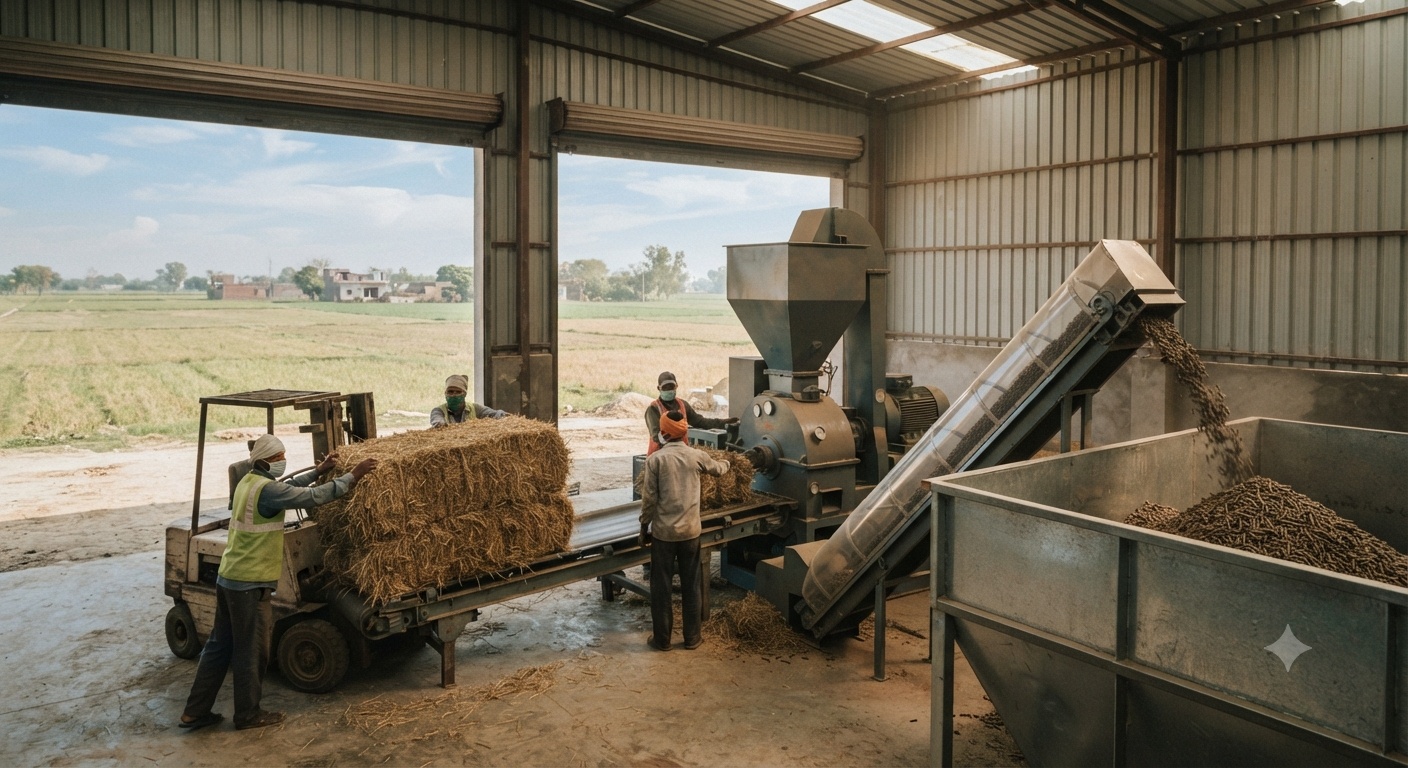
Punjab is poised for a sharp expansion in biomass pelletisation capacity, with 72 new entrepreneurs registered to establish small-scale pellet-making units alongside 74 plants already operating across the state, according to officials from the Punjab Pollution Control Board (PPCB). The proposed facilities could add capacity to process about 2.2 million tonnes of paddy residue, compared with around 1.9 million tonnes for existing units.
The expansion is being driven by efforts by the Centre and Punjab government to create an alternative to the open burning of paddy straw. Biomass pellets produced from agricultural residue can be supplied to thermal power plants and other industrial users for co-firing.
The new projects are at different stages of approval and installation. PPCB nodal officer Sukhdev Singh said six or seven of the proposed units are expected to become operational by December, while work on the remaining projects continues.
72 new pelletisation projects registered across Punjab
Punjab currently has 74 operational pelletisation units across 20 districts, according to PPCB officials. The 72 additional projects would take the number of units to 146 if all proposed facilities are commissioned.
The new plants are expected to process approximately 22 lakh tonnes of paddy residue, while existing units have a reported processing capacity of about 19 lakh tonnes.
Interest has been particularly strong in Punjab’s Malwa region, including Bathinda and neighbouring districts. Among the proposed projects, Sangrur has 12, followed by Muktsar with 10, Ludhiana with seven and Barnala with six, according to the reported PPCB data.
Entrepreneurs have expressed interest in 18 of Punjab’s 23 districts.
Among existing facilities, Mansa has 18 units, while Bathinda has seven and Sangrur and Patiala have seven each.
Pelletisation emerges as an ex-situ stubble-management route
Punjab’s pelletisation programme began in 2023 as an ex-situ crop-residue management measure, with five initial units established to process non-basmati paddy straw.
The approach shifts part of the residue-management process away from farms by collecting agricultural waste and converting it into a transportable solid fuel. The resulting pellets can then be used in industrial boilers and thermal power plants, including for coal substitution or co-firing.
The expansion comes against a broader effort to increase the utilisation of agricultural residue outside the field. A government report on air-pollution mitigation has previously identified increased ex-situ utilisation of paddy straw as part of the strategy for reducing residue burning in Punjab and neighbouring states.
40% government grant supports new projects
According to PPCB’s Sukhdev Singh, the growth in entrepreneurial interest has been supported by a central government financial incentive.
Under the structure described by PPCB, an entrepreneur receives a 40% financial grant, contributes another 40% from their own resources, and raises the remaining 20% through an institutional source.
The combination of capital support and an established market for biomass fuels is helping make small-scale pelletisation commercially viable for some operators.
PPCB has also directed coal-based thermal power plants in Punjab to procure biomass pellets and briquettes produced by entrepreneurs within the state, according to Singh.
Malwa region sees strong project interest
The concentration of new projects in the Malwa region reflects the importance of agricultural residue availability to pelletisation economics.
Sangrur’s 12 proposed projects represent the largest pipeline among districts, followed by Muktsar. Ludhiana and Barnala also have multiple projects under development.
The distribution of existing facilities shows that the industry is already established in several parts of the state. Mansa has the largest number of operational units, with 18, while Bathinda, Sangrur and Patiala each have seven.
For pellet producers, proximity to paddy-growing areas can help reduce the cost and logistical complexity of collecting and transporting bulky agricultural residue before processing.
Existing operators look to expand thermal-plant supply
The emerging market is also being shaped by entrepreneurs who have already operated pelletisation plants through multiple crop cycles.
Sandeep Dhillon, who has operated a unit in Kota Fatta village in Bathinda since 2023, said he was preparing to supply pellets to thermal power plants for a fourth consecutive year.
Dhillon said greater industrial demand for biomass pellets would be important for allowing small-scale producers to contribute more significantly to paddy-residue management.
The comment highlights an important link between pellet-production capacity and downstream fuel demand: new plants can only support residue management at scale if thermal power stations and other industrial consumers maintain sufficient demand for the resulting fuel.
Capacity growth does not automatically translate into residue utilisation
The planned expansion would represent a substantial increase in the number of pelletisation units, but installed processing capacity and actual annual utilisation are not necessarily the same.
Earlier biomass assessments have highlighted the difference between available agricultural residue, economically collectable biomass and the quantities actually reaching pellet manufacturers. A GIZ assessment of Punjab, for example, estimated significant biomass-surplus potential while reporting much lower utilisation by pellet manufacturers at the time of its assessment.
This makes feedstock aggregation, transportation, storage and plant utilisation important factors alongside the headline number of new facilities.
Bioenergy Business Analysis
Punjab’s proposed expansion of biomass pelletisation provides another link between agricultural-residue management and industrial fuel demand. If the 72 proposed projects are commissioned, the state would have a substantially larger network of small-scale facilities capable of converting paddy straw into a marketable solid fuel.
The more important test, however, will be whether the new capacity operates consistently. Pelletisation economics depend on reliable feedstock collection, competitive logistics, moisture management, plant utilisation and dependable offtake. The reported direction from PPCB for thermal plants to procure locally produced pellets could strengthen the demand side, but sustained purchasing will remain important for the viability of new facilities.
There is also a distinction between processing capacity and actual stubble diverted from burning. A larger pellet-making fleet can increase the state’s ex-situ treatment capacity, but its contribution to residue management will ultimately depend on how much paddy straw is collected and delivered to plants each season. For Punjab’s emerging biomass market, the next phase therefore involves building not only more pellet plants, but a reliable feedstock-collection and fuel-offtake ecosystem around them.