


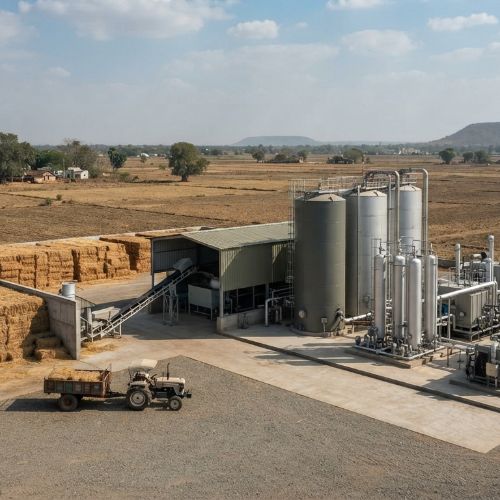
Madhya Pradesh’s Vidisha district is moving ahead with plans to establish three compressed biogas (CBG) plants using agricultural residues, as authorities seek to improve crop-residue management and create additional income opportunities for farmers.
The plants are proposed in the Nateran, Basoda and Kurwai development blocks under the government’s biofuel project, with Indian Oil Corporation Limited (IOCL) set to establish the facilities.
The district administration has started the process of identifying government land for the projects. Around 15 to 20 acres of land is being considered for each development block, according to the source report.Crop residues to serve as CBG feedstock
The proposed CBG plants will use crop residues collected from farms in surrounding areas. These are expected to include residues from maize, paddy, wheat and other crops.
The initiative is intended to provide an alternative to the open burning of narwai—crop residue left in fields after harvesting. Crop-residue burning contributes to air pollution and can affect soil quality by destroying beneficial microorganisms and reducing soil fertility.
By diverting agricultural residues to CBG production, the projects aim to turn material that is commonly treated as waste into a feedstock for energy production.
Farmers could gain additional income from residues
The proposed plants could also create an economic use for crop residues generated on farms.
A collection and transportation system for narwai and other agricultural residues will need to be developed to supply the plants. Once such a system is established, farmers could receive an additional source of income from residues that would otherwise have limited economic value.
The initiative is being advanced around the concept of “Kisan Banega Urjadata”, or farmers becoming energy providers, by linking agricultural production with energy generation.
Government land being identified for projects
Under the guidance of Vidisha Collector Anshul Gupta, preliminary identification of government land for the three CBG plants is underway in Nateran, Basoda and Kurwai.
The identified land is proposed to be leased to IOCL for the long term. The company is expected to use crop residues at the facilities to produce biogas and other useful products.
The projects therefore combine a waste-management objective with the development of a local agricultural-residue supply chain.
CBG plants aimed at reducing crop-residue burning
The proposed facilities are being positioned as part of efforts to reduce crop-residue burning in Vidisha district.
Instead of burning narwai in fields, the collection and utilisation model could provide an alternative route for managing agricultural residues while supporting energy production.
The district administration expects the initiative to contribute to reducing air pollution, protecting soil quality and promoting more systematic management of agricultural residues.
Agriculture department reviews project progress
On September 1, 2026, Nishant Varwade, Secretary of the Madhya Pradesh Department of Farmers’ Welfare and Agriculture Development, held a video conference with officials from the district administration and IOCL to discuss the CBG projects.
According to the source report, Varwade issued directions to accelerate the process of establishing the plants in the district.
Once operational, the facilities are expected to use crop residues collected from farmers’ fields as an energy feedstock, while creating an additional economic avenue linked to agricultural waste.
Bioenergy projects could link farm waste with rural economy
The proposed CBG plants in Nateran, Basoda and Kurwai could create a local value chain around agricultural residues, connecting crop-residue collection with renewable gas production and rural economic activity.
For Vidisha, the projects also represent an effort to address crop-residue burning through an economic-use model rather than relying solely on disposal or management measures.
The administration is currently progressing with land identification and other preparatory processes for the three projects.
Bioenergy Business Analysis
The Vidisha proposal highlights the role that CBG infrastructure can play in creating an economic pathway for agricultural residues. The viability of such projects will depend in part on establishing reliable systems for aggregating, transporting and supplying crop residues to the plants.
If these supply chains are developed effectively, the projects could simultaneously address crop-residue management and provide farmers with a potential additional revenue stream. The next stages—particularly land allocation, project development and establishment of the feedstock collection system—will determine how quickly the proposed plants move from planning to implementation.