


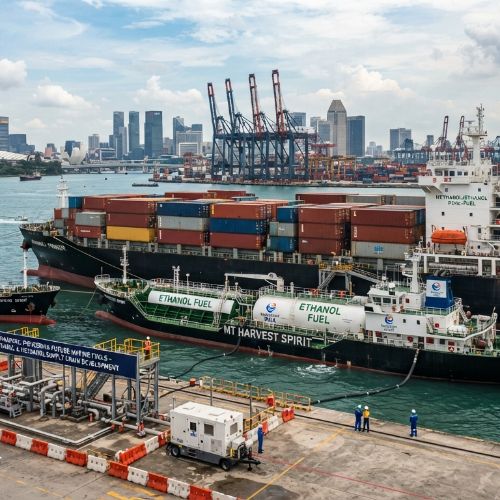
Singapore could begin seeing ethanol bunkering for ships in the coming months, as fuel suppliers and shipowners explore bilateral arrangements ahead of the development of a dedicated pricing mechanism for marine ethanol, according to Clarence Woo, managing director of the Global Centre for Green Fuels (GCGF).
Woo’s comments, reported by TradeWinds, point to a possible early commercial pathway for ethanol in one of the world’s most important bunkering hubs. Rather than waiting for a fully developed spot market and benchmark price, bilateral supply agreements could allow initial marine ethanol deliveries to proceed while the wider market infrastructure develops.
The development comes as shipping companies and engine manufacturers increasingly examine alcohol fuels, particularly methanol and ethanol, as alternatives for reducing emissions from maritime transport.
Bilateral deals could precede dedicated marine ethanol pricing
A key challenge for the emergence of ethanol as a marine fuel is the absence of a mature marine pricing and trading structure comparable with conventional bunker fuels.
Woo believes bilateral commercial arrangements could bridge this gap during the early phase of market development. Such agreements would allow individual fuel suppliers and vessel operators to negotiate supply and pricing directly rather than relying on a standardised market benchmark.
This approach could be particularly relevant for Singapore, where an established bunkering ecosystem already supports multiple alternative fuels.
Singapore’s Maritime and Port Authority (MPA) has developed regulatory arrangements for the supply of biofuels to vessels within the port. The authority’s current framework explicitly identifies ethyl alcohol among the biofuels covered by international carriage requirements, although its published biofuel-bunkering framework primarily sets out requirements around biofuel blends and does not constitute a dedicated ethanol-bunkering market.
Singapore’s bunkering infrastructure provides a potential starting point
Singapore is already a major global marine-fuel hub and has been expanding its alternative-fuel infrastructure.
The MPA says its approach is to prepare the port for a diverse future fuel mix rather than determine a single fuel pathway. In a September 2026 speech, MPA Deputy Chief Executive David Foo said Singapore had already commenced methanol bunkering operations, while continuing work on ammonia, LNG and sustainable biofuels.
That infrastructure could provide a foundation for additional liquid alternative fuels, although ethanol would still require fuel-specific commercial, technical and safety arrangements.
The MPA requires biofuel supplied in Singapore to comply with applicable quality and bunkering requirements. Its framework also requires commercial agreements between bunker suppliers and buyers to adequately cover fuel specifications and delivery terms.
Ethanol gains attention alongside methanol
Ethanol has traditionally been associated with road transport, but its potential maritime role has expanded as shipping looks for multiple pathways to lower lifecycle emissions.
The Global Centre for Green Fuels launched the Maritime Ethanol & Methanol Alliance (MEMA) in Singapore in October 2025 to coordinate work involving shipowners, fuel producers, engine manufacturers, regulators, ports and classification societies. The organisation said the initiative would focus on fuel specifications, safe handling, crew training and bunkering practices.
Industry activity is also extending to marine engines. According to GCGF, WinGD has announced plans for an ethanol-capable two-stroke engine, while Everllence has conducted ethanol engine testing.
S&P Global reported in December 2025 that ethanol and methanol were gaining attention as scalable alternatives for the 2030s, while major engine manufacturers including MAN, WinGD and Wärtsilä had conducted or supported work involving engines capable of using alcohol fuels.
Supply availability could support early adoption
One potential advantage for ethanol is its existing global production base.
Unlike fuels that require entirely new production systems, ethanol is already produced at large scale for road-fuel blending and industrial applications. GCGF has argued that existing production and logistics infrastructure could help support its eventual use in maritime applications.
Woo has previously estimated that maritime applications could create more than 20 million tonnes per year of additional low-carbon ethanol demand if adoption expands, although that figure represents an industry potential scenario rather than an established market forecast.
The maritime market would nevertheless introduce new requirements around fuel specifications, storage, bunkering procedures, safety and lifecycle-carbon accounting.
Pricing and standards remain important market gaps
The emergence of physical ethanol bunkering would not by itself establish a liquid marine ethanol market.
Suppliers and buyers would still need to resolve questions around pricing, contract structures, fuel specifications, sustainability certification, storage and handling. Standardisation is particularly important because shipowners need predictable fuel quality and supply arrangements before committing to new-fuel vessels.
Singapore’s existing biofuel framework requires suppliers to meet specified quality and measurement requirements and to provide documentation covering the fuel supplied.
At the international level, work is also continuing on technical standards and safety requirements for ethanol and methanol as marine fuels. This is likely to remain an important component of commercial-scale adoption.
Bioenergy Business Analysis
The possibility of ethanol bunkering in Singapore would represent a transition from technology and engine trials towards early commercial fuel supply, but the development should not be interpreted as evidence that a large-scale ethanol marine-fuel market has already formed.
The more immediate significance is the potential emergence of a bilateral market model. Direct contracts could allow suppliers and shipowners to establish initial volumes before a transparent benchmark price or exchange-traded marine ethanol market develops. This could reduce one of the barriers facing a new marine fuel: the need to build both physical supply infrastructure and a functioning commercial market simultaneously.
Singapore’s existing bunkering ecosystem provides an important platform, while the expansion of ethanol-capable marine engines and international work on safety and fuel standards could gradually address other parts of the value chain.
However, commercial adoption will depend on more than availability. Fuel economics, verified lifecycle emissions, sustainable feedstock supply, vessel compatibility, storage requirements, safety procedures and regulatory recognition will determine whether ethanol moves beyond individual contracts into regular marine-fuel demand. The reported possibility of near-term bunkering is therefore best viewed as an early market-development step rather than confirmation of widespread commercial deployment.