


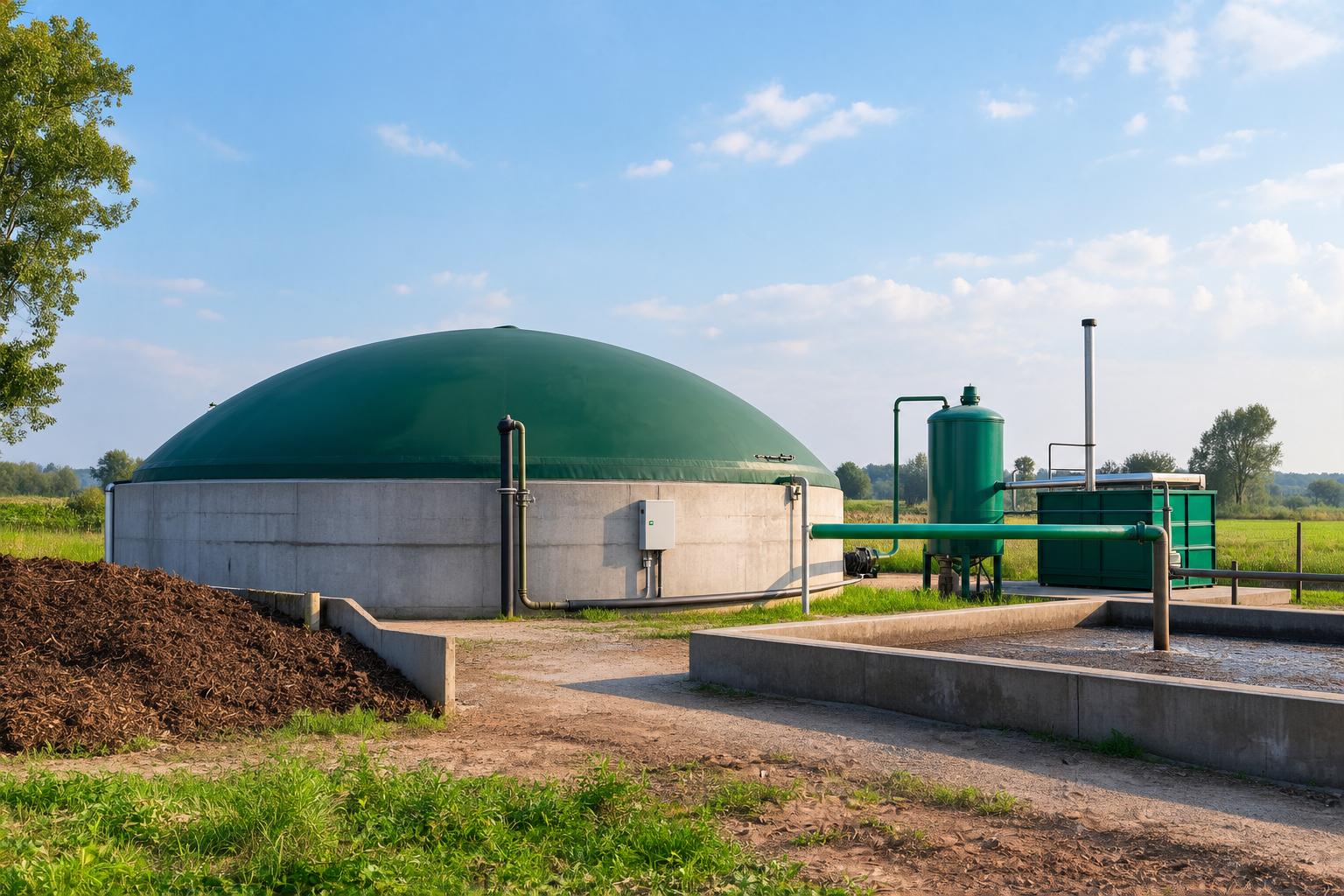
Narnaul farmer Omveer of Rata village in Narnaul is using a household biogas plant to convert cow dung from his dairy operation into cooking gas, while putting the residual slurry back into agriculture as natural fertiliser.
As reported by Dainik Jagran, Omveer has integrated livestock rearing and crop cultivation to make use of resources generated across both activities. Cow dung produced by his dairy is fed into the biogas plant, with the resulting gas used for cooking at home.
The approach provides a use for a regular farm waste stream while reducing the household’s reliance on conventional cooking fuel, according to the source material.
Omveer has a dairy operation that generates a significant quantity of cow dung each day. Rather than treating the material as waste, he feeds it into the biogas plant installed at his home.
The plant produces gas that is subsequently used for cooking. This creates a direct link between livestock management and household energy use, allowing the farmer to derive fuel from an agricultural by-product generated on his own farm.
Biogas slurry used as natural fertiliser
The process does not end with gas production. The slurry remaining after digestion is collected and used to prepare natural fertiliser for Omveer’s fields.
According to Omveer, this has helped reduce the farm’s dependence on chemical fertilisers. The use of digested slurry also provides a productive outlet for the residue generated through the household biogas system.
He describes livestock rearing and farming as complementary activities. Cow dung from the animals can be returned to the farm as fertiliser after processing, while fodder produced through agriculture can be used to feed the livestock.
This integrated approach can help farmers make greater use of resources already available within the farm system. In Omveer’s case, the biogas plant adds an energy-use component to that cycle by converting livestock waste into cooking fuel.
Rata initiative draws interest from neighbouring farmers
Omveer’s approach is attracting attention among farmers in and around Rata village. He said that appropriate utilisation of livestock-generated cow dung can help save fuel while supporting soil fertility.
The initiative illustrates how small-scale anaerobic digestion can connect waste management, household energy and agricultural nutrient use at farm level. However, the source material does not specify the plant’s capacity, technology provider, installation date or operating costs.
Bioenergy Business Analysis
Omveer’s experience demonstrates the potential value of farm-scale biogas where livestock and crop production operate alongside each other. The key feature is the utilisation of the same biomass stream for two purposes: producing cooking fuel through anaerobic digestion and returning nutrients to agriculture through the resulting slurry.
For farmers with a reliable supply of cattle dung, such systems can potentially reduce unmanaged waste while creating an on-site source of renewable thermal energy. The agricultural use of digestate can also improve resource circularity by retaining nutrients within the farm system. However, the economic case depends on factors including plant capital cost, dung availability, gas yield, maintenance requirements, household energy demand and the value of displaced fertiliser and cooking fuel.
Omveer’s case is therefore best viewed as a local example of integrated resource use rather than evidence of a quantified economic or environmental outcome. More hdlknc detailed data on biogas production, investment, fuel displacement and fertiliser savings would be needed to assess the system’s financial performance and replicability at wider scale.