


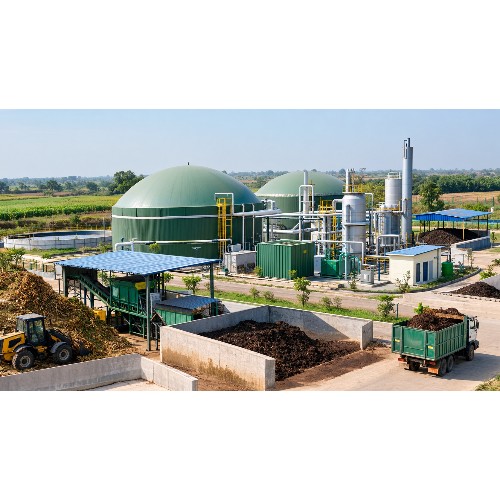
India’s ₹23,731 crore GOBARdhan National Circular Bioenergy Scheme is creating a more structured policy and commercial framework for compressed biogas (CBG), with assured offtake, administered pricing, capital assistance, pipeline infrastructure and credit support among its key components.
For Organic Recycling Systems Limited (ORSL), the policy comes as the company expands its CBG project development, engineering, operations and maintenance activities across several states.
The Union Cabinet approved GOBARdhan on August 6, 2026, for implementation from FY2026-27 to FY2035-36. The government says the scheme is designed to increase domestic CBG production nearly ten-fold and establish CBG as a major component of India’s future energy mix.
The scheme consolidates support across the CBG value chain, while ORSL is positioning its existing project execution, organic waste processing, CBG, organic manure and research capabilities to participate in the expanding market.
GOBARdhan introduces six pillars for CBG development
The government has structured GOBARdhan around six main components: assured CBG offtake, a stable pricing framework, capital assistance, pipeline infrastructure, credit guarantees and a CBG ecosystem challenge fund.
Under the offtake framework, City Gas Distribution (CGD) entities will procure CBG to support the notified CBG obligation trajectory of 3% in FY2026-27, 4% in FY2027-28 and 5% from FY2028-29 onwards for the CNG transport and PNG domestic segments.
The scheme also introduces a government-backed administered CBG price of ₹2,110 per MMBTU, with a minimum 10-year pricing horizon. Eligible greenfield CBG projects can receive capital assistance of up to ₹2 crore per tonne per day of installed CBG capacity, while brownfield capacity expansion is also covered.
Pipeline infrastructure connecting CBG plants with trunk pipelines and CGD networks is another component, alongside a dedicated credit guarantee mechanism for eligible MSME-based projects.
The government has also established a CBG Ecosystem Challenge Fund aimed at supporting district-level implementation, feedstock assessment, infrastructure development, technology adoption and capacity building.
CBG sector enters GOBARdhan with an existing project base
GOBARdhan builds on earlier programmes including SATAT, the Market Development Assistance scheme for organic manure, the Biomass Aggregation Machinery scheme, the Development of Pipeline Infrastructure scheme and financial assistance under the National Bioenergy Programme.
Government data published in August showed that 1,929 CBG/Bio-CNG plants had been registered as of August 13, 2026, of which 217 had been commissioned and 357 were under construction.
This provides a significantly larger existing project base than the more than 200 commissioned plants referenced in the original company material.
ORSL targets agricultural and organic waste-based CBG projects
ORSL said GOBARdhan aligns with several parts of its existing business platform, including feedstock processing, CBG production, organic manure, project execution, operations and maintenance, and research and development.
The company said it is targeting Kerala, Madhya Pradesh, Chhattisgarh and Karnataka for expansion of its planned Build-Own-Operate (BOO) agricultural valorisation projects.
The company has also linked the new policy framework to its board-approved ₹1,000 crore Build-Own-Operate Agro Valorisation platform, which comprises five integrated CBG projects. ORSL said these projects are being selectively pursued in states with supportive policy frameworks and have targeted returns of more than 20%.
Those return targets are company projections and should not be interpreted as realised financial performance.
Organic manure forms another part of the business model
GOBARdhan also provides support for the organic manure value chain, alongside CBG production.
ORSL said it has been producing and selling Fermented Organic Manure (FOM) alongside CBG since 2008. The company has also been advocating for development of the FOM market.
The government’s GOBARdhan framework similarly links CBG production with organic manure and other value-chain opportunities, reflecting the policy’s broader objective of converting agricultural residue, cattle dung, press mud, municipal organic waste and other biomass into clean fuels and organic products.
ORSL’s R&D platform targets process and technology development
The company said its NABL-accredited ORS Research and Innovation Centre has more than seven innovations in its pipeline and maintains research partnerships with IIT Bombay and IIT Kharagpur.
ORSL has identified the technology-development component of GOBARdhan as another area relevant to its activities.
The policy’s CBG Ecosystem Challenge Fund is intended to support technology adoption and process improvement alongside district-level ecosystem development.
BPCL contracts expand ORSL’s CBG project execution portfolio
Recent contracts with public-sector oil marketing companies provide a separate indicator of ORSL’s project activity.
The company’s wholly owned subsidiary, Solapur Bioenergy Systems Private Limited (SBESPL), has secured EPCOM contracts from Bharat Petroleum Corporation Limited (BPCL) for organic municipal solid waste-based CBG projects.
Two BPCL contracts announced in September cover projects in Mysuru, Karnataka, and Raipur, Chhattisgarh. Public reporting based on regulatory disclosures puts their combined value at about ₹167.30 crore, including GST, with planned processing capacities of approximately 5 TPD and 4.8 TPD respectively.
The company subsequently announced another BPCL EPCOM project for an organic municipal solid waste-based CBG plant in Kozhikode, Kerala, under which SBESPL is to undertake engineering, procurement, construction and commissioning followed by five years of operations and maintenance.
ORSL has put the combined value of its three BPCL projects in the range of ₹250 crore to ₹275 crore.
The projects broaden the company’s exposure across different feedstock and geographic markets while giving it EPCOM and long-term O&M responsibilities.
IOCL renews Gorakhpur CBG plant O&M contract
ORSL’s CBG operations portfolio also includes an O&M engagement with Indian Oil Corporation Limited (IOCL) for the Gorakhpur CBG plant in Uttar Pradesh.
SBESPL renewed the contract in August 2026 for a second consecutive term. Public reporting puts the value of the renewed two-year agreement at ₹15.46 crore, covering O&M services from August 13, 2026, to August 12, 2028, for IOCL’s 200-TPD paddy-straw-based CBG plant.
The scope includes plant operations, preventive and breakdown maintenance, safety compliance and manpower management.
The renewed contract gives ORSL’s subsidiary an ongoing operating role beyond project construction, an increasingly relevant capability as India’s CBG pipeline expands.
Policy support could improve project bankability
For ORSL, the significance of GOBARdhan lies primarily in the changes to the commercial environment surrounding CBG projects.
“The GOBARdhan 2.0 Scheme addresses CBG sector’s two biggest bottlenecks; demand uncertainty and capital access. The mandatory CGD offtake obligations, a stable 10-year administered price, and layered financial support (capital assistance, pipeline funding, and credit guarantees for MSMEs) has created a coherent framework to move CBG projects to investable asset category. The new policy will act like a catalyst in enabling well-structured, secured and performance-focused sectoral development.” — Sarang Bhand, Promotor and Managing Director, Organic Recycling Systems Limited
The company also said the policy framework complements capabilities it has developed across technology, project execution, O&M, CBG production and organic manure.
“GOBARdhan is the policy framework that India’s CBG sector has needed for years. It addresses the entire value chain — offtake, pricing, capital, infrastructure, and manure, rather than just one part of it. For a company like ORSL that has been operating across this value chain since 2008, the policy is now finally complementing what the technology and the operations have long been capable of delivering.” — Pankaj Tanwar, CEO – Bioenergy, Organic Recycling Systems Limited
ORSL plans BSE Main Board transition
The company said it is targeting a transition to the BSE Main Board by October 2026.
ORSL is currently identified as BSE-listed under scrip code 543997. Recent company and market disclosures show continued expansion of its bioenergy project and O&M portfolio.
The planned move to the Main Board is a corporate development disclosed by the company and remains subject to the applicable process and requirements.
Bioenergy Business Analysis
GOBARdhan changes the operating environment for India’s CBG industry by addressing several of the commercial constraints that have historically affected project development simultaneously. For companies such as ORSL, the policy’s relevance extends beyond new plant ownership. Engineering, procurement, construction, long-term O&M, feedstock processing, CBG production and organic manure create multiple potential participation points across the value chain.
ORSL’s recent BPCL and IOCL engagements demonstrate activity across both project execution and plant operations, although these contracts should not by themselves be treated as evidence of the company’s future financial performance.
The larger industry question will be implementation. The effectiveness of GOBARdhan will depend on consistent CGD procurement, timely financial support, development of pipeline connections, reliable feedstock aggregation and the ability of individual projects to maintain stable plant utilisation. The availability and quality of agricultural and municipal organic feedstock will also remain important to project economics.
For ORSL specifically, the company’s stated ₹1,000 crore expansion platform and projected returns of more than 20% represent forward-looking corporate plans rather than achieved results. Their eventual viability will depend on project-level financing, execution, feedstock availability, offtake arrangements and operating performance.