


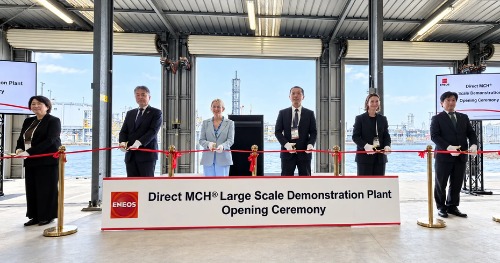
ENEOS Corporation has commissioned a 1.2 MW-class demonstration plant in Queensland, Australia, to produce methylcyclohexane (MCH), a liquid hydrogen carrier, using its proprietary Direct MCH® electrochemical synthesis technology.
The Japanese energy company held an opening ceremony for the facility on October 8, with demonstration operations scheduled to begin in January 2027 following trial operations.
The project is intended to generate the technical and operational data required to advance Direct MCH® towards commercial deployment and support the development of large-scale green hydrogen supply chains.
Direct MCH® targets lower-cost hydrogen transport
MCH is an organic hydride that can store hydrogen at ambient temperature and atmospheric pressure while reducing its volume to approximately one-500th of that of gaseous hydrogen.
Conventional MCH production involves first producing hydrogen through water electrolysis and then reacting the hydrogen with toluene to form MCH. ENEOS’s Direct MCH® technology is designed to combine these stages into a single electrochemical reaction.
The process produces MCH directly from water and toluene using electricity, including electricity generated from renewable sources.
ENEOS said the technology could help address the cost challenges associated with producing and transporting green hydrogen by reducing the number of process steps involved in hydrogenation.
Australia was selected for the demonstration because of its position as one of the world’s leading renewable energy-producing regions. Operating the technology at the Australian site is expected to allow ENEOS to identify technical issues associated with large-scale plant operation at an early stage.
Demonstration plant increases electrolyser scale
The Queensland facility incorporates an electrolyser with a capacity of approximately 1.2 MW, which ENEOS describes as the minimum unit size required for commercial deployment.
The electrolyser is around eight times larger than the unit used in the company’s previous demonstration in 2023. The new plant is designed for a maximum MCH production capacity of 9 tonnes per day.
Demonstration operations are expected to run for approximately two years.
During this period, ENEOS plans to assess the plant’s performance, degradation behaviour and other operational characteristics. The company will use the resulting data to evaluate the technology’s readiness for commercialisation and determine requirements for future deployment.
The project forms part of the Green Innovation Fund programme commissioned by Japan’s New Energy and Industrial Technology Development Organization (NEDO), under a programme focused on establishing large-scale hydrogen supply chains and developing innovative liquefaction, hydrogenation and dehydrogenation technologies.
ENEOS targets commercial deployment of Direct MCH®
ENEOS has been developing Direct MCH® as part of its efforts to reduce the cost of hydrogen supply chains. The company previously reported technical verification of its electrochemical organic hydride synthesis approach in 2019 and conducted an earlier demonstration in 2023.
The latest facility represents a significant increase in electrolyser scale and is intended to provide operating experience closer to the requirements of commercial projects.
Following the demonstration, ENEOS plans to assess the technology’s technical progress, economic viability and market conditions before pursuing wider commercialisation and deployment.
The company said the development forms part of its longer-term objective of maintaining a stable supply of energy and materials while supporting the transition towards a carbon-neutral society.
Bioenergy Business Analysis
Hydrogen carriers such as MCH could play an important role in future hydrogen supply chains because they allow hydrogen to be handled in a liquid form under relatively conventional storage and transport conditions. The key proposition behind Direct MCH® is not the carrier itself, but the attempt to simplify its production by combining hydrogen generation and hydrogenation into a single electrochemical process.
The Queensland demonstration is therefore an important scale-up test rather than evidence of commercial readiness. The 1.2 MW electrolyser and planned two-year operating period should give ENEOS data on system performance, degradation and operating economics at a substantially larger scale than its previous demonstration. The technology’s eventual commercial potential will depend on whether those results can support competitive hydrogen costs and reliable operation when integrated with renewable electricity and larger-scale hydrogen supply chains.