


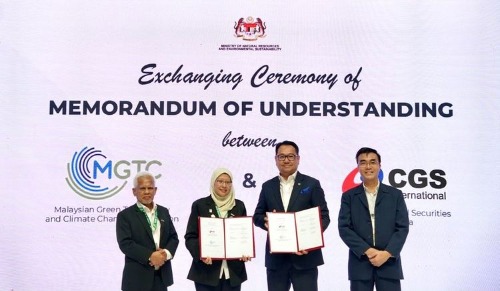
The Malaysian Green Technology and Climate Change Corporation (MGTC) and CGS International Securities Malaysia Sdn Bhd (CGS MY) have signed a memorandum of understanding (MoU) to explore collaboration on carbon-market development as Malaysia works to strengthen the infrastructure supporting its net-zero emissions ambition.
The MoU, signed at the International Greentech & Eco Products Exhibition and Conference Malaysia (IGEM) 2026 in Kuala Lumpur, covers potential cooperation on carbon-crediting methodologies, standards and approaches in Malaysia and China, alongside knowledge sharing and the possible development of carbon-market mechanisms, frameworks and platforms.
The partnership comes after Malaysia launched its National Carbon Market Policy (NCMP) in April 2026. The policy establishes a national framework for carbon-market development and places greater emphasis on market integrity, carbon-credit trading and international cooperation.
MGTC and CGS MY target carbon-market capabilities
Under the MoU, MGTC and CGS MY will examine opportunities to develop and apply carbon-crediting methodologies and standards, including approaches used in Malaysia and China.
The parties also intend to share knowledge and explore carbon-inclusive mechanisms and platforms that could support the implementation of Malaysia’s developing carbon market.
MGTC Group Chief Executive Officer Saiful Adib Abdul Munaff said Malaysia’s transition towards net zero would require policy frameworks, credible standards, technical expertise and market infrastructure capable of translating climate commitments into measurable outcomes.
He identified the National Carbon Market Policy, Malaysia’s NDC 3.0 and the Long-Term Low Emissions Development Strategy as components of that broader framework.
The collaboration, he said, is intended to strengthen domestic technical capabilities while drawing on regional experience as Malaysia develops its carbon market.
CGS MY Chief Executive Officer Khairi Shahrin Arief Baki said CGS MY would work with its Hong Kong-based sister company, CGS International Holdings Ltd, to bring regional expertise in carbon-crediting methodologies, standards and approaches to the partnership.
He said the companies would use their regional network, market knowledge and resources to support the development of a carbon market designed around credibility and market integrity, while connecting Malaysian businesses with regional opportunities.
Malaysia’s carbon-market framework expands
The MoU adds another layer to Malaysia’s developing carbon-market ecosystem.
The National Carbon Market Policy was launched by the Ministry of Natural Resources and Environmental Sustainability (NRES) on 21 April 2026. The policy is designed to provide a framework for carbon-credit transactions, including the use of Malaysian carbon credits for NDC achievement, other international mitigation purposes and domestic compliance applications.
The policy also places emphasis on high-integrity carbon markets, a conducive market ecosystem, increased carbon-credit trading and stronger domestic and international linkages.
Malaysia is simultaneously developing the institutional and regulatory infrastructure needed to support carbon pricing. The country’s 13th Malaysia Plan 2026–2030 states that carbon trading linked to its emissions-reduction commitments will be intensified through implementation of the National Carbon Market Policy, alongside planned climate legislation and development of a carbon-emissions trading scheme.
Bursa Carbon Exchange provides voluntary-market infrastructure
Malaysia already has a voluntary carbon-market platform through the Bursa Carbon Exchange (BCX).
Bursa Malaysia launched BCX in December 2022 after receiving a government mandate to establish a voluntary carbon-market initiative. The exchange enables companies to trade standardised contracts backed by verified carbon credits.
BCX also supports renewable energy certificates alongside carbon credits, making it part of Malaysia’s wider environmental-attribute market infrastructure.
MGTC has previously worked with Bursa Malaysia to develop Malaysia’s voluntary carbon-market ecosystem, including a national VCM handbook and a directory connecting carbon-project developers, consultants, validation and verification bodies and financial institutions.
The new MGTC-CGS MY collaboration therefore builds on an ecosystem that already includes voluntary carbon trading while moving further towards a broader national carbon-market framework.
NDC 3.0 sets emissions-reduction trajectory
The carbon-market initiative is linked to Malaysia’s updated climate targets.
Malaysia submitted its NDC 3.0 to the UNFCCC on 24 October 2025. The submission states that national GHG emissions are expected to peak between 2029 and 2034, with Malaysia striving to reach its emissions peak by 2030, subject to support and enabling conditions.
From that peak, Malaysia targets an absolute reduction of 15 million to 30 million tonnes of CO₂ equivalent by 2035. The NDC specifies that up to 20 million tonnes of the reduction is expected to come through domestic efforts, while a further 10 million tonnes is conditional on international climate finance, technology transfer and capacity-building support.
Unlike a target expressed solely as an emissions-intensity reduction, NDC 3.0 establishes an economy-wide absolute emissions-reduction target covering all seven greenhouse gases.
Carbon-market integrity becomes a central issue
The development of methodologies, standards and monitoring systems is particularly important as Malaysia moves towards a more structured carbon market.
Malaysia’s National Carbon Market Policy identifies the need for high-integrity credits, transparency and robust monitoring, reporting and verification (MRV). The policy also incorporates cooperation under Article 6 of the Paris Agreement, including mechanisms for international cooperation and the transfer of mitigation outcomes.
The government’s broader climate-policy development also points towards stronger emissions-data infrastructure. In March 2026, Malaysia’s NRES said a proposed National Climate Change Bill would establish an MRV system and a national carbon registry as foundations for carbon-pricing mechanisms.
This creates a growing need for consistent methodologies and reliable systems for measuring, verifying, registering and tracking emissions reductions and carbon credits.
Regional cooperation could connect Malaysian projects to wider markets
CGS MY’s involvement introduces a financial-markets and regional-network component to the initiative.
The collaboration is intended to draw on expertise from Malaysia and China while supporting access to opportunities across the wider region, according to CGS MY.
For Malaysian project developers, stronger regional connectivity could potentially broaden access to buyers, financiers and technical expertise. However, the extent of that opportunity will depend on the methodologies ultimately adopted, the treatment of internationally transferred mitigation outcomes and Malaysia’s rules governing the use and export of carbon assets.
Malaysia has already indicated that it intends to manage international transfers carefully to protect the emissions reductions required under its own NDC. In September 2026, Natural Resources and Environmental Sustainability Minister Arthur Joseph Kurup said the country would use eligibility whitelists and dynamic sales limits to manage carbon-asset exports and avoid compromising its NDC commitments.
Net-zero ambition links carbon markets to wider economic policy
Malaysia’s carbon-market development forms part of a broader low-carbon economic strategy encompassing the National Energy Transition Roadmap (NETR), the New Industrial Master Plan 2030 and the country’s wider Ekonomi MADANI framework.
For businesses, a functioning carbon market can provide an additional mechanism for financing emissions-reduction projects and managing environmental liabilities. For policymakers, it also creates infrastructure through which carbon pricing, climate reporting and international carbon cooperation can potentially be implemented.
MGTC and CGS MY’s MoU does not itself establish a new carbon-trading scheme or announce a specific carbon-crediting methodology. Rather, it creates a framework for the two organisations to explore technical, market and platform-level cooperation.