

Organic Recycling Systems Limited (ORSL) is participating in the Danish–Thai–Indian Circular Bioeconomy Network GNIP, an international collaboration focused on developing innovative pathways for mango waste valorisation and broader sustainable bio-based solutions.
The consortium recently reached its midway milestone with a meeting at Khon Kaen University in Thailand, bringing together representatives from the University of Southern Denmark, Khon Kaen University, IIT Bombay and ORSL.
The meeting provided a platform for the partners to exchange knowledge, assess progress and strengthen cooperation as the initiative moves towards its next phase.
GNIP Focuses on Circular Bioeconomy and Integrated Biorefinery Systems
The collaboration covers several areas relevant to the development of circular bioeconomy systems, including bioenergy, integrated biorefineries, Power-to-X and carbon capture, utilisation and storage (CCUS).
A central objective is to connect research and innovation with practical applications that can be developed into scalable solutions. Mango waste is a particular area of focus, with the participating institutions examining opportunities to extract greater value from organic resources rather than treating them solely as waste streams.
The cross-border structure of the network brings together academic and industrial expertise from Denmark, Thailand and India, supporting knowledge exchange across research, technology development and commercial applications.
India Phase to Showcase ORSL Mango Waste Pilot
The next phase of the collaboration is scheduled to take place in India in December 2026 and will be jointly hosted by IIT Bombay and ORSL.
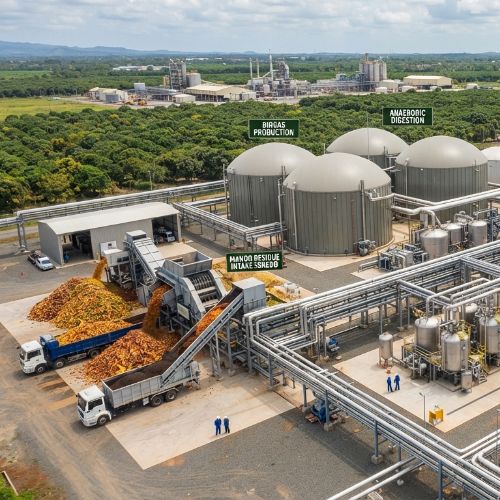
As part of the programme, the participating partners are expected to visit ORSL’s mango waste valorisation pilot facility. The visit will provide an opportunity to review ongoing work involving the sustainable utilisation of organic resources and integrated biorefinery approaches.
The facility visit is also intended to strengthen the connection between research activities and industrial applications, particularly in the context of converting agricultural and food-processing residues into useful products and energy streams.
Cross-Border Collaboration for Circular Bioeconomy Development
The GNIP collaboration illustrates the role of international partnerships in developing technologies for resource recovery and circular bioeconomy applications.
For India, the utilisation of mango waste represents an opportunity to explore higher-value pathways for an agricultural residue while supporting technologies that integrate waste management, bioenergy and biorefinery concepts.
The involvement of universities alongside an industrial participant such as ORSL creates a platform for research findings to be evaluated against practical deployment requirements. The December 2026 programme in India is expected to provide a further opportunity for the partners to connect laboratory and pilot-scale work with potential future applications.
Bioenergy Business Analysis
The GNIP initiative is significant because it brings agricultural waste valorisation, bioenergy and biorefinery development into a single collaborative framework. Mango waste can present both a waste-management challenge and a potential feedstock opportunity, making technologies that can recover energy or other value from the material relevant to the wider circular bioeconomy.
The planned visit to ORSL’s pilot facility could help strengthen the link between international research cooperation and technology demonstration. However, the supplied announcement does not provide details on the pilot’s capacity, specific products, technology configuration or commercial deployment timeline, so the project’s eventual scale and market impact cannot yet be assessed.