


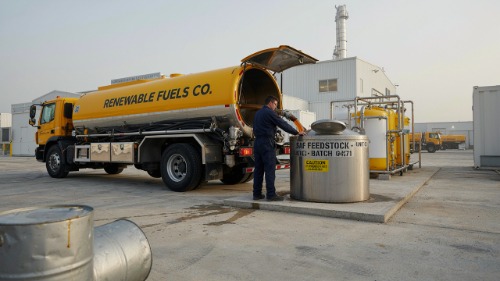
The SAF Association (SAFA) and Al Ola have signed a memorandum of understanding (MoU) to explore the development, collection, aggregation and supply of used cooking oil (UCO), with the aim of strengthening feedstock availability for the sustainable aviation fuel (SAF) industry.
The agreement was announced during the 2nd India SAF Conclave & Awards 2026 at Bharat Mandapam in New Delhi. The collaboration will focus on improving UCO collection and aggregation networks and connecting UCO generators, collectors, aggregators and buyers across the supply chain.
The parties will explore opportunities in India, Egypt and other relevant markets, while assessing UCO’s role as a sustainable feedstock for SAF production.
Collaboration targets UCO collection and aggregation
Under the MoU, SAFA and Al Ola will examine opportunities to develop more structured UCO supply chains.
The proposed collaboration covers the development, collection and aggregation of UCO, as well as supply arrangements connecting feedstock sources with downstream buyers.
The organisations intend to strengthen links between different participants in the UCO value chain, including UCO generators, collection companies, aggregators and SAF-related buyers.
The approach is intended to address one of the important upstream requirements for UCO-based SAF pathways: securing consistent and traceable feedstock supplies at sufficient scale.
India-Egypt cooperation to support wider market linkages
The MoU provides a framework for exploring UCO opportunities across India, Egypt and other relevant markets.
The cross-border focus could support the development of supply relationships between feedstock markets and SAF producers as the aviation sector increases its focus on lower-carbon fuel alternatives.
However, the announcement does not specify volumes of UCO to be collected, investment commitments, identified projects or a timeline for commercial operations.
The proposed cooperation therefore represents an exploration framework rather than a confirmed UCO procurement or SAF production agreement.
UCO supply is becoming increasingly important for SAF
UCO is one of the feedstocks being considered for SAF production, particularly through hydroprocessed esters and fatty acids (HEFA) technology.
For SAF developers, feedstock availability is an important consideration because commercial-scale production requires reliable supplies that meet applicable sustainability, traceability and quality requirements.
In India, improving UCO collection also intersects with the wider challenge of diverting used cooking oil away from inappropriate reuse in the food chain.
A more organised collection and aggregation system can potentially improve traceability while connecting dispersed feedstock sources with industrial users.
India SAF Conclave focuses on supply-chain development
The MoU was announced at the 2nd India SAF Conclave & Awards 2026, which brings together participants from across the SAF value chain.
The event provides a platform for UCO generators, aggregators, SAF producers, technology providers, investors, airlines and other industry stakeholders to develop commercial and technical connections.
The SAFA-Al Ola collaboration places particular emphasis on the upstream portion of that value chain, where collection and aggregation determine how efficiently UCO can reach potential SAF producers and other buyers.
Bioenergy Business Analysis
The SAFA-Al Ola MoU addresses a critical but often less visible component of the SAF value chain – feedstock aggregation. Building SAF production capacity is only one part of establishing a viable supply chain. Developers also require consistent access to eligible feedstocks, supported by collection systems capable of demonstrating origin, quality and traceability.
The India-Egypt dimension could eventually provide a basis for wider international UCO trading and supply-chain relationships, although the current agreement does not establish specific volumes or commercial commitments. The proposed JV is also at the exploration stage. Its significance will ultimately depend on whether it progresses into a funded platform with defined collection capacity, buyers, sustainability systems and long-term offtake arrangements.
For India’s SAF market, stronger UCO aggregation could help address fragmentation at the feedstock level. The opportunity is particularly relevant as SAF policies and airline decarbonisation commitments create potential demand for eligible waste-based feedstocks. At the same time, competition for UCO from biodiesel and other renewable-fuel applications, together with collection costs, sustainability certification and cross-border requirements, will remain important factors in determining how much feedstock can reach the SAF market.