


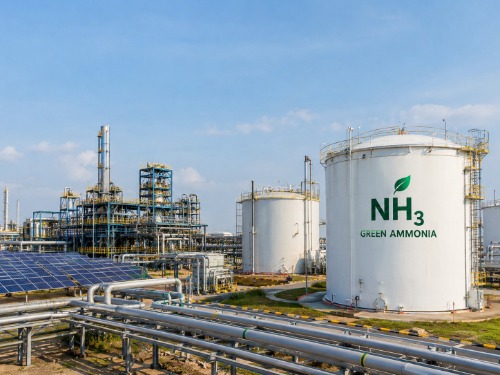
India’s green ammonia industry is set to receive fresh development financing after the Asian Development Bank (ADB) and the Government of Japan signed financing agreements with AM Green Ammonia (India) Private Limited to support a renewable-powered ammonia production facility with an annual capacity of approximately 1.1 million tonnes. The project marks the first investment under the Action for Creating Energy Security for Long-term Resilience (ACCEL), an initiative launched by ADB and Japan in May 2026 to strengthen energy security and support the transition to more diversified energy systems across Asia and the Pacific.
The project will convert an existing ammonia and urea plant from natural gas-based production to green ammonia manufacturing powered by renewable energy. The development is expected to support lower-emission ammonia production in India while creating opportunities for the country to participate in the emerging international market for renewable fuels and low-carbon industrial products.
The financing package includes a $100 million loan from the Leading Asia’s Private Infrastructure Fund 2 (LEAP 2), which is financed by the Japan International Cooperation Agency (JICA) and administered by ADB.
India’s Green Ammonia Capacity to Reach 1.1 Million Tonnes Annually
The project will repurpose an existing industrial facility, replacing its natural gas-based ammonia production pathway with a renewable-energy-powered process.
Ammonia is a critical industrial chemical, used extensively in fertiliser manufacturing and in other industrial applications. Conventional ammonia production relies heavily on fossil fuels, making the sector an important target for industrial decarbonisation.
Green ammonia is produced using renewable electricity, typically to generate hydrogen through water electrolysis, which is then combined with nitrogen to produce ammonia. Replacing fossil-fuel-derived hydrogen with renewable hydrogen can significantly reduce production-related emissions, although the overall environmental benefit depends on the electricity supply, plant configuration and associated production processes.
With a planned annual capacity of approximately 1.1 million tonnes, the Indian facility is intended to support large-scale green ammonia production and the development of an export-oriented industry.
The project announcement does not specify a commissioning date, the detailed construction schedule or the expected annual emissions reductions.
ADB and Japan Advance First ACCEL Investment
The financing agreements represent the first project investment under ACCEL, which ADB and Japan launched in May 2026.
The initiative aims to help countries and businesses across Asia and the Pacific respond to rising energy prices while strengthening the resilience of regional energy systems.
Japan is contributing through its Japan-financed trust funds administered by ADB and through collaboration with Japanese development finance institutions, including JICA and the Japan Bank for International Cooperation (JBIC).
The green ammonia project places the initiative’s longer-term energy transition objectives into practice by directing development finance towards industrial infrastructure designed to use renewable energy instead of fossil fuels.
ADB and Japan Highlight Energy Security and Industrial Decarbonisation
ADB President Masato Kanda said the project would change how ammonia is produced by substituting renewable energy for fossil fuels and deploying the technology at industrial scale.
He also highlighted the potential for the investment to support a new market and employment opportunities, describing the project as an example of how development finance can translate energy security objectives into practical investments.
Japan’s Finance Minister Satsuki Katayama said strengthening the resilience of Asia’s energy supply chains was essential. She also highlighted Japan’s POWERR Asia initiative, including ACCEL, and reaffirmed Japan’s cooperation with ADB to diversify energy sources and strengthen regional economic resilience.
The project therefore combines two policy objectives: reducing the carbon intensity of an essential industrial chemical and broadening the range of energy resources used by regional economies.
What the Project Means for India’s Green Ammonia Industry
The planned facility could strengthen India’s position in the emerging green ammonia market by converting existing industrial infrastructure to renewable-powered production.
Its potential significance extends across three areas.
Industrial decarbonisation: Ammonia is an essential input for fertiliser production and other industrial processes. Shifting production towards renewable hydrogen could help reduce emissions from a sector that has traditionally depended on fossil fuels.
Export market development: A facility with annual capacity of approximately 1.1 million tonnes could support India’s ambitions to supply green ammonia to international buyers. However, the scale of actual exports will depend on offtake agreements, production economics, certification requirements, transport infrastructure and market demand.
Energy security and investment: Development financing from ADB and Japan provides institutional backing for a major industrial transition. The project also illustrates how multilateral development banks and public financing mechanisms can support capital-intensive energy infrastructure.
The announcement establishes the project’s intended production capacity and financing framework, but further details would be needed to assess its commercial competitiveness, renewable electricity requirements, hydrogen production arrangements and expected emissions performance.
Bioenergy Business Analysis
The AM Green Ammonia project highlights the growing role of development finance in moving renewable fuels and low-carbon industrial chemicals from policy ambitions towards commercial-scale infrastructure. Its importance lies not only in the planned production capacity, but also in the conversion of an existing natural gas-based industrial site into a renewable-powered facility.
ADB’s project documentation identifies the site as Kakinada, Andhra Pradesh, and specifies a planned capacity of approximately 1.09 million tonnes per annum, divided into two production phases of 547,500 tonnes each. Phase 2 is conditional on securing additional long-term offtake arrangements. ADB lists scheduled commissioning dates of 31 March 2029 for Phase 1 and 31 March 2030 for Phase 2.


