The EU and the United States are looking for ways to address the acute diesel shortage. The G7 countries have released strategic reserves, and US President Donald Trump has agreed on a short-term deal with Russia for the delivery of 800,000 tonnes of diesel. These measures may provide temporary relief to the markets, but they do not solve the underlying problem in times of increasing geopolitical conflicts.
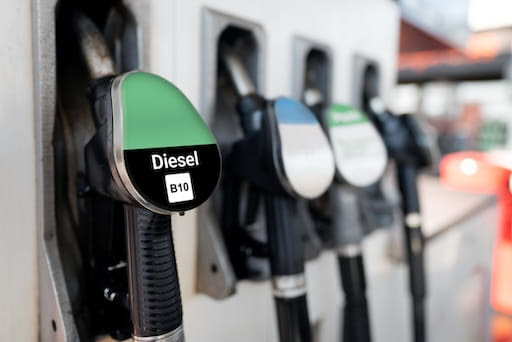
French President Emmanuel Macron is taking a much more forward-looking approach in this regard. In September, he called on the European Commission in a letter to blend more domestically produced biodiesel into fossil diesel. The biodiesel content in fossil diesel should be increased from the current market-standard 7% (B7) to 10% (B10). Such a measure would improve the supply situation, reduce dependence on imports and ease price pressure, Macron said.
Motorists should take note. If German petrol stations were already offering B10, it could have been up to 3 euro cents per litre cheaper than B7 at certain times this year. With every 65-litre tankful, consumers could therefore have saved around 2 euros.
France’s president is making his demand for B10 with the knowledge that the European Union has already regarded B10 as the new standard diesel since 2023.
Recital 99 of EU Directive 2023/2413 states:
“Almost the entire Union’s diesel supply already consists of B7, which limits the achievement of the envisaged higher targets for biofuel blending. The maximum proportion of bio-based components should therefore be increased from 7% to 10%.”
Detlef Evers, Managing Director of MVaK, commented:
“Although the German federal government permits B10 to be offered at public petrol stations, it simultaneously blocks its availability through a restrictive regulation governing the retention of existing fuel grades. If the federal government wants to ease the burden on diesel drivers while doing more for climate protection and security of supply, the regulation governing the retention of existing fuel grades must be reformed.”
One possible approach would be to adopt Italy’s regulation governing the retention of existing fuel grades. There, only 30% of petrol stations in a province are required to stock B7. This regulation takes into account the fact that numerous passenger cars and trucks have now been approved for operation with B10.
Evers continued:
“Germany has the capacity to produce more than 4 million tonnes of biodiesel. Only 2 million tonnes of biodiesel are needed to supply B7. Before German producers have to export their biodiesel, the federal government should ensure that more of it is used in Germany. This would help dampen diesel prices, provide greater climate protection in road transport and strengthen our security of supply.”
Truck fleets also benefit from the low price of biodiesel and currently save approximately 30 euro cents per litre when filling their tanks with B100, meaning 100% biodiesel.
About the Mittelstandsverband abfallbasierter Kraftstoffe e.V. (MVaK)
The MVaK represents 32 predominantly small and medium-sized companies operating across the entire value chain for the production of waste-based and advanced biodiesel. Its member companies collect suitable plant-based waste and residual materials, particularly used cooking oils and waste fatty acids, process these materials, convert them into waste-based or advanced biodiesel, or trade in raw materials and finished products.
Bioenergy Business Analysis
Germany’s potential shift from B7 to B10 highlights how higher biodiesel blending could support domestic renewable fuel demand while offering potential cost benefits to diesel consumers. The proposal comes as European markets face concerns over diesel supply and import dependence, making the use of domestically produced biofuels an important part of the broader energy security discussion.
According to the MVaK, Germany has the capacity to produce more than 4 million tonnes of biodiesel annually, while approximately 2 million tonnes are required to supply B7. The association argues that expanding B10 availability would help absorb more domestic production, reduce reliance on exports and strengthen the country’s fuel supply position.
For the European biofuels sector, the debate illustrates the connection between blending policy, domestic production capacity and transport decarbonisation. If regulatory barriers are addressed and vehicle compatibility is adequately considered, wider B10 adoption could create additional demand for biodiesel in Germany. The central challenge will be translating that potential into a commercially viable and sustainable increase in renewable fuel use.