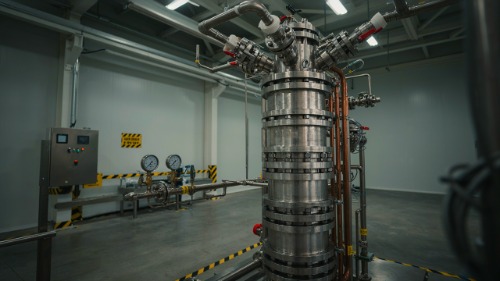
HYDGEN has inaugurated a new electrolyser manufacturing facility with an annual production capacity of 20 megawatts (MW) at Ganjimutt in Mangaluru, Karnataka, alongside unveiling its 250-kilowatt (kW) anion exchange membrane (AEM) and proton exchange membrane (PEM) electrolysers.
The company announced the developments at HYDGEN Innovation Day 2026. The newly unveiled systems were designed, assembled and tested in Mangaluru, according to the company.
The facility was inaugurated by Dakshina Kannada Member of Parliament Captain Brijesh Chowta and Mangaluru City North MLA Dr Y. Bharath Shetty. The launch adds domestic manufacturing capacity for hydrogen-production equipment as India develops its green hydrogen ecosystem.
HYDGEN said it had executed more than 20 projects across India, Singapore and Thailand over the preceding 12 months, generating more than US$1 million in sales. The company did not disclose a breakdown of project sizes, customer names or revenue by market.
HYDGEN introduces 250 kW AEM and PEM electrolysers
The two newly unveiled systems use different membrane technologies to split water into hydrogen and oxygen through electrolysis. The choice of technology can affect system design, operating conditions, efficiency, materials and suitability for different applications.
Anion exchange membrane (AEM) electrolysers use an anion-conducting membrane and an alkaline operating environment. The technology is being developed as an alternative that may combine aspects of alkaline electrolysis with membrane-based system design. Commercial performance depends on factors including membrane durability, catalyst materials and operating conditions.
Proton exchange membrane (PEM) electrolysers use a proton-conducting polymer membrane. They are commonly associated with compact system designs and flexible operation, including the ability to respond to variable electricity supply. Costs, stack lifetime and materials requirements remain important considerations in deployment.
HYDGEN said the 250 kW units were designed, assembled and tested locally. It did not disclose their efficiency figures, hydrogen output rates, operating pressures, system costs or expected commercial delivery schedules in the announcement.
The systems are intended to support hydrogen production, including industrial applications. Actual hydrogen output will depend on system performance and operating conditions.
New facility targets larger systems and wider markets
HYDGEN said the Ganjimutt facility was developed to support the next phase of its operations, including larger systems, more customers and a local network of component suppliers. The company aims to serve customers in India and international markets from its Mangaluru base.
The facility tour during Innovation Day covered stack assembly, system integration, testing and hydrogen quality checks. These activities represent key stages in electrolyser manufacturing and system validation before equipment is deployed at customer sites.
The company’s reported execution of more than 20 projects in India, Singapore and Thailand provides an indication of its existing project activity. However, the announcement did not clarify how many projects are operational, the total installed electrolyser capacity or the share of projects using AEM or PEM technology.
Industry and government representatives attend launch
The inauguration was attended by HYDGEN co-founder and chairman Dr Michael Gryseels, co-founder and chief technology officer Dr Goutam Kumar Dalapati, co-founder and chief operating officer Dr Krishna Kumar, and corporate director Ramyasri D S.
Mohammad Shoeb Ali, founder and managing partner of Transition VC, and Dr Avishek Kumar, founder and CEO of AAGM, also attended and spoke at the event.
In his address, MP Captain Brijesh Chowta highlighted the “Back to Ooru” initiative, which encourages professionals and entrepreneurs to return to their hometowns and contribute to regional development. He welcomed HYDGEN’s investment in Mangaluru and said the company’s growth could create local employment opportunities.
MLA Dr Y. Bharath Shetty also welcomed the manufacturing investment in Ganjimutt, which falls within his constituency. Karnataka health and family welfare minister U. T. Khader conveyed his best wishes to the company in a message.
The programme included a keynote address by Dr Ashish Lele, director of CSIR–National Chemical Laboratory, Pune, on moving hydrogen technologies from laboratory research into commercial applications. Panel discussions examined scaling membrane electrolysers from pilot systems to multi-megawatt plants, industrial applications of on-site hydrogen and approaches to financing lower hydrogen production costs.
India expands electrolyser manufacturing under its green hydrogen mission
India’s National Green Hydrogen Mission aims to establish the country as a hub for green hydrogen production, use and export. The government has set an objective of developing 5 million tonnes per year of green hydrogen production capacity by 2030.
As of March 2026, the Ministry of New and Renewable Energy reported that 15 companies had been awarded a combined 3,000 MW per year of electrolyser manufacturing capacity under the mission’s incentive scheme. This represents awarded capacity across the programme, not necessarily capacity already commissioned or operating.
HYDGEN’s 20 MW-per-year facility is a separate company announcement; the available information does not establish whether this particular facility is included in the government’s awarded capacity figures.
Bioenergy Business Analysis
HYDGEN’s new manufacturing facility adds another development to India’s emerging hydrogen equipment supply chain. Its focus on both AEM and PEM technologies is notable because electrolyser manufacturers are working to address different operating requirements, materials challenges and cost barriers as hydrogen applications develop.
The distinction between manufacturing capacity and hydrogen production is important. HYDGEN’s stated 20 MW annual capacity refers to the power rating of electrolysers it can manufacture over a year, not 20 MW of hydrogen-generation capacity already operating at customer sites. Similarly, the 250 kW rating describes the nominal power rating of each unveiled system, not the quantity of hydrogen it produces per hour.
The commercial test will be whether the facility can convert its manufacturing capability into repeat orders, reliable equipment performance and competitive delivered costs. The company’s reported project activity across three countries provides an early indicator of market engagement, but information on customer deployments, operating data, electrolyser efficiency and order backlog would help assess the scale of its commercial position.