


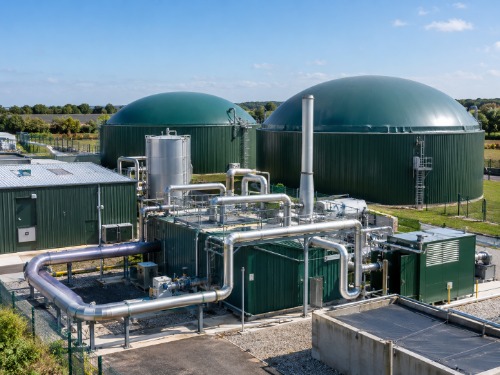
Eco Sustainable Solutions has officially opened a £20 million anaerobic digestion (AD) facility at its Parley site in Dorset, UK, converting locally collected food waste into renewable biomethane for injection into the gas network.
The plant can process more than 50,000 tonnes of food waste annually and produces biomethane at a reported rate of 900 cubic metres per hour. The company says the gas could provide heating for approximately 7,000 homes.
Commissioned in March 2026, the facility serves food waste collected from households and businesses across Bournemouth, Christchurch and Poole and surrounding areas. It is located within Eco Sustainable Solutions’ 40-acre Eco Park at Parley and has six full-time operators.
Construction began in 2024, following planning permission granted more than a decade earlier. Simon Boyd, vice-president of Dorset Chamber and managing director of REIDsteel, officially opened the facility.
Food waste converted into biomethane and biofertiliser
The plant uses anaerobic digestion to process organic waste. During the process, microorganisms break down the material in the absence of oxygen, producing biogas that can be upgraded to biomethane for use in the gas network.
According to the company, the facility operates around the clock and can handle more than 1,000 tonnes of food waste each week. Alongside renewable gas, the process produces digestate that is treated and supplied as nutrient-rich biofertiliser for agricultural use.
Eco Sustainable Solutions managing director Justin Dampney said the facility had been developed in response to the UK government’s Simpler Recycling reforms. He said the plant would transform food waste into renewable biomethane for the gas network and biofertiliser for agriculture.
The project connects local food-waste collection with renewable gas production and nutrient recovery, providing an alternative to sending suitable organic material to disposal.
Facility adds to Dorset’s organic waste infrastructure
The Parley plant is part of Eco Sustainable Solutions’ wider waste recycling and resource recovery operations. The company also operates sites at Piddlehinton and Weymouth, handling green waste, wood, road sweepings and food waste for clients including Bournemouth, Christchurch and Poole Council and Dorset Council.
The business began as a small green-waste composting operation and has since expanded to employ 53 people, with annual turnover exceeding £20 million, according to the company information supplied with the announcement.
In its 2025 reporting, Eco said its waste-diversion activities prevented more than 120,000 tonnes of carbon dioxide from entering the atmosphere. The company also reported that it has recycled more than 4.3 million tonnes of organic material since it began trading. These are company-reported figures and should not be interpreted as independently verified emissions savings from the new Parley facility alone.
UK food-waste reforms create demand for treatment capacity
The facility’s opening comes as England’s Simpler Recycling reforms expand requirements for the separate collection of food waste from households and businesses. Separating food waste can help make organic material available for treatment through anaerobic digestion or other appropriate processes.
The environmental benefits depend on the waste-management route being displaced, the energy used in processing, methane capture and leakage control, and the final use of digestate. Where food waste is suitable for anaerobic digestion, the process can recover energy and nutrients from material that might otherwise be discarded.
Bioenergy Business Analysis
Eco Sustainable Solutions’ Parley facility illustrates how local food-waste collection can be linked to biomethane production and agricultural nutrient recovery. Its capacity to process more than 50,000 tonnes of food waste annually gives the Dorset region an additional route for managing organic material while producing a renewable gas that can use existing gas-network infrastructure.
The project’s value lies in more than the volume of biomethane produced. Anaerobic digestion can also return nutrients to agricultural soils through treated digestate, although the benefits depend on digestate quality, handling and application practices. Reliable feedstock collection and consistent plant operation are equally important to the facility’s long-term performance.


