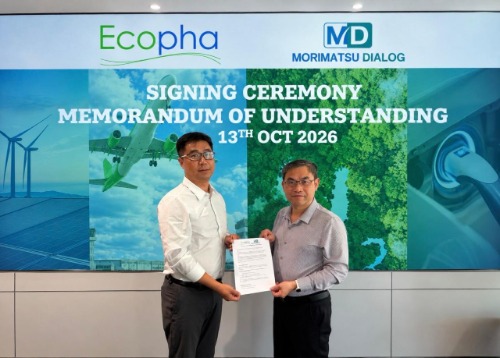
ECOPHA Pty Ltd and Morimatsu Dialog in Malaysia have signed a memorandum of understanding (MoU) to explore modular biorefinery solutions designed to co-produce sustainable aviation fuel (SAF) and polyhydroxyalkanoate (PHA) bioplastics.
Announced following a signing ceremony on 13 October 2026, the proposed collaboration combines ECOPHA’s proprietary dual-output technology with Morimatsu Dialog’s engineering, procurement and fabrication capabilities. The companies intend to investigate standardised modular plant designs and potential feedstock pathways using non-food resources, including Pongamia oil and used cooking oil (UCO).
The agreement establishes a framework for exploring technical and engineering opportunities rather than confirming a final investment decision or a project ready for construction. The announcement does not disclose a project location, investment value, production capacity, construction schedule or commercial commissioning date.
Partnership Targets Modular Biorefinery Development
The MoU brings together technology development and industrial engineering to examine how future biorefinery concepts could be translated into deployable plant infrastructure.
ECOPHA contributes its proprietary dual-output technology, while Morimatsu Dialog brings engineering, procurement and fabrication capabilities. According to the announcement, the companies intend to explore standardised modular plant architectures that could be adapted for deployment across different locations.
Modular plant designs typically organise equipment and processing systems into integrated assemblies that can be fabricated and tested before installation at a project site. Depending on the design and project conditions, this approach may improve construction planning, equipment consistency and installation efficiency.
The extent to which these benefits can be achieved in the proposed collaboration will depend on the eventual process design, project scale, feedstock requirements and site-specific engineering.
SAF and PHA Bioplastics Identified as Co-Production Targets
A central element of the proposed collaboration is the potential integration of SAF production with PHA bioplastics manufacturing.
SAF is an alternative aviation fuel produced through approved production pathways using eligible renewable or other qualifying feedstocks. Its compatibility with existing aviation infrastructure depends on the specific fuel pathway, applicable specifications and blending requirements.
The companies intend to explore engineering and processing arrangements relevant to SAF infrastructure. However, the announcement does not identify the proposed conversion technology, the intended SAF production pathway or expected fuel output.
Polyhydroxyalkanoates are a family of polymers produced by microorganisms under suitable biological processing conditions. Depending on their formulation and application, PHA materials can be used in products designed for different performance and end-of-life requirements.
The MoU identifies PHA bioplastics as a potential co-product of ECOPHA’s dual-output technology. Further technical information would be needed to establish how the proposed process would integrate fuel and polymer production, including its feedstock requirements, material yields and processing configuration.
The commercial significance of the proposed dual-output model will depend on whether the two product streams can be produced efficiently and meet the relevant quality and market requirements.
Pongamia Oil and Used Cooking Oil Under Consideration
The announcement identifies Pongamia oil and used cooking oil as potential feedstock options for the proposed biorefinery concept.
Pongamia, also known as karanja, is a non-food oilseed tree whose oil is being explored for renewable fuel and bio-based material applications. Used cooking oil is a recovered waste resource that can serve as a feedstock for certain renewable fuel production pathways, subject to appropriate quality controls and processing requirements.
ECOPHA’s approach has attracted industry attention because of its proposed integration of SAF and PHA production. In a 30 September 2026 interview, S&P Global Energy reported that ECOPHA was seeking an Indian biorefinery partner and had conducted laboratory and pilot work involving 400–500 litres of Pongamia oil. The report also noted that feedstock availability and the time required for Pongamia plantations to mature remain challenges for scaling supply.
The Morimatsu Dialog MoU introduces an engineering collaboration to explore modular plant solutions, but it does not confirm that either Pongamia oil or used cooking oil has been selected for a commercial facility.
Modular Engineering Could Support Future Deployment
Morimatsu Dialog (Malaysia) specialises in process modules, modular plant construction and fabrication of industrial process equipment. Its capabilities include engineering design, procurement of core equipment and the fabrication of integrated process systems.
Applying these capabilities to a biorefinery could help the companies evaluate standardised equipment layouts and manufacturing approaches before committing to a specific project configuration.
The announcement identifies Australia, Southeast Asia and international markets as areas of potential relevance. However, it does not identify a confirmed project site, customer, engineering contract or deployment schedule.
The proposed collaboration therefore remains at the exploratory stage. Further technical disclosures will be needed to establish the process configuration, production scale and commercial pathway.
Bioenergy Business Analysis
The ECOPHA–Morimatsu Dialog MoU brings together two capabilities that are important to the development of integrated bio-refineries: a technology platform intended to produce two outputs and an engineering partner experienced in modular industrial facilities.
Its significance lies in the opportunity to examine how SAF and PHA bioplastics might be produced within an integrated process. Whether that model becomes commercially viable will depend on process performance, feedstock supply, capital requirements and the ability to secure buyers for both products.
The agreement creates a framework for evaluating the engineering and deployment of a SAF–PHA biorefinery concept. It is a development-stage collaboration, not yet evidence of a commissioned plant or a commercially proven large-scale production system.