


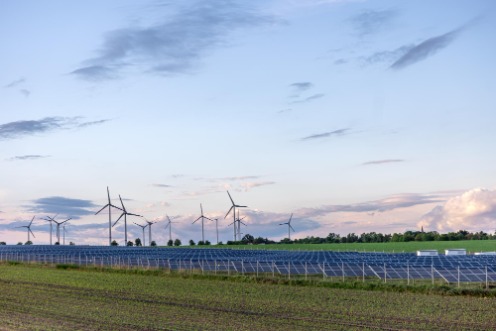
Juniper Green Energy Limited has commissioned an additional 65.40 MW of wind power capacity through its wholly owned subsidiary, Juniper Green Stellar Private Limited, taking the reported operational capacity associated with the project to 434.35 MWp, alongside approximately 201 MWh of battery energy storage.
The commissioning took place on 16 October 2026 and forms part of the company’s 200 MW Firm and Dispatchable Renewable Energy (FDRE) project, according to a regulatory filing submitted to Indian stock exchanges. The project has a planned renewable energy capacity of 550.6 MWp, supported by approximately 201 MWh of battery energy storage system (BESS) capacity.
Following the latest commissioning, Juniper Green Energy and its subsidiaries reported aggregate operational capacity of approximately 2,811 MWp, supported by around 603 MWh of BESS.
Juniper Green advances wind and storage project
The newly commissioned wind capacity adds to the renewable generation assets already operating within the project. The remaining development towards the planned 550.6 MWp capacity represents further potential additions to the project’s generation portfolio.
The company’s regulatory disclosure identifies the 65.40 MW addition as part of its 200 MW FDRE project. It separately reports 434.35 MWp of operational project capacity and 550.6 MWp of planned capacity. These figures use different capacity descriptions, so the 200 MW FDRE designation should not be interpreted as the total installed capacity of the associated generation assets.
The project also includes approximately 201 MWh of battery storage. Battery energy storage can store electricity and release it at a later time, helping manage differences between when renewable generation is available and when electricity is required.
Battery storage supports firm and dispatchable renewable power
FDRE projects are designed to deliver electricity according to specified supply requirements by combining renewable generation with technologies such as battery storage. Unlike generation from a single variable renewable source, a coordinated project can use storage and complementary generation profiles to help meet defined delivery schedules.
The effectiveness of this approach depends on factors including the generation mix, battery power rating and duration, operating strategy and the terms of the electricity supply agreement. Battery storage can shift electricity across time, but its contribution to supply reliability depends on the system’s design and operating conditions.
For Juniper Green, the reported 201 MWh of BESS forms part of the project’s planned configuration. The company has not disclosed in the cited commissioning notice the battery’s power rating, dispatch schedule or the specific electricity delivery profile associated with this milestone.
Juniper Green Energy’s operational portfolio reaches 2,811 MWp
The additional wind capacity brings the combined operational portfolio of Juniper Green Energy and its subsidiaries to approximately 2,811 MWp, with around 603 MWh of battery storage, as of 16 October 2026.
The company develops renewable energy projects across wind, solar, wind-solar hybrid and FDRE configurations, including projects that incorporate battery storage. Its portfolio expansion reflects the growing role of integrated generation and storage infrastructure in India’s electricity system.
The latest commissioning adds to the company’s operational renewable capacity. Further progress towards the project’s planned capacity will depend on subsequent commissioning milestones and the company’s disclosures.
Bioenergy Business Analysis
Juniper Green Energy’s latest commissioning highlights the continued development of renewable generation paired with storage in India. Such configurations are increasingly relevant as power systems seek to integrate variable wind and solar generation while meeting electricity supply requirements.
The reported figures also illustrate why capacity measures matter when assessing integrated projects. Wind capacity is reported in MW, solar or direct-current generation capacity may be expressed in MWp, and battery storage capacity is measured in MWh. These units describe different characteristics and should not be treated as interchangeable.
The project’s next milestones to watch are further commissioning towards the planned 550.6 MWp, disclosures on the operational status of its storage system and any additional information on how the FDRE project is structured to meet its contracted supply obligations. These details will provide a clearer picture of how the generation and storage components contribute to dispatchable renewable electricity.


