


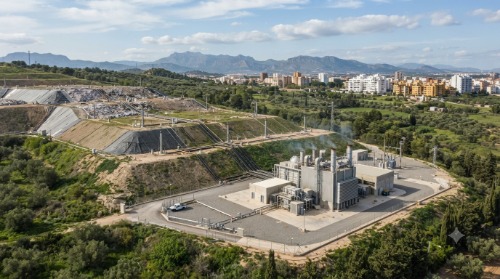
A landfill-gas recovery project at the Artigas landfill near Bilbao, Spain, demonstrated more than three decades ago how methane generated by decomposing municipal waste could be captured and converted into electricity.
During its first year of operation, from November 1992 to October 1993, the Artigas plant generated 4.4 million kWh of electricity, with 4.1 million kWh sold to Iberdrola, according to an archived European Commission CORDIS project record.
The project was designed to demonstrate the technical and economic viability of using landfill gas as an energy source. At the time, Artigas received around 700 tonnes of waste per day from Bilbao and nearby municipalities, representing a population of approximately 800,000 people.
Rather than allowing methane generated inside the landfill to accumulate or escape, the project used a network of collection wells to extract the gas, condition it and feed it into internal-combustion engines for electricity generation.
Artigas landfill gas system
As reported by the Economic Times, the plant’s gas collection system comprised 21 wells connected to 12 gas lines, according to the CORDIS project record. The wells ranged from 10 to 18 metres deep and transported collected gas towards a central collector located in the engine building.
The system had a collection capacity of approximately 600 cubic metres of biogas per hour, with methane accounting for around 52% on average. The gas supplied to the engines was consumed at approximately 500 cubic metres per hour.
Before entering the engines, the landfill gas underwent treatment to remove particles and moisture. A flare was also used for excess gas that could not be consumed by the engines.
Moisture removal was particularly important because condensate could damage the generating equipment. The CORDIS record says the gas was cooled, passed through a water separator and subsequently reheated before being supplied to the engines.
Two 450 kW engines generated electricity
The power-generation system consisted of two internal-combustion engines, each coupled to a 450 kW alternator, giving the installation a combined generating capacity of approximately 900 kW.
Electricity from the two units was combined and passed through a 2,000 kVA transformer before being supplied to the Iberdrola electricity grid. Iberdrola was identified by the European Commission record as the sole buyer and consumer of the electricity produced by the project.
During the first operational year, the plant generated 4.4 million kWh, of which 4.1 million kWh was sold to Iberdrola. The CORDIS record also reports an average purchase price of 10.6 Spanish pesetas per kWh for the electricity sold during the period.
Gas monitoring was central to the project
The Artigas project was not simply an electricity-generation installation. Gas extraction was also intended to address safety and environmental issues associated with methane accumulation within the landfill.
The European Commission’s project documentation says the collection and removal of landfill gas helped reduce the potential formation of explosive mixtures, limit vegetation damage caused by methane displacing oxygen around plant roots and reduce unpleasant odours at the landfill.
The composition of the gas was monitored regularly. According to the CORDIS record, the Institute of Renewable Energies had been analysing the landfill gas and associated condensates since 1990.
The analyses recorded average methane concentrations of approximately 50%, while oxygen levels varied between 0.72% and 8.65%. The gas also contained volatile organic compounds, including benzene, toluene and ethylbenzene, reinforcing the need for gas conditioning before combustion in the engines.
From landfill gas to renewable electricity
The Artigas project was developed as a demonstration of landfill-gas energy recovery under an EEC programme supporting energy demonstration and industrial pilot projects. The project began on 30 May 1990 and was formally completed on 15 May 1993, with a reported total project cost of €947,816 and an EEC contribution of €189,563.
The Basque Energy Agency, Ente Vasco de la Energía (EVE), identifies BioArtigas as its first facility for the valorisation of landfill biogas. EVE says the project was established in 1992 and had two linked objectives: removing methane from the landfill to address emissions, odour and explosion risks, and producing renewable electricity from the recovered gas.
EVE currently describes the facility as still operational but in a declining phase because the landfill no longer receives new organic material and the available biogas is progressively decreasing.
An early example of landfill-gas valorisation
Artigas represents an early example of treating landfill methane as a recoverable energy resource rather than solely as a waste-management problem.
The project connected three functions: landfill gas management, methane recovery and electricity generation. Its first-year output demonstrated that gas produced from existing municipal waste deposits could be captured, conditioned and converted into grid electricity.
The technology has since evolved considerably, but the underlying principle remains relevant to landfill-gas projects: controlling methane generated by organic waste can simultaneously address environmental and safety concerns while creating an energy stream.
Bioenergy Business Analysis
The Artigas experience highlights an important distinction between landfill-gas recovery and modern anaerobic-digestion-based biogas production. Landfill gas is generated passively as organic material decomposes under landfill conditions, whereas controlled anaerobic digestion is designed around managed feedstock, process conditions and gas production.
Nevertheless, landfill-gas recovery can provide an energy and emissions-management pathway for existing waste deposits where methane continues to be generated. Artigas showed that collection infrastructure, gas conditioning and appropriately sized generation equipment could convert that otherwise uncontrolled gas stream into electricity.
The project’s current trajectory also illustrates the finite nature of landfill-gas resources. EVE says the Artigas installation is approaching exhaustion because new organic material is no longer being deposited. This makes landfill-gas recovery most relevant as part of managing legacy waste sites, while newer waste strategies increasingly focus on source segregation, recycling, organic-waste treatment and controlled biogas production before waste reaches landfill.
Read also: Jordan signs €3.3m consultancy deal to advance wastewater biogas power