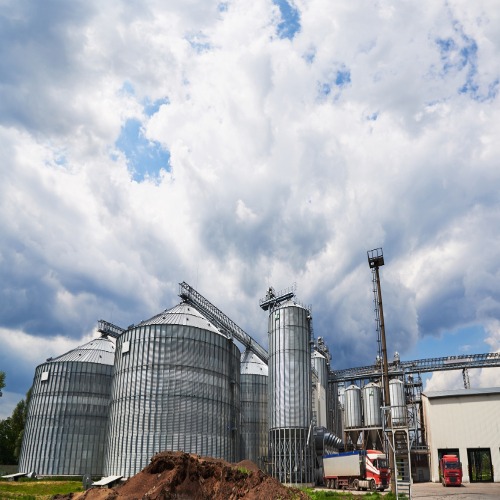
PurposeEnergy has commissioned a $40 million-plus anaerobic digestion and wastewater pre-treatment facility in Minster, Ohio, that will process up to 250,000 gallons of organic residuals per day from Danone USA’s yogurt manufacturing plant and other regional food and beverage producers.
The facility converts high-strength food waste and wastewater residuals into renewable biogas, treated water and nutrient-rich soil amendments. Its biogas is supplied through a dedicated pipeline to a boiler at Danone’s Minster plant, where it replaces conventional natural gas used for process heat.
According to PurposeEnergy, the facility is expected to produce approximately 50,000 million British thermal units (MMBtu) of renewable biogas annually at full operation. The company estimates that using the biogas in place of natural gas will avoid approximately 3,200 US tons of carbon dioxide equivalent (CO₂e) emissions per year, based on standard US Environmental Protection Agency and Energy Information Administration combustion emission factors.
The project is operational and ramping up production, with a grand opening celebration planned for spring 2027.
Anaerobic Digestion Converts Food Manufacturing Residuals into Energy
Located on Columbia Drive in the Route 66 Industrial Park, the PurposeEnergy–Minster facility is designed to process wastewater and concentrated organic residuals generated by food and beverage manufacturing operations.
The material is piped directly from Danone’s Minster yogurt plant and supplemented by residuals from other regional producers. Anaerobic digestion uses microorganisms to break down organic matter in the absence of oxygen, generating biogas that can be used as a renewable energy source.
In this project, the resulting biogas is delivered to Danone’s manufacturing facility for use in a dedicated boiler. The arrangement creates a direct link between organic waste generation and energy consumption at the industrial site.
At its designed capacity of up to 250,000 gallons per day, the facility could process approximately 91.25 million gallons annually if it operates at that rate throughout the year. Actual throughput will depend on operational performance and feedstock availability as the plant ramps up.
PurposeEnergy said the project represents an investment of more than $40 million and is its first project with Danone.
Project Targets 50,000 MMBtu of Renewable Biogas Annually
At full operation, the facility is expected to generate approximately 50,000 MMBtu of renewable biogas each year. The gas is piped to Danone’s Minster manufacturing site, where it displaces natural gas in process heating.
PurposeEnergy estimates that this substitution will avoid approximately 3,200 US tons of CO₂e emissions annually. The estimate is based on standard EPA/EIA combustion emission factors and represents the stated benefit from replacing conventional natural gas; it should not be interpreted as a complete lifecycle emissions assessment of the facility.
The company also estimates that transporting organic residuals directly from Danone’s plant to the nearby processing facility avoids a further 720 US tons of CO₂e per year compared with the previous off-site handling route.
These estimates relate to different aspects of the project: fuel substitution and changes to residuals handling. They should be reported separately rather than added together without confirming whether the underlying calculations use consistent boundaries and avoid double counting.
Treated Water and Soil Amendments Support Resource Recovery
Alongside renewable energy production, the facility is designed to recover value from the liquid and solid streams generated during processing.
Water leaving the plant is treated to meet municipal discharge standards before being sent to the Village of Minster’s wastewater treatment works. According to PurposeEnergy, the treatment process removes surplus nutrients and dissolved solids, reducing the burden on local municipal infrastructure.
The facility also produces nutrient-rich soil amendments. The announcement does not specify their composition, annual output or intended end users.
The project therefore combines energy recovery with wastewater pre-treatment and the potential beneficial use of recovered nutrients. The extent of these additional benefits will depend on actual operating performance, water quality, residuals management and the use of the resulting soil amendments.
Danone and Minster Highlight Industrial and Community Benefits
PurposeEnergy founder and chief executive Eric Fitch described the facility as an example of circularity in food and beverage manufacturing, with organic residuals converted into energy and other useful outputs.
Danone Americas chief operating officer Heiko Gerling said the project forms part of the company’s Danone Impact Journey and its Re-Fuel energy excellence programme. He highlighted the integration of the yogurt plant, local infrastructure and community stakeholders.
For the Village of Minster, the project is intended to reduce pressure on municipal wastewater infrastructure by treating incoming residual streams before the water reaches the village’s treatment works.
Mayor Craig Oldiges also highlighted the role of local infrastructure investment in supporting the community’s long-term resilience. The facility is now operational and ramping up, with a public grand opening planned for spring 2027. The announcement does not provide a date for reaching full processing capacity.
Bioenergy Business Analysis
The commissioning of PurposeEnergy’s Minster facility demonstrates how anaerobic digestion can be integrated directly into food manufacturing operations to manage organic residuals and supply renewable process heat. Rather than treating wastewater and food waste solely as disposal challenges, the project uses them as inputs for energy recovery and resource management.
For food and beverage manufacturers, the project offers a model worth examining where concentrated organic residuals, suitable industrial heat demand and wastewater management needs occur together. Its significance extends beyond the production of renewable gas to the integration of waste treatment, energy supply and resource recovery within an industrial supply chain.
The next milestones to watch are the facility’s progression to full capacity, verified annual biogas output, actual natural gas displacement and the performance of its wastewater treatment system. These data will help establish how effectively the project translates its design targets into measurable operational and environmental outcomes.