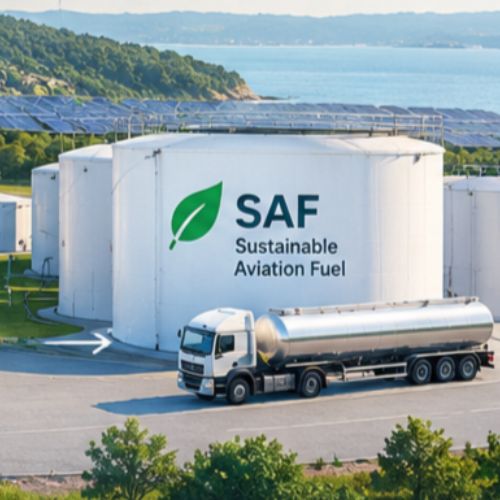
Aeon Blue, a clean-technology startup based in Sydney, Nova Scotia, has partnered with Eskasoni First Nation to develop a $4 million pilot facility designed to produce sustainable aviation fuel (SAF) using hydrogen extracted from seawater and carbon dioxide captured from the atmosphere.
As reporetd by The Chronicle Herald, the joint venture, eFuels Mi’kmaq Limited, will be established on Eskasoni land at the Sydport industrial park in Cape Breton. Eskasoni is investing $1.5 million in the project and will hold a majority ownership stake, making the venture a potential model for Indigenous participation in Canada’s emerging clean-fuels sector.
The pilot is intended to demonstrate the company’s saltwater electrochemical technology and assess whether synthetic fuels can eventually compete economically with conventional petroleum-based fuels. The process is designed to use renewable electricity, including wind and solar power.
Pilot project to test seawater-based fuel production
Aeon Blue was founded in Texas in 2018 by siblings Lark Meadow, the company’s chief executive, and Deois Ua Cearnaigh, a renewable-energy scientist and electrochemist. The company later moved to Nova Scotia to advance the commercialisation of its technology, drawing on regional renewable-energy resources, research capabilities and government support.
The initial pilot facility is expected to begin operating in early 2027, with planned production of approximately one tonne of fuel annually. A second development phase targeted for 2028 aims to increase annual production capacity to around 30 tonnes.
These stages are intended to help the company test operating performance, improve process efficiency and demonstrate equipment at a larger scale before pursuing a commercial facility. Aeon Blue is targeting 2030 or 2031 for that development, although a location has not yet been disclosed.
How Aeon Blue’s saltwater electrochemical process works
Aeon Blue’s technology uses an electrochemical system to produce hydrogen from seawater while generating sodium hydroxide, which plays a role in the company’s carbon-capture process.
The system is designed to capture carbon dioxide from the atmosphere. Some of the captured carbon is then concentrated for use in synthetic-fuel production, while additional carbon dioxide may be sold as an industrial feedstock or directed towards permanent storage.
Hydrogen and carbon dioxide are combined to produce synthetic hydrocarbons that can be processed into fuels, including aviation fuel and synthetic methane. The process can also produce ultrapure water as a co-product.
The company says its approach is intended to address two challenges facing synthetic fuels: the cost of hydrogen production and the origin of the carbon used in the fuel. Using atmospheric carbon dioxide, rather than relying exclusively on fossil-derived carbon, is central to its proposed emissions-reduction pathway.
However, the project’s ability to deliver cost-competitive fuel and meaningful lifecycle emissions reductions will need to be assessed through operational data, energy requirements and independent analysis.
Renewable electricity central to the project
The proposed facility is expected to rely on renewable electricity, with wind power a key potential source given Atlantic Canada’s onshore and offshore wind development prospects. Aeon Blue says its process can adjust to variable renewable power availability, allowing it to operate in coordination with fluctuating electricity supply.
The availability and cost of electricity will be important factors in determining the economics of the technology. Hydrogen production and carbon capture can require substantial energy inputs, making electricity prices, equipment performance and plant utilisation significant variables for any commercial-scale project.
Cape Breton’s location also offers potential access to Canadian and US customers, as well as shipping routes serving European markets. The partners are positioning the project within a broader opportunity to develop a clean-fuels industry in Nova Scotia.
Eskasoni partnership targets jobs and Indigenous ownership
The joint venture places Eskasoni First Nation in a majority ownership position in the proposed clean-fuels business. The community’s $1.5 million investment represents a substantial share of the project’s $4 million initial funding requirement.
The partners plan to train as many as 12 Eskasoni members in engineering, operations and management. If the project progresses to a larger commercial facility, it could create up to 80 full-time jobs, according to the plans outlined by the partners.
Eskasoni Chief Leroy Denny has described the venture as an opportunity to combine environmental stewardship with economic development and create benefits for community members.
The partnership also reflects a wider question in the clean-energy transition: how Indigenous communities can participate as owners and investors in emerging energy businesses, rather than solely as project hosts or stakeholders in consultation processes.
Commercial scale-up remains the next milestone
Aeon Blue’s immediate objective is to use the pilot phases to refine its process and demonstrate the performance of its equipment. A larger facility would require further capital, evidence of reliable production and a clearer picture of potential fuel costs and customer demand.
The company has identified aviation as its initial target market because synthetic fuels could offer a route to lower-emission aviation without requiring fundamental changes to existing aircraft engines. It has also identified potential applications in marine fuels and other synthetic hydrocarbons.
The proposed project remains at an early stage. The planned production volumes are small compared with commercial aviation-fuel demand, and the pilot’s results will be important in determining whether the technology can progress towards industrial deployment.
Bioenergy Business Analysis
Aeon Blue and Eskasoni First Nation are pursuing a pathway that combines synthetic-fuel production, atmospheric carbon capture and Indigenous majority ownership. The project is notable both for its proposed technology and for the structure of the partnership.
Its commercial prospects will depend on whether the process can convert renewable electricity, seawater and captured carbon dioxide into fuel at competitive cost. Key factors include electricity consumption, hydrogen and carbon yields, equipment durability, carbon-capture performance and the costs of scaling from a pilot to a commercial plant.
The carbon benefit also needs to be evaluated across the full lifecycle. Capturing carbon from the atmosphere does not, by itself, establish that a fuel is carbon-neutral or carbon-negative; the energy source, process emissions, carbon allocation and the fate of captured carbon all matter.
The planned pilot will therefore be an important test of technical and operational feasibility, but it will not by itself establish commercial cost parity or lifecycle emissions performance. If the project meets its milestones, it could provide a basis for further investment while creating a pathway for Eskasoni First Nation to participate directly in the developing synthetic-fuels market.