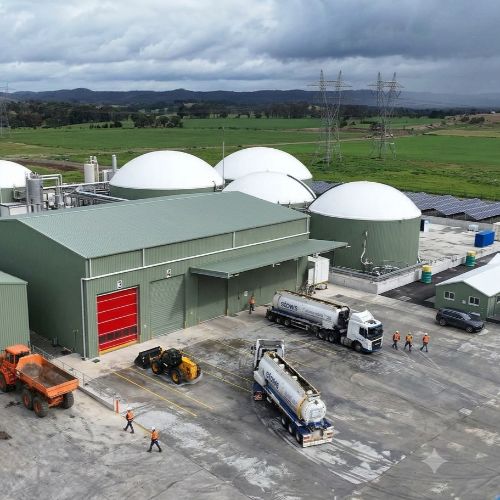
Delorean Corporation has secured an operational licence from South Australia’s Environment Protection Authority (EPA) for its SA1 Salisbury Bioenergy Project at Edinburgh Parks, clearing a key regulatory milestone as construction approaches completion and the facility prepares to accept organic waste, as reported by The Australian.
The facility is designed to process 70,000 tonnes of organic waste annually from commercial, industrial and municipal sources across metropolitan Adelaide. Once operational, it is expected to produce 210 terajoules (TJ) of renewable gas and 6,000 tonnes of biogenic, food-grade liquid carbon dioxide each year.
Delorean Corporation (ASX: DEL) said construction was approximately 90% complete, with staged waste acceptance, biological commissioning and the first injection of biomethane into Adelaide’s gas network among the next milestones.
The licence allows the company to progress towards operations, subject to its conditions and the facility’s readiness. It does not mean the plant has already begun commercial biomethane production.
SA1 to Begin With Packaged Organic Waste
Delorean plans to initially prioritise packaged organic waste to support controlled commissioning before progressively introducing suitable liquid and solid organic waste streams.
The facility will use anaerobic digestion to convert organic material into biogas. The gas will then undergo upgrading to remove carbon dioxide and other contaminants, producing biomethane suitable for injection into the gas network.
At its planned annual processing capacity of 70,000 tonnes, SA1 is intended to divert organic residuals from conventional waste management routes while producing renewable gas and other saleable outputs.
In addition to biomethane, Delorean expects the project to produce biogenic liquid carbon dioxide and biofertiliser. The company also identifies Australian Carbon Credit Units (ACCUs) and GreenPower Renewable Gas Guarantee of Origin certificates among the project’s anticipated value streams, subject to the applicable eligibility and certification requirements.
The company has not yet reported actual annual output, as the facility remains in the construction and commissioning phase.
Gas Network Connection to Extend Biomethane Market Access
SA1’s connection to South Australia’s existing gas network is central to its commercial model. Under an agreement announced in April 2025, Australian Gas Infrastructure Group (AGIG) is to connect the facility to its network, allowing biomethane to be supplied to gas customers beyond the immediate vicinity of the plant.
Network injection can broaden the potential market for renewable gas by allowing it to reach industrial and other users through existing gas infrastructure. This can be particularly relevant for applications where replacing gas-fired equipment with electric alternatives may be technically difficult or costly.
Delorean also announced an additional $1.66 million grant commitment from the Australian Renewable Energy Agency (ARENA) in June, bringing total support under the relevant agreement to $7.74 million, excluding GST.
The funding provides government backing for the project, although the supplied announcement does not detail the complete project financing structure or the share of total capital costs covered by grants.
Salisbury Project Recognised at 2026 AFR Energy Awards
The licensing milestone follows SA1’s win in the sustainability category at the Australian Financial Review Energy Awards on October 13, 2026.
The recognition highlights the project’s potential contribution to waste recovery and renewable gas supply. However, its longer-term environmental and commercial performance will depend on successful commissioning, consistent feedstock supply, gas quality and the ability to operate at the planned scale.
Delorean has positioned SA1 as a model for its wider renewable infrastructure pipeline. The company is targeting construction of its NSW1 and VIC1 projects in financial year 2027, according to the supplied report. These remain forward-looking development plans rather than confirmed operating capacity.
Australia’s Biomethane Market Gains Momentum
SA1 is entering a market where renewable gas is attracting interest as a potential tool for reducing emissions, improving organic waste management and diversifying gas supply.
The International Energy Agency’s Renewables 2025 report forecasts that combined global biogas and biomethane production will increase by 22% between 2025 and 2030, with biomethane expected to drive net growth. The outlook reflects factors including energy security, emissions reduction and waste management policies.
Australia already has projects upgrading biogas from wastewater treatment. Jemena’s Malabar facility in Sydney, for example, upgrades wastewater-derived biogas and has an initial capacity of 95 TJ per year, according to the supplied report.
SA1 differs in its focus on commercial and industrial organic waste. The project is expected to become Australia’s first facility to inject biomethane into a gas network from the processing of commercial and industrial organic waste, according to Delorean’s announcement.
Production costs remain an important constraint on broader adoption. ARENA’s 2021 Bioenergy Roadmap modelled biomethane production costs declining from $12.20/GJ in 2021 to $9.80/GJ in 2030, compared with a modelled natural gas price of $11.50/GJ in 2030. These are historical modelled estimates, not verified current market prices, and should not be interpreted as a guarantee that biomethane will be cheaper than natural gas.
GreenPower’s government-backed renewable gas certification pilot is another mechanism intended to support market development. The supplied report identifies both SA1 and Malabar as accredited producers under the relevant scheme.
Bioenergy Business Analysis
The SA1 operating licence marks an important step in moving Delorean Corporation’s Salisbury project from construction towards commissioning and commercial operation. Its significance lies in combining organic waste processing, biomethane production and access to existing gas infrastructure within one project.
SA1 also provides a useful test case for Australia’s emerging waste-to-biomethane industry. Its ability to move from licensed construction to stable gas injection could offer practical evidence about the economics of processing commercial and industrial organic waste at scale.
The next milestones to monitor are the start of waste acceptance, completion of biological commissioning, first biomethane injection and progression towards commercial operation. Until these milestones are achieved, the facility’s annual production figures should be treated as expected output rather than demonstrated performance.