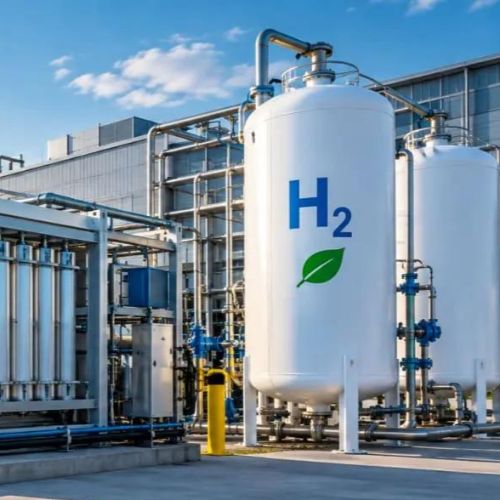
India could become the world’s largest producer and exporter of green hydrogen, Union Minister for Road Transport and Highways Nitin Gadkari said on 23 October, outlining the potential role of hydrogen and other alternative fuels in the country’s future transport and industrial energy mix.
Speaking at KPMG’s Agrasar Bharat Manch, Gadkari said hydrogen would eventually replace fossil fuels as a primary energy source for mobility and industry. He also highlighted electric vehicles, ethanol, methanol, biodiesel and liquefied natural gas (LNG) as technologies being developed to diversify energy use.
The remarks come as India advances its National Green Hydrogen Mission, launched in January 2023. The programme targets at least 5 million metric tonnes (MMT) of annual green hydrogen production by 2030, alongside more than ₹8 lakh crore in investment and the creation of over 600,000 jobs. These are mission targets, rather than achieved outcomes.
National Green Hydrogen Mission Sets 2030 Target
The National Green Hydrogen Mission is intended to establish India as a global hub for green hydrogen production, use and exports. Its scope includes incentives for electrolyser manufacturing and hydrogen production, pilot projects, infrastructure development and the creation of green hydrogen hubs.
Green hydrogen is generally produced by splitting water through electrolysis powered by renewable electricity. It is being developed as a potential lower-emissions fuel and industrial feedstock in sectors where direct electrification can be difficult, including refining, fertilisers, steel and some transport applications.
The government has also supported domestic electrolyser manufacturing and green hydrogen production through its Strategic Interventions for Green Hydrogen Transition (SIGHT) programme. In February 2026, the Ministry of New and Renewable Energy reported that 15 companies had been awarded a combined 3,000 MW per year of electrolyser manufacturing capacity, while 18 companies had been awarded a cumulative green hydrogen production capacity of 862,000 tonnes per year.
These allocations indicate planned capacity supported through the mission; they should not be confused with actual annual production. Meeting the 2030 target will depend on project execution, renewable electricity availability, infrastructure, demand and the cost of producing and transporting hydrogen.
Gadkari Highlights Alternative Fuels and Battery Costs
Gadkari said India was developing several technologies to reduce reliance on conventional fuels, including electric vehicles, ethanol, methanol, biodiesel, LNG and hydrogen.
He also cited a decline in lithium-ion battery costs from US$150 per kilowatt-hour to US$50 per kilowatt-hour to illustrate the importance of technology development. The figures were part of his remarks and were not presented as a new, independently verified market-price assessment.
For the transport sector, the range of technologies under development reflects different potential pathways for reducing emissions. Electrification is relevant to many road-transport applications, while liquid biofuels can be blended with or used in suitable existing engine systems. Hydrogen may have a role in selected heavy-duty transport and industrial uses, depending on infrastructure, vehicle technology and economics.
Each pathway has different requirements for production, storage, distribution and end-use equipment. Their commercial prospects will depend on cost, operational performance and the availability of suitable supply chains.
Logistics Costs and Infrastructure in Focus
Gadkari also linked infrastructure development to India’s export competitiveness, saying improvements in roads had reduced logistics costs from 15% to 9%. He argued that lower costs would support the movement of goods and improve the country’s position in international trade.
India’s Department for Promotion of Industry and Internal Trade (DPIIT), drawing on an assessment prepared by the National Council of Applied Economic Research, estimated logistics costs at ₹24.01 lakh crore in 2023–24. This represented 7.97% of GDP and 9.09% of non-services output. The measures use different denominators, so they should not be treated as interchangeable with the minister’s statement.
Gadkari also discussed the Sagarmala programme, which focuses on port-led development. According to his remarks, projects worth ₹16 lakh crore had been planned by leveraging the financial position of India’s 12 major ports, and work worth more than ₹13 lakh crore had been completed.
Ports, roads, freight corridors and other logistics infrastructure can influence the competitiveness of energy-related exports. For green hydrogen and its derivatives, export development will also require suitable production facilities, renewable power, storage and handling systems, and access to ports and international buyers.
Bioenergy Business Analysis
Gadkari’s remarks place green hydrogen within a wider energy-transition strategy that also includes biofuels, electrification and infrastructure investment. For India’s bioenergy sector, the reference to ethanol, methanol and biodiesel reinforces that alternative fuels are being considered alongside hydrogen rather than as a single replacement pathway.
The National Green Hydrogen Mission provides a measurable 2030 ambition, but production targets and announced capacity do not by themselves establish that India will become the world’s leading producer or exporter. That outcome will depend on the pace of project commissioning, delivered hydrogen costs, domestic demand, export contracts and competition from other producing regions.
Logistics infrastructure is another relevant factor. Efficient freight and port systems could support exports of fuels and energy-intensive products, but hydrogen and its derivatives have distinct storage, transport and handling requirements. Lower general logistics costs alone will not guarantee commercially competitive hydrogen exports.
For Bioenergy Business readers, the key developments to monitor are actual green hydrogen production, electrolyser deployment, industrial offtake agreements, progress in biofuel adoption and infrastructure investment. These indicators will provide a clearer measure of implementation than broad projections about future global leadership.