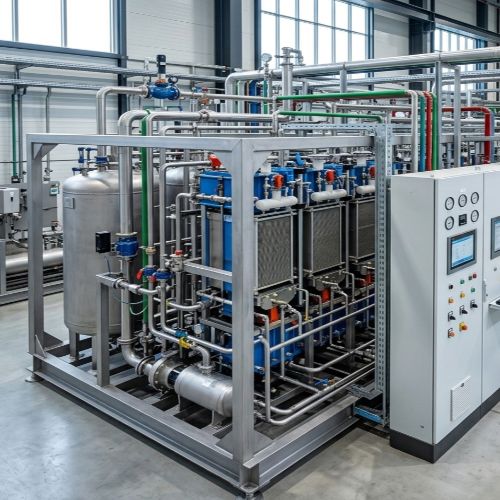
Researchers at the Korea Advanced Institute of Science and Technology (KAIST) have developed a ruthenium-based catalyst designed to improve hydrogen production while reducing reliance on expensive precious metals. The catalyst achieved performance comparable to a commercial platinum catalyst in water electrolysis testing, using 75% less precious metal.
The development could help address one of the cost challenges associated with green hydrogen production: the use of precious-metal catalysts in electrolysers. However, further validation at larger scales and over longer operating periods will be needed to establish its commercial potential.
According to a report published by Mirage News, KAIST announced the development on October 28. The research team was led by Professor Jinwoo Lee of the university’s Department of Chemical and Biomolecular Engineering, in collaboration with researchers from KAIST, Konkuk University, the Korea Basic Science Institute (KBSI) and the Korea Research Institute of Chemical Technology (KRICT).
Ruthenium catalyst uses an atom-layer structure
The research centres on an “atom-layer neighbor” structure that arranges small groups of three or four ruthenium atoms in a layer just one atom thick. The design aims to make more effective use of the precious metal while allowing neighbouring atoms to cooperate during the hydrogen-producing reaction.
Conventional precious-metal nanoparticle catalysts contain clusters of atoms, including atoms buried inside the particles that may contribute little to the reaction. Although single-atom catalysts can improve metal utilisation by dispersing individual atoms across a support, isolating the atoms can limit reactions that require multiple atoms to work together.
The KAIST team sought to combine the advantages of both approaches by keeping small groups of ruthenium atoms close enough to cooperate without allowing them to aggregate into larger particles.
To stabilise the structure, the researchers used molecular interactions during catalyst synthesis to limit aggregation. Subsequent heat treatment strengthened the interaction between the metal and a tungsten carbide (WCₓ) support, helping anchor the ruthenium atoms in place.
The team also varied the number of atoms in each group to identify a configuration suited to hydrogen production.
Surface chemistry supports faster hydrogen production
Beyond the arrangement of ruthenium atoms, the researchers optimised the chemical environment surrounding the catalyst’s active sites.
Hydroxyl species (OH) on the support surface strengthened hydrogen-bond networks among water molecules, facilitating proton transfer. This approach combined control over the active metal structure with adjustments to the surrounding water environment to support the electrochemical reaction.
The findings highlight how catalyst performance can depend not only on the choice of metal but also on the arrangement of its atoms and their interactions with the support and surrounding molecules.
Catalyst performance compared with commercial platinum
The team evaluated the catalyst in an anion-exchange membrane water electrolyser (AEMWE) cell. At 2.0 volts and 80°C, it achieved a reported current density of 9.82 amperes per square centimetre (A/cm²).
Current density measures the electrical current flowing per unit of electrode area and is used to assess electrolyser performance under specified operating conditions.
According to the reported results, the ruthenium catalyst delivered performance comparable to a commercial platinum catalyst while using 75% less precious metal. Its catalytic activity per unit mass of precious metal was approximately four times that of the platinum comparator.
The researchers also assessed durability through a 500-hour continuous-operation test. Over that period, the ruthenium catalyst’s performance loss was approximately half that recorded for the platinum catalyst used in the comparison.
These results indicate that the material could combine high catalytic activity with reduced precious-metal requirements and promising stability under the tested conditions. They do not, on their own, establish long-term performance under commercial operating conditions.
Implications for green hydrogen costs
Water electrolysis splits water into hydrogen and oxygen using electricity. When powered by renewable sources such as wind and solar, it can produce green hydrogen with low operational carbon emissions, depending on the electricity supply and wider system conditions.
Catalyst costs and material utilisation are relevant to the economics of electrolyser equipment. A catalyst that maintains performance while using less precious metal could potentially reduce material requirements and, if proven commercially, contribute to lower equipment, replacement and maintenance costs.
The practical impact will depend on factors including catalyst manufacturing costs, durability beyond the 500-hour test, performance at larger scales and compatibility with commercial electrolyser systems. The research team notes that further scale-up and longer-term validation are needed before the technology’s contribution to green hydrogen costs can be established.
Research findings published in Nature Communications
Research Professor Seongbeen Kim, a co-first author of the study, said the team brought small groups of precious-metal atoms together and optimised the surrounding environment for water reactions to enable efficient and sustained hydrogen production using a limited quantity of precious metal.
He said the researchers hope the findings will help reduce precious-metal use in hydrogen production equipment and inform the development of other catalysts.
Professor Kim, KAIST researchers Hyunwoo Jun and Jihye Park, and Dr Sungjun Kim of KRICT contributed as co-first authors.
The study, titled “Stabilizing ruthenium atom layer neighbors through molecular and metal support interactions for water electrolyzers,” was published online in Nature Communications on September 22, 2026, as Volume 17, Article 11021.
The research was supported by grants from South Korea’s National Research Foundation, funded by the Ministry of Science and ICT, and by the Basic Science Research Program of the Korea Basic Science Institute.
Bioenergy Business Analysis
The KAIST study addresses an important materials challenge in green hydrogen production: improving the use of expensive metals without sacrificing catalytic performance. Its atom-layer approach is designed to balance two competing requirements—making more metal atoms available for reactions while keeping neighbouring atoms close enough to work together.
The reported platinum-comparable performance, lower precious-metal use and 500-hour durability results are promising laboratory findings. The next step is to determine whether the catalyst can maintain these advantages through extended operation, larger-scale manufacturing and testing in commercially relevant electrolyser systems.
For the green hydrogen sector, reducing precious-metal intensity could become one part of improving electrolyser economics. The technology’s eventual significance will depend on whether its laboratory performance translates into reliable operation and measurable cost savings at scale.
Source credit: This article is based on research information reported by Mirage News and the study published in Nature Communications.
Related: KIMM showcases ammonia power generation and seawater carbon capture technologies