


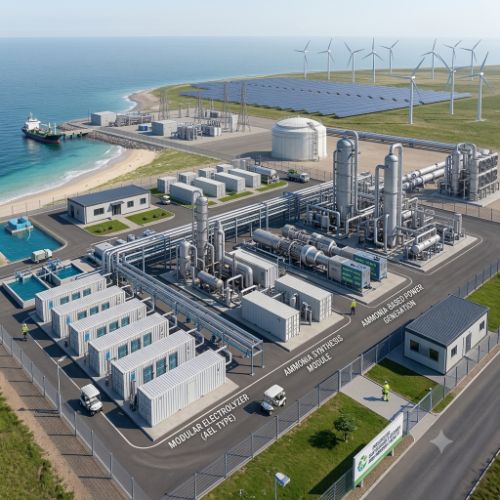
The Korea Institute of Machinery & Materials (KIMM) has showcased a portfolio of energy technologies spanning ammonia-based power generation, hydrogen production, carbon capture from seawater and artificial intelligence (AI)-enabled equipment management at Smart Energy Plus 2026 in Seoul.
The technologies were displayed on October 28 at COEX in Samsung-dong, Seoul, highlighting research aimed at improving energy system efficiency and developing alternatives to conventional fossil-fuel-based technologies.
Among the exhibits were a high-temperature ammonia fuel cell system, a solid oxide electrolysis (SOEC) system for hydrogen production, an electrochemical process to recover dissolved carbon dioxide from seawater, and AI-based tools for diagnosing equipment faults and predicting operational lifespan.
KIMM also presented integrated energy systems designed to supply electricity, heating and cooling for applications including agricultural facilities.
KIMM advances ammonia-based power generation
Ammonia is attracting interest as an energy carrier because it can be stored and transported more easily than hydrogen under certain conditions. It can also serve as a fuel for power-generation technologies, although its wider adoption depends on factors including production emissions, conversion efficiency, infrastructure and emissions control.
At the exhibition, KIMM displayed a model of a solid oxide fuel cell (SOFC) system designed to generate electricity using ammonia. The model illustrated the system’s components, from the fuel supply section to the fuel cell stack, alongside a representation of the wider ammonia supply chain.
According to the institute’s reported results, KIMM has completed more than 100 hours of long-term evaluation of a 1-kilowatt (kW)-class high-temperature fuel cell stack. An integrated system rated at 1.5 kW recorded an efficiency of 48% and completed more than 150 hours of operational evaluation.
The technology is designed to generate electricity using ammonia directly or after reforming it into a hydrogen-rich fuel.
KIMM is also researching low-temperature ammonia fuel cells intended to use ammonia directly and reduce system size compared with conventional hydrogen fuel cell configurations. The institute additionally presented electrochemical ammonia compression technology designed to operate without mechanical drive components, potentially reducing noise and vibration.
Solid oxide electrolysis system records 5,000 hours of operation
KIMM also exhibited a 20 kW-class solid oxide electrolysis (SOEC) system designed to produce hydrogen by electrolysing high-temperature steam.
SOEC technology operates at elevated temperatures, allowing heat to contribute to the electrolysis process. Its overall efficiency and emissions profile depend on the source of electricity and heat, system design and operating conditions.
The institute reported completing more than 5,000 hours of demonstration operation with its system. Extended operating data are important for evaluating performance degradation, component durability and maintenance requirements—factors that can influence the commercial viability of electrolysers.
The reported demonstration period represents progress in operational testing, although it does not by itself establish commercial-scale readiness or long-term performance over the full operating life of an industrial installation.
Electrochemical technology targets carbon dioxide in seawater
Another technology featured at the exhibition is designed to capture carbon dioxide dissolved in seawater through electrochemical reactions.
The process separates and recovers carbon from seawater, with KIMM also pursuing research into technologies that could use the recovered carbon to produce fuels.
Carbon dioxide removal from seawater is an emerging research area that could potentially support carbon management by drawing on the exchange of carbon between seawater and the atmosphere. Its climate benefits, however, depend on factors such as energy consumption, process efficiency, the fate of the recovered carbon and the effects of the process on seawater chemistry.
The exhibition material did not provide detailed figures for capture capacity, energy consumption, costs or the lifecycle emissions associated with the technology. Those metrics will be important in determining its potential for deployment beyond demonstration settings.
AI-based diagnostics target equipment downtime
KIMM also presented an AI-based equipment management technology that analyses operating data from fuel cell and electrolysis systems to identify faults and predict equipment lifespan.
The institute reported a fault diagnosis rate of 98.6%, using 5,000 hours of demonstration data from solid oxide electrolysis systems.
The technology is intended to identify equipment problems before they lead to failures, helping operators plan maintenance and reduce unplanned downtime. Predictive maintenance can be particularly relevant for energy systems that operate continuously or contain components exposed to high temperatures and demanding operating conditions.
However, the reported diagnostic rate alone does not establish performance across all operating environments. Additional information about the testing methodology, types of faults, false alarms and validation on independent operating data would help assess its practical value.
Integrated energy systems target agricultural applications
Beyond individual energy technologies, KIMM showcased a system combining fuel cells, heat pumps, solar thermal energy and absorption chillers to provide electricity, heating and cooling.
The institute said the integrated system had been demonstrated in a smart greenhouse in the Jeonju region, where it supplies energy for agricultural operations and aims to improve efficiency.
Combining multiple energy technologies can help coordinate electricity, heating and cooling demands. The practical benefits depend on local energy requirements, seasonal conditions, equipment performance and the costs of installation and operation.
For agricultural facilities, integrated systems could offer a way to manage different energy loads together rather than relying on separate equipment for each requirement. The scale of potential savings would need to be established through detailed operating data.
Bioenergy Business Analysis
KIMM’s exhibition highlights how research into next-generation energy systems is expanding beyond hydrogen production to include ammonia conversion, carbon management, equipment diagnostics and integrated energy services.
The reported operating periods for its 1 kW-class fuel cell stack and 20 kW-class SOEC system provide useful indicators of testing progress. Meanwhile, the seawater carbon capture technology and AI-based diagnostics address two different challenges in the energy transition: developing new carbon-management pathways and improving the reliability of energy equipment.
The key next steps are to establish performance under extended operating conditions, disclose system-level energy and cost data, and demonstrate whether the technologies can scale economically. Such evidence will help determine which developments can move from research and demonstration towards commercial deployment.
Related: KAIST develops ruthenium catalyst matching platinum performance for hydrogen production


