


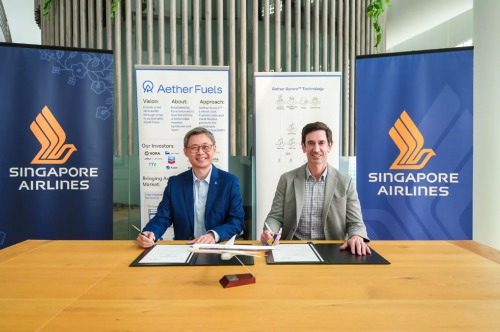
Singapore Airlines (SIA) has signed an agreement to purchase up to 4,800 tonnes of sustainable aviation fuel (SAF) from Aether Fuels over three years, with deliveries scheduled to begin in 2028. The fuel will be produced at Project Beacon, Aether’s planned commercial production facility at Aster’s refining complex on Pulau Bukom, Singapore.
The agreement makes SIA the first airline to purchase SAF from Project Beacon and marks its first procurement of aviation fuel produced using a technology designed to convert waste-carbon feedstocks into liquid fuel, according to the companies’ announcement.
The fuel will be produced using feedstocks including biomethane and industrial waste gases, processed through Aether’s proprietary Aurora technology. The agreement also signals prospective demand for alternative SAF production pathways as Singapore seeks to expand its lower-carbon fuel capabilities.
Project Beacon targets waste-carbon-to-SAF production
Project Beacon is being developed at Aster’s refining complex on Pulau Bukom. Its production pathway is designed to convert waste-derived gases into liquid aviation fuel using a process based on the Fischer–Tropsch synthesis route.
The approach differs from the hydroprocessed esters and fatty acids (HEFA) pathway, which uses lipid-based feedstocks such as waste oils and fats. By targeting biomethane and industrial waste gases, Aether aims to broaden the range of carbon sources that can be used to produce SAF.
The fuel supplied under the agreement is expected to be certified under the Carbon Offsetting and Reduction Scheme for International Aviation (CORSIA), the International Civil Aviation Organization’s framework for addressing international aviation emissions.
Actual lifecycle emissions reductions will depend on feedstock origin, production energy, processing efficiency and the applicable sustainability accounting methodology. Certification and compliance details will therefore be important in assessing the fuel’s environmental performance.
Deliveries scheduled to begin in 2028
Under the agreement, SIA will receive up to 4,800 tonnes of SAF over three years, beginning in 2028. The announcement does not specify the annual delivery schedule or the financial terms of the offtake agreement.
Aether plans to expand its production capacity beyond Project Beacon. The company intends to start up a large-scale commercial plant by 2031, with planned capacity at least 10 times that of Beacon. The announcement does not provide a specific annual output figure for either facility.
The proposed expansion will be important in determining whether the technology can progress from an initial commercial facility to larger-scale production. Feedstock availability, plant performance, production costs and access to long-term buyers will all influence the pathway’s commercial development.
Singapore Airlines links SAF procurement to its 2050 climate goal
Lee Wen Fen, chief sustainability officer of Singapore Airlines, said securing future SAF supplies is an important part of the airline’s ambition to achieve net-zero carbon emissions by 2050.
“Supporting the development and adoption of SAF, and securing future supplies, are integral to SIA’s ambition of achieving net zero carbon emissions by 2050,” Lee said.
She added that SIA’s purchase from Project Beacon demonstrates demand for emerging lower-carbon fuel production pathways in Singapore. The airline intends to continue working with global partners to expand SAF production and support aviation’s transition to lower-carbon operations.
Aether says agreement strengthens commercial demand
Conor Madigan, co-founder and chief executive officer of Aether Fuels, said the agreement builds on the company’s earlier memorandum of understanding with Singapore Airlines. Since that announcement, Aether has selected Singapore for its first commercial facility and developed partnerships across the local value chain.
Madigan said: “This binding agreement is an important next step and a strong signal of committed demand from a leading global airline – exactly the type of collaboration needed to create the commercial conditions to bring new SAF pathways to scale.”
The company views airline offtake commitments as an important part of developing a market for fuels produced through emerging technologies. Long-term purchasing agreements can provide producers with greater visibility into prospective demand, although commercial viability will also depend on production costs, financing and the ability to deliver fuel at the required scale.
Bioenergy Business Analysis
The SIA–Aether agreement brings together an airline buyer and a producer developing a waste-carbon-based route to SAF. Its significance lies in the potential to expand feedstock options beyond the lipid-based materials used in conventional HEFA production.
Using biomethane and industrial waste gases could create additional pathways for converting carbon-containing resources into aviation fuel. However, the environmental and commercial performance of this route will depend on where the feedstocks originate, how they are processed, the energy used in production and the lifecycle emissions of the resulting fuel.
The offtake volume—up to 4,800 tonnes over three years—is an initial commercial commitment rather than evidence of large-scale market deployment. Aether’s planned expansion by 2031 will be a key milestone, but the company will need to demonstrate reliable production, competitive economics and compliance with relevant fuel and sustainability standards.
For Singapore, Project Beacon also connects SAF production with an established refining and aviation ecosystem. The longer-term opportunity will depend on whether this infrastructure, combined with dependable feedstock supplies and airline demand, can support repeatable production at larger scale.


