


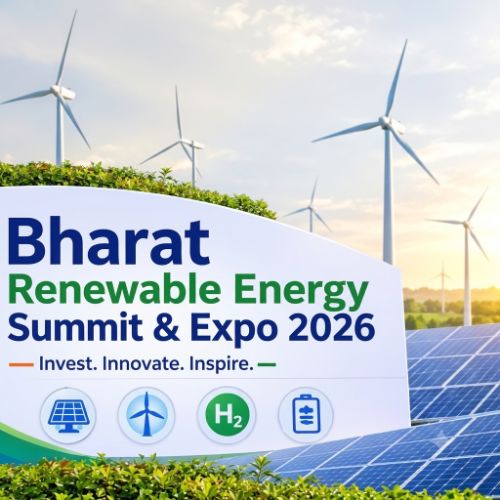
Prime Minister Narendra Modi is scheduled to inaugurate the Bharat Renewable Energy Summit & Expo (BRESE) 2026 on November 2 at Bharat Mandapam in New Delhi, bringing together international policymakers, investors, technology providers and industry leaders to discuss investment and collaboration across the clean energy sector.
Organised by the Ministry of New and Renewable Energy (MNRE), the four-day event will run from November 2 to 5 under the theme ‘Invest. Innovate. Inspire.’ The summit is expected to attract participants from more than 130 countries, including over 40 ministers, alongside representatives of financial institutions, renewable energy companies and multilateral organisations.
The event will provide a platform for discussions on renewable energy deployment, technology development, financing and international partnerships as India advances its target of achieving 500 GW of installed non-fossil fuel capacity by 2030.
Bharat RE 2026 to Bring Together Global Renewable Energy Stakeholders
The summit will feature participation from nine international country partners: Australia, Denmark, the European Union, France, Germany, the Netherlands, Norway, Sweden and the United Kingdom.
Thirteen Indian states and Union Territories will also showcase their renewable energy potential, manufacturing capabilities, policy initiatives and investment opportunities. These include Andhra Pradesh, Assam, Bihar, Chhattisgarh, Delhi, Gujarat, Karnataka, Madhya Pradesh, Maharashtra, Odisha, Rajasthan, Uttar Pradesh and West Bengal.
The programme is expected to include high-level plenary sessions, ministerial discussions, chief executive officer roundtables and country- and state-specific sessions. Business-to-business (B2B), business-to-government (B2G) and government-to-government (G2G) engagements will also facilitate discussions around project development, investment opportunities and technology partnerships.
Three Major Clean Energy Platforms to Convene Under One Programme
Bharat RE 2026 will take place alongside two other international renewable energy events: the 9th Session of the International Solar Alliance (ISA) Assembly and the 4th International Conference on Green Hydrogen (ICGH).
The three platforms will address different areas of the energy transition:
- Bharat Renewable Energy Summit & Expo: Investment mobilisation, clean energy technologies, manufacturing and international industry partnerships.
- International Solar Alliance Assembly: International cooperation on solar energy deployment, financing and institutional capacity building.
- International Conference on Green Hydrogen: Green hydrogen technologies, investment opportunities and commercial scale-up.
The combined programme is expected to facilitate discussions across renewable energy financing, technology development and international cooperation, bringing together government representatives, companies and investors.
Expo to Feature More Than 400 Renewable Energy Exhibitors
The accompanying exhibition will feature more than 400 exhibitors, including manufacturers, project developers, technology providers, startups and research institutions from India and overseas.
The event will also provide opportunities for companies to explore business partnerships, investment prospects and technology collaborations.
Additional activities will include the Bharat Renewable Energy Hackathon 2026, which brought together students, startups and researchers to develop solutions to ten renewable energy challenges. The RE National Renewable Energy Quiz 2026 will conclude with its national-level finale at Bharat Mandapam, while the REGen Pavilion will provide a platform for young innovators, entrepreneurs and researchers to present their ideas. Press Information Bureau
India Targets 500 GW of Non-Fossil Fuel Capacity by 2030
The summit comes as India continues to expand its non-fossil fuel electricity capacity and attract investment into renewable energy infrastructure.
According to the Ministry of New and Renewable Energy, India had 308 GW of installed non-fossil fuel capacity at the time of its October 28, 2026 announcement. The country is targeting 500 GW of installed non-fossil fuel capacity by 2030.
MNRE Secretary Santosh Sarangi stated that achieving this target would require approximately US$220 billion in investment between 2027 and 2030.
He also highlighted the need for accelerated deployment of energy storage, stronger transmission infrastructure and expanded domestic manufacturing to support the next phase of the transition.
The ministry further reported that India invested US$63.7 billion in its renewable energy sector between July 2024 and June 2026, citing BloombergNEF.
These investment requirements are expected to form an important part of the discussions at Bharat RE 2026, particularly around project financing, technology partnerships and infrastructure development.
Bioenergy Business Analysis
Bharat Renewable Energy Summit & Expo 2026 comes at a time when India’s clean energy transition is increasingly shaped by the need to connect renewable energy deployment with financing, manufacturing and supporting infrastructure.
The summit’s significance extends beyond the scale of international participation. Its combination of investment discussions, technology exhibitions and government-to-industry engagements provides an opportunity to address some of the practical requirements of expanding clean energy capacity.
For India’s bioenergy industry, the wider investment discussions are relevant to the development of integrated renewable energy systems, particularly where organic waste management, renewable gas production and industrial energy demand intersect.
The summit’s eventual industry value will depend on whether discussions translate into identifiable investments, technology agreements, project partnerships and financing commitments. Announced participation and exhibition numbers alone will not establish the scale of commercial outcomes.
Bharat RE 2026 therefore provides a platform to assess how India’s renewable energy ambitions can be translated into bankable projects, stronger domestic supply chains and greater international technology cooperation.



