


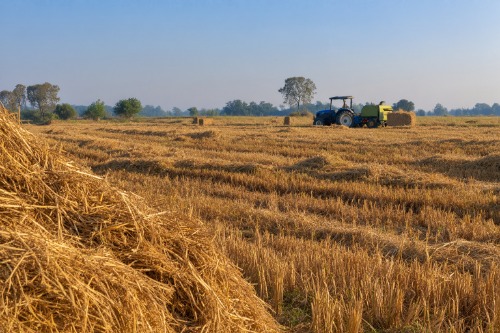
Punjab has submitted an 85-page five-year roadmap to the Commission for Air Quality Management (CAQM) aimed at achieving zero stubble burning by 2030, combining crop diversification, expanded crop residue management, biomass industrial parks and new compressed biogas (CBG) capacity.
The plan, prepared by the Punjab Pollution Control Board (PPCB), sets out short-term measures for the current kharif season alongside a longer-term strategy for 2026-30 covering both in-situ and ex-situ management of paddy straw. Hindustan Times reported that the roadmap was submitted to CAQM and is intended to strengthen the institutional and industrial infrastructure for managing crop residue.
Punjab expects to generate 18.81 lakh metric tonnes of paddy straw from around 31 lakh hectares under paddy cultivation this season, making the development of economically viable routes for collecting and using the residue a central element of the strategy.
Punjab Plans to Reduce Paddy Area by 7 Lakh Hectares
The roadmap proposes crop diversification as one of the structural measures for reducing the volume of paddy residue generated each year.
The state aims to reduce paddy acreage by 7 lakh hectares, while encouraging alternative crops and developing agricultural systems that can reduce dependence on paddy cultivation.
The strategy also proposes the development of next-generation, low-cost crop residue management (CRM) machinery designed for small and fragmented farms, where conventional machinery can face operational and economic constraints.
For in-situ management, the plan targets sustained availability of CRM equipment in proportion to the state’s paddy-growing area by 2030.
According to the roadmap, 1,58,898 subsidised machines are currently being used to integrate around 10.15 lakh tonnes of straw into the soil.
Biomass Industrial Parks and CBG Plants to Expand Ex-Situ Management
A major component of Punjab’s strategy is to create additional industrial demand for paddy straw rather than leaving farmers dependent on field burning as a rapid disposal method.
The plan proposes establishing biomass industrial parks equipped with common boilers, alongside additional CBG plants capable of using paddy straw as feedstock.
The government aims to develop CBG capacity capable of consuming 10-12 lakh tonnes of paddy straw within three to five years.
Punjab currently has six operational CBG projects with combined capacity of 107 tonnes per day, while another five projects totalling 37.5 tonnes per day are expected to be commissioned during the current financial year.
A further 46 CBG projects, including projects allocated to GAIL, HPCL and BPCL, are at different stages of execution or pre-construction clearances. The roadmap expects these projects to be commissioned over the next two to three years.
According to the plan, once commissioned, these projects are expected to consume approximately 2.80 million tonnes of paddy straw annually.
Pellet Capacity to Supply Thermal Power and Industry
Pelletisation is another route identified in the roadmap for absorbing surplus agricultural residue.
Punjab plans to increase pellet-production capacity to utilise 25-30 lakh tonnes of paddy straw in thermal power plants, brick kilns and industries.
The strategy also targets the use of approximately 6 million tonnes of straw in industrial boilers, creating another large-scale outlet for material that might otherwise be burned in fields.
Permanent bale-storage depots are also proposed across the state to address one of the logistical challenges associated with seasonal straw availability.
These storage facilities could help create a more consistent supply chain between the short harvesting window and industries that require biomass feedstock throughout the year.
Government Seeks Stronger Economics for Paddy Straw
The roadmap identifies the economic value of paddy straw as an important factor in achieving sustained reductions in field burning.
A senior state official cited by Hindustan Times said stronger mechanisms were needed to make paddy straw a resource and remunerative material for farmers. The official also called for central-government policy interventions and financial support, including viability-gap funding for biomass power plants and measures to address impediments affecting upcoming CBG projects.
The approach therefore combines agricultural policy with industrial utilisation, with the objective of creating outlets for straw while improving the economics of residue collection.
Punjab Reports Sharp Reduction in Stubble Fires
The roadmap comes after a significant decline in reported stubble-burning incidents in Punjab.
As per Hindustan Times report, the state recorded 5,114 stubble-fire cases in 2025, compared with 10,909 in 2024, representing a 54% reduction.
The state is nevertheless seeking a longer-term structural change rather than relying only on annual enforcement and machinery distribution.
The roadmap’s 2030 target combines changes in cropping patterns with permanent biomass supply-chain infrastructure and additional industrial demand for agricultural residue.
Recent measures have also included further deployment of CRM machinery. Hindustan Times reported in August that Punjab planned to provide 22,500 additional crop-residue management machines at subsidised rates for in-situ and ex-situ management.
Biomass Supply Chain Becomes Central to 2030 Strategy
The proposed biomass parks, CBG projects, pellet facilities and bale-storage depots collectively point towards a more integrated residue-management system.
Instead of treating paddy straw primarily as a seasonal waste-management problem, the roadmap seeks to establish multiple end-use markets covering biogas, biomass fuels, industrial boilers and thermal power generation.
The scale of the proposed CBG and pelletisation programmes also means that collection, baling, storage and transportation infrastructure will need to develop alongside processing capacity.
Bioenergy Business Analysis
Punjab’s 2030 roadmap places industrial utilisation of paddy straw alongside crop diversification and in-situ management, potentially shifting part of the state’s residue challenge towards a biomass supply-chain model. The planned CBG expansion is particularly significant, with projects at various stages potentially creating substantial additional demand for agricultural residue.
The central challenge will be converting seasonal paddy straw availability into a reliable and remunerative year-round feedstock. Permanent storage, transport infrastructure, machinery suited to fragmented farms and viable economics for biomass and CBG projects will all influence how much of the proposed capacity translates into actual residue utilisation.
The roadmap establishes the targets and infrastructure priorities; achieving zero stubble burning by 2030 will depend on implementation across these interconnected areas.
Read also: Seras expands UK waste wood operations with Enva acquisition