Union Minister for Road Transport and Highways Nitin Gadkari has called for greater integration of agriculture with India’s energy and power sectors, highlighting the role of ethanol, compressed biogas (CBG), green hydrogen and bio-bitumen in reducing the country’s dependence on imported fossil fuels.
Speaking at the inauguration of the Enrich 2026 Experience Zone at KPMG’s Energy and Resources Forum in New Delhi on November 2, Gadkari said India’s fossil fuel imports cost approximately ₹22 lakh crore. He argued that greater use of domestically produced alternative fuels could strengthen energy security while creating additional income opportunities for farmers.
Gadkari said India’s approach to alternative fuels should prioritise technologies that are import-substituting, cost-effective, pollution-free and indigenous. He also emphasised the need to develop multiple fuel pathways rather than rely on a single alternative energy source.
Ethanol blending and flex-fuel vehicle development
Highlighting progress in ethanol adoption, Gadkari said approximately four crore four-wheelers and 20 crore two-wheelers were using E20 fuel.
He also announced plans to launch a Toyota Innova flex-fuel vehicle capable of operating on 100% bioethanol.
According to the minister, automobile manufacturers including Tata Motors, Mahindra, Toyota, Suzuki and Hyundai are working on flex-fuel vehicle technologies.
He identified corn, broken rice, sugarcane juice, molasses and bamboo as potential feedstocks for ethanol production. Diversifying feedstock sources could broaden the agricultural base supporting India’s biofuel industry.
CBG production and agricultural residue utilisation
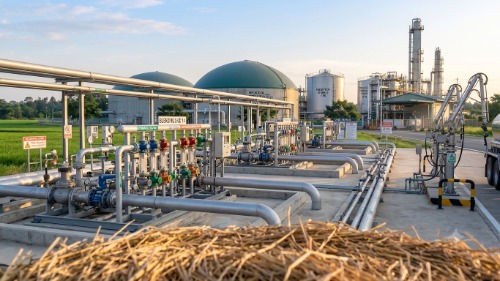
Gadkari also highlighted the potential of agricultural waste, particularly rice straw, as a feedstock for compressed biogas production.
He said approximately 3,000 CBG plants had been registered under the government’s GOBARdhan initiative, of which 280 had commenced operations.
The minister called for greater utilisation of agricultural residues to produce bio-CNG, offering an alternative to the open burning of crop waste.
Expanding the use of agricultural residues for biogas production could support rural waste management while creating additional value from agricultural resources. However, the figures cited by Gadkari indicate a substantial difference between plant registrations and operational facilities.
Green hydrogen cost reduction target
Gadkari also called for increased research and development in green hydrogen, identifying production costs as an important factor affecting wider adoption.
He said the government was working towards reducing green hydrogen production costs from approximately US$5 per kg to US$1 per kg.
The minister further stated that India had received an order to export 500,000 tonnes of hydrogen. The announcement did not identify the buyer, delivery schedule, production source or whether the stated volume relates specifically to green hydrogen.
Achieving lower production costs will be important for improving the competitiveness of hydrogen in industrial and transport applications.
Agricultural residues for bio-bitumen production
Beyond liquid and gaseous fuels, Gadkari highlighted the potential of converting agricultural residues into bio-bitumen for road construction.
He said India consumes approximately 125 lakh tonnes of bitumen annually, with nearly half of its requirement met through imports.
Using agricultural residues to produce bio-based alternatives could create another market for farm waste while supporting efforts to reduce dependence on imported road-construction materials.
The minister linked these opportunities to employment generation in rural and tribal areas, alongside improved utilisation of domestic agricultural resources.
Bioenergy Business Analysis
Gadkari’s remarks point to a broader policy direction in which agriculture could become an important supplier of feedstocks for India’s alternative fuel and materials industries.
Ethanol, CBG and bio-bitumen offer different routes for converting agricultural output and residues into higher-value products. While ethanol production can use crops such as corn and sugarcane, CBG facilities can utilise organic waste and agricultural residues. Bio-bitumen could provide an additional industrial application for biomass.
The gap between the approximately 3,000 CBG plants registered under GOBARdhan and the 280 reported as operational also highlights the importance of moving projects from registration to commissioning and sustained operation.
Related: Toyota to launch 100% bioethanol-powered Innova in India on 26 November, Says Gadkari