


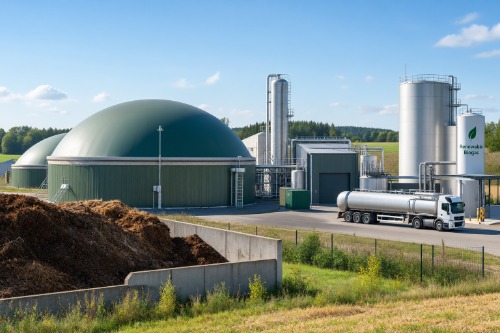
The West Bengal Panchayat Department has partnered with the Council of Scientific and Industrial Research’s Central Mechanical Engineering Research Institute (CMERI) to accelerate the deployment of biogas projects in villages, with a particular focus on using cattle dung and organic waste to produce renewable energy.
The collaboration was discussed at a workshop held at CMERI in Durgapur, attended by Panchayat Department officials and senior representatives from 14 South Bengal Zilla Parishads. The initiative is intended to take the Centre’s GOBARdhan mission to rural communities while promoting domestic biogas use and waste management.
The workshop was chaired by CMERI Director Naresh Chandra Murmu and Abida Sultana, Deputy Secretary of the West Burdwan Zilla Parishad.
CMERI technology centres on cattle dung
CMERI has developed biogas technology that uses cow dung as its primary feedstock. The technology is intended to convert an abundant agricultural and livestock waste stream into biogas that can be used for energy applications.
The West Bengal Panchayat Department and participating Zilla Parishads are looking to place greater emphasis on the use of biogas in households, according to officials involved in the workshop.
Murmu said the participating Zilla Parishads had pledged to give greater attention to domestic biogas use, citing the potential to reduce dependence on LPG while providing access to clean energy.
The initiative also includes a technology-awareness component. Murmu said that, alongside technology transfer, greater emphasis had been suggested on creating awareness about the available technology.
GOBARdhan mission links waste management with rural energy
The proposed expansion aligns with the Centre’s GOBARdhan initiative, which promotes the conversion of cattle dung and other organic waste into useful resources such as biogas and biofertilisers.
For rural communities, decentralised biogas systems can provide a way of addressing two needs simultaneously: managing organic waste and producing energy close to where the feedstock is generated.
The Bengal initiative is therefore centred not only on installing individual biogas units but also on increasing awareness and encouraging wider household adoption across participating rural areas.
The involvement of 14 South Bengal Zilla Parishads provides a potential administrative framework for taking the technology beyond individual demonstration projects and into village-level programmes.
CMERI demonstrates integrated waste-to-energy model
CMERI has already installed a biogas unit as part of its integrated municipal solid waste management system, known as iMSWDS.
The system operates within CMERI’s 250-family residential colony and combines waste segregation, biogas generation and the production of briquettes from slurry. The colony has been described in the supplied source as Bengal’s first zero-waste colony.
According to the source, the system can mechanically segregate 100 kg of waste per hour and produce approximately 20 cubic metres of biogas per day for cooking and power generation.
The system also produces briquettes from the resulting slurry. Together, these processes are intended to reduce waste sent for disposal while lowering the colony’s reliance on LPG.
The CMERI model provides a practical example of how organic waste can be integrated into a local energy system rather than being treated solely as a disposal problem.
Rural biogas could strengthen circular economy approach
The Bengal programme brings together technology transfer, household energy use and organic-waste management under a single rural development framework.
Cow dung is particularly relevant for decentralised biogas because livestock farming generates the feedstock close to rural households and agricultural communities. Processing the material through anaerobic digestion can produce biogas while leaving a nutrient-rich digestate that can have agricultural applications.
The approach also fits within the broader circular-economy concept promoted through GOBARdhan, where waste materials are converted into energy and potentially useful agricultural products.
For the Panchayat Department and Zilla Parishads, the challenge will be translating technology availability into sustained village-level adoption. Awareness, appropriate system sizing, reliable operation and effective management of feedstock and digestate will be important to the long-term performance of decentralised systems.
Bioenergy Business Analysis
The Bengal-CMERI partnership highlights the importance of technology deployment and local awareness in scaling rural biogas. The availability of cow dung as a distributed feedstock gives village-level projects a clear resource base, but widespread adoption depends on whether communities can operate and maintain systems effectively.
CMERI’s own integrated waste-management installation is significant in this context because it demonstrates how biogas can form part of a broader waste-to-energy system rather than functioning as an isolated fuel technology. Its reported combination of waste segregation, biogas production and briquette manufacturing illustrates the potential to extract multiple uses from organic waste streams.
The participation of 14 Zilla Parishads could provide a route for taking this experience into a larger rural programme. The success of the initiative will ultimately depend on how effectively technology transfer and awareness efforts translate into functioning household and community-scale biogas systems.
Read also: IOAGPL signs first tripartite CBG agreement in Kerala with GAIL and BPWSPL