


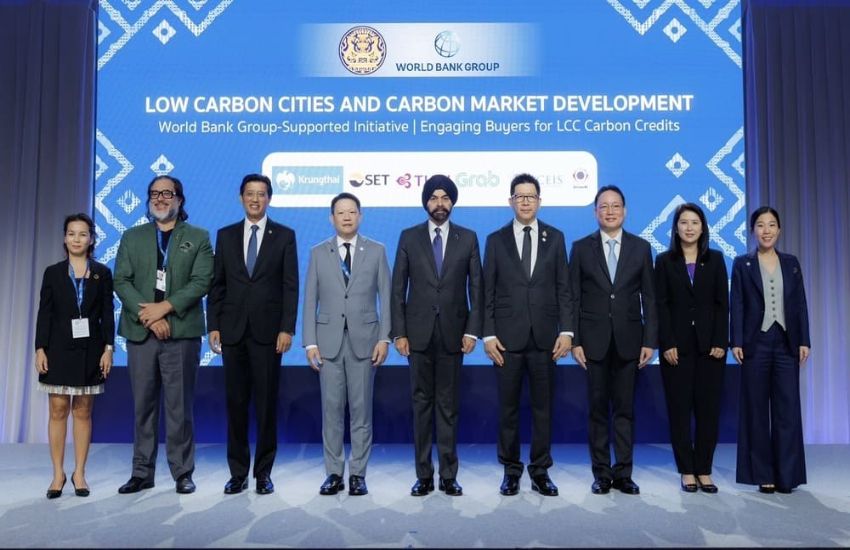
Krungthai Bank and the Stock Exchange of Thailand (SET) are working with Grab, Thai Airways, ACEIS Electric and Power, and DriverAI to develop a carbon credit market under Thailand’s World Bank-supported Low Carbon Cities and Carbon Market Development Project (LCC).
The collaboration aims to connect eligible carbon-credit projects with corporate buyers through a transparent auction and price-discovery mechanism. The partnership was announced on 4 November 2026 during the 2026 IMF–World Bank Group Annual Meetings.
Under the arrangement, Krungthai will aggregate eligible carbon credits from smaller projects and connect them with prospective buyers. SET will develop the auction platform and a mechanism for transparent price discovery.
Grab, Thai Airways, ACEIS Electric and Power, and DriverAI have expressed interest in participating as prospective buyers. Their participation is intended to help establish demand for credits generated under the LCC Project. However, the companies have not announced confirmed purchase volumes or completed transactions.
All credits must undergo the applicable validation and verification procedures and be formally issued under relevant standards before they can be sold.
SET targets first carbon credit auctions by Q2 2027
SET President Asadej Kongsiri said the collaboration would bring financial institutions and private-sector participants together to establish market infrastructure linking investment in greenhouse gas emission reductions with corporate demand for carbon credits.
The exchange plans to use its auction platform to support a voluntary carbon credit market open to domestic and international buyers. The first round of auctions is expected to take place by the second quarter of 2027.
SET also intends for the platform to provide a foundation for a future mandatory emissions trading platform under Thailand’s draft Climate Change Act. This would depend on the development and implementation of the relevant legislation.
The initiative forms part of SET’s three-year strategic plan for 2026–2028, which includes developing infrastructure for carbon credit trading.
Krungthai to aggregate credits and develop digital data platform
Krungthai Bank Chief Executive Officer Payong Srivanich said the development of a credible carbon market depended on connecting high-quality projects with genuine buyer demand through transparent market mechanisms.
The bank is working with Thailand’s Department of Climate Change and Environment, SET and private-sector partners to connect projects, data and market infrastructure.
Krungthai is also developing a national digital data platform intended to reduce transaction costs and improve market access for smaller projects. The bank will use a digital measurement, reporting and verification (dMRV) system to strengthen the integrity of project data.
Payong said the objective was to expand the market beyond individual projects, creating a system that could serve businesses nationwide and connect with international markets.
Thai Airways explores CORSIA-eligible carbon credits
Thai Airways has expressed interest in becoming a potential buyer of eligible credits generated under the LCC Project. The airline is also exploring how credits developed through the programme could qualify as CORSIA Eligible Emissions Units (CEEUs) under the International Civil Aviation Organization (ICAO).
Cherdchome Therdsteerasukdi, Thai Airways’ Chief of Finance and Accounting, said the airline was working to advance the possibility of using qualifying credits to offset greenhouse gas emissions from its international aviation operations in the future.
Any such use would depend on the credits meeting the applicable CORSIA eligibility requirements. The announcement does not confirm that credits generated by the LCC Project have already achieved CORSIA eligibility.
Grab said its Green Programme enables users to make voluntary contributions towards carbon credit projects in Thailand and Southeast Asia through rides and orders on its platform. The company said it would explore opportunities to purchase eligible credits from the LCC Project, while continuing to prioritise emissions reductions across its own value chain.
World Bank-backed project targets renewable energy and energy efficiency
The LCC Project is supported by a US$200 million loan from the World Bank Group’s International Bank for Reconstruction and Development (IBRD). The financing is channelled through the Export-Import Bank of Thailand (EXIM Thailand) and backed by a sovereign guarantee from the Thai government.
The project is designed to expand renewable energy and energy-efficiency investments in public assets, including public buildings and industrial estates. EXIM Thailand will provide financing to qualified energy service companies implementing eligible investments.
According to the World Bank, the project is expected to support up to 180 MW of renewable energy capacity and deliver approximately 448 GWh of annual electricity savings.
Krungthai serves as the project’s Coordinating and Managing Entity (CME), supporting the aggregation of smaller projects and the development of carbon credits. The LCC Programme of Activities has been registered with Gold Standard. Individual credits will still need to complete the relevant validation, verification and issuance requirements before they can be sold.
The project is intended to link revenue from carbon credits with investment in clean energy and energy efficiency, providing an additional financial incentive for low-carbon development.
Bioenergy Business Analysis
The collaboration marks a step towards building the market infrastructure needed to connect emissions-reduction projects with corporate demand in Thailand. The planned SET auction platform, alongside Krungthai’s project aggregation and digital monitoring role, could help smaller projects access carbon-credit markets that may otherwise be difficult to navigate.
The prospective interest from Grab, Thai Airways, ACEIS Electric and Power, and DriverAI provides an early indication of potential buyer demand. However, the market’s development will depend on the volume and quality of credits available, the integrity of verification procedures, transparent price discovery and the ability to convert expressions of interest into actual purchases.
The first auction, expected in the second quarter of 2027, will be an important milestone in assessing whether the LCC framework can translate Thailand’s clean-energy and efficiency investments into a functioning carbon-credit market.



