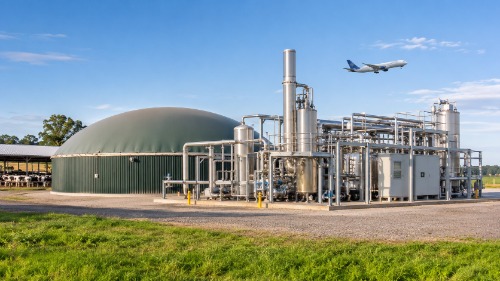
US renewable fuels company Circularity Fuels has raised $7 million in seed funding to advance its technology for converting dairy manure-derived biogas into sustainable aviation fuel (SAF), as it moves towards demonstration-scale operations and commercial plant development.
The funding round was led by Trucks Venture Capital and DCVC, with participation from Sum Ventures and Automotive Ventures. The Redwood City, California-based company said the financing would support an 18-month development programme focused on building and operating a demonstration facility, completing engineering design for a proposed commercial plant with a capacity of 75 barrels per day (bpd), and securing airline fuel supply agreements.
The latest financing brings Circularity Fuels’ total funding to approximately $17 million, including nearly $7 million in grants from organisations such as the US Department of Energy’s Advanced Research Projects Agency–Energy (ARPA-E) and the National Science Foundation (NSF).
Dairy Biogas-to-SAF Technology Moves Towards Demonstration Scale
The funding follows a six-month pilot programme completed in June 2026, during which Circularity Fuels converted raw biogas obtained directly from a dairy farm’s manure digester near Madera, California, into jet fuel.
The company reported that the resulting fuel met the specifications of ASTM D7566 Annex A1, a technical standard covering synthetic paraffinic kerosene produced through the Fischer–Tropsch (FT) process.
According to Circularity Fuels, the pilot demonstrated an integrated conversion pathway using untreated agricultural biogas without first removing its carbon dioxide content. The company described the achievement as the world’s first end-to-end conversion of raw dairy biogas into SAF.
The process combines two proprietary reactors. Its electrified Ouro reforming reactor converts the methane and carbon dioxide in biogas into synthesis gas, or syngas, consisting primarily of carbon monoxide and hydrogen. The Aion reactor then uses Fischer–Tropsch synthesis to convert the syngas into liquid hydrocarbons that can be processed into aviation fuel.
The company plans to use the new capital to establish a demonstration operation capable of producing jet fuel regularly and complete the engineering design for a commercial facility rated at 75 bpd. It will also pursue airline fuel purchase agreements required to support the proposed plant’s development.
Circularity Fuels Targets Commercial Deployment and Technology Licensing
Alongside its plant development plans, Circularity Fuels intends to begin licensing the technology behind its Ouro reactor to third-party partners interested in developing their own biogas-to-fuel facilities.
The company’s modular, skid-mounted system is designed to process biogas at or near agricultural waste sources, potentially allowing dairy operators to convert manure-derived gas into liquid fuels rather than relying exclusively on conventional biogas utilisation routes.
Circularity Fuels projects that the capital cost of its commercial technology could be approximately one-fifth that of jet fuel facilities currently under construction in Europe. This remains a company projection and has not been independently established through comparable project cost data.
The company is also seeking to secure airline fuel supply agreements before proceeding with construction of its proposed commercial facility.
USDA Advances Circularity Fuels’ Loan Guarantee Application
Circularity Fuels has also received a development milestone in its application for support under the US Department of Agriculture’s (USDA) Section 9003 Biorefinery, Renewable Chemical, and Biobased Product Manufacturing Assistance Program.
The company said its application has advanced to Phase 2 of the review process. The federal programme provides loan guarantees to support the development, construction and retrofitting of eligible commercial-scale biorefineries and biobased product manufacturing facilities.
Advancement to Phase 2 does not constitute final loan guarantee approval or confirmation of funding. The USDA’s process requires further technical, financial and environmental documentation before a guarantee can be awarded. Rural Development+1
Dairy Manure Offers an Alternative Feedstock for SAF Production
Circularity Fuels’ approach uses biogas generated through anaerobic digestion of dairy manure, combining agricultural waste management with renewable aviation fuel production.
The company argues that livestock operations represent an underutilised source of biogas feedstock and that modular fuel-production systems could create an additional revenue stream for farmers while providing airlines with an alternative source of jet fuel.
The funding announcement comes as the aviation sector faces pressure to diversify fuel supplies and increase SAF availability. The company’s proposed pathway adds dairy-derived biogas to the range of feedstocks being developed for aviation fuel production, alongside used cooking oil, waste fats, agricultural residues and other renewable carbon sources.
However, the transition from a successful pilot to commercially competitive production will depend on demonstration-scale performance, plant economics, feedstock availability, financing and the establishment of long-term fuel purchase agreements.
Bioenergy Business Analysis
Circularity Fuels’ latest funding round highlights growing investor interest in technologies that connect agricultural waste management with the production of sustainable aviation fuel.
The company’s approach is notable because it uses both the methane and carbon dioxide components of raw dairy biogas as inputs for syngas production. This creates a pathway for converting a distributed agricultural waste resource into liquid hydrocarbons suitable for further processing into aviation fuel.
Unlike conventional large-scale SAF production facilities, the company’s proposed modular approach is intended to operate closer to the feedstock source. If demonstrated at commercial scale, this could offer dairy operators another route to monetise biogas while supporting the development of decentralised renewable fuel production.
Nevertheless, the $7 million financing round represents an early-stage technology development milestone rather than evidence of commercial viability. The next important indicators will be the performance of the demonstration facility, completion of engineering for the proposed 75-bpd plant, airline offtake agreements and progress towards financial close and construction.
For the wider SAF industry, the development is worth following as another attempt to diversify renewable feedstocks and develop new production pathways for aviation fuel.