


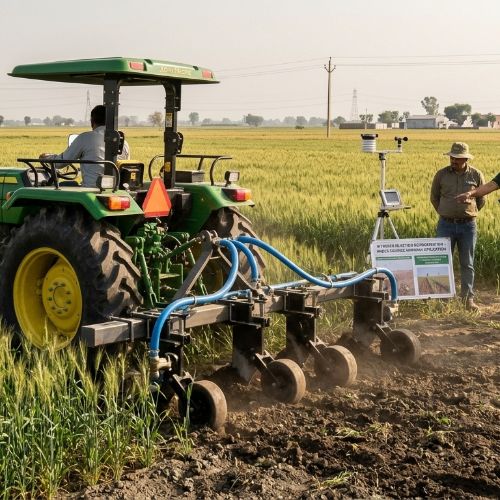
Field demonstrations of green ammonia application in wheat cultivation have begun across approximately 110 acres in Bathinda district, Punjab, as agricultural researchers assess its potential to reduce dependence on conventional urea fertiliser.
The initiative is being conducted by Punjab Agricultural University’s Krishi Vigyan Kendra (KVK), Bathinda, in collaboration with the Indian Council of Agricultural Research’s (ICAR) Agricultural Technology Application Research Institute (ATARI), Zone-I, Ludhiana. The demonstrations began on 2 November 2026 at Mehma Sarkari village, according to The Tribune.
The trials aim to evaluate green ammonia as an alternative nitrogen source for wheat crops, with researchers examining nitrogen-use efficiency, crop growth, yield and soil health. The technology involves injecting ammonia approximately 15 centimetres below the soil surface using specialised application equipment.
The subsurface application method is intended to improve nitrogen availability to crops and limit nutrient losses. Researchers will assess its effectiveness under field conditions before drawing conclusions about its suitability as an alternative to conventional urea-based fertiliser management.
ICAR initiative targets green ammonia demonstrations across India
The Bathinda trials form part of a wider national initiative to evaluate green ammonia as an alternative to nitrogenous fertilisers, including urea.
ICAR launched the National Initiative on Promotion of Green Ammonia as an Alternative to Nitrogenous (Urea) Fertiliser in Punjab on 24 October 2026 at Bijalpur village in Sangrur district.
The programme targets demonstrations across 10,000 acres nationally during the 2026 rabi season. In Punjab, six Krishi Vigyan Kendras in Bathinda, Jalandhar, Moga, Amritsar, Sangrur and Hoshiarpur are scheduled to conduct 300 demonstrations each, taking the planned total to 1,800 demonstrations across the state.
The field programme is designed to generate evidence on the performance of green ammonia under different agricultural conditions. Its findings will help assess the potential of the technology as an alternative nitrogen source and inform future decisions on its wider application.
Researchers assess nitrogen efficiency and soil health
Dr Gurdeep Singh, Deputy Director (Training) at KVK Bathinda, said growing agricultural demand for nitrogen made it necessary to explore alternative approaches to fertiliser management.
He said the institution was conducting research and field demonstrations to assess the potential of supplying nitrogen to crops through green ammonia. The results will help determine whether the technology can reduce farmers’ dependence on urea.
Dr Tejbir Singh Buttar, Assistant Professor of Soil Science at KVK Bathinda, highlighted the importance of balancing crop productivity with soil health and natural resource conservation.
He also briefed farmers on the objectives of the Khet Bachao (Save the Fields) campaign and emphasised maintaining soil fertility through balanced fertiliser application.
Bioenergy Business Analysis
The Bathinda demonstrations bring green ammonia into the discussion on agricultural decarbonisation and alternative fertiliser inputs. Ammonia is a key source of nitrogen in conventional fertilisers, while green ammonia production uses renewable electricity to produce hydrogen through electrolysis and combines it with nitrogen to synthesise ammonia.
For India, evaluating green ammonia in agriculture could create an additional application pathway for renewable hydrogen beyond industrial energy use. However, the potential benefits will depend on the technology’s agronomic performance, production costs, availability of green ammonia and the economics of its application for farmers.
The current Bathinda programme remains at the field-demonstration stage. Its results on crop yields, nitrogen-use efficiency, soil health and application costs will be important in determining whether the technology can become a commercially viable alternative to conventional urea fertilisation.



