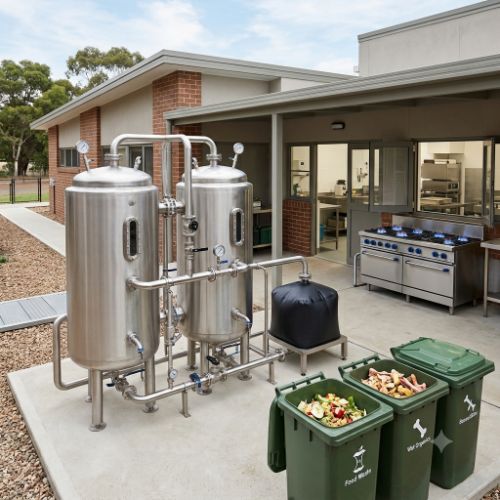
The Malkajgiri Municipal Corporation (MMC) in Telangana has installed a biogas plant to convert food waste collected from hotels near its headquarters into cooking gas for the Indiramma canteen operating on its premises. The facility can process 125 kg of food waste daily, with the resulting gas supplied to the canteen, according to a report published by Deccan Chronicle on 13 November 2026.
The plant also produces liquid organic fertiliser, which is being used for landscaping and horticulture within the municipal premises. The initiative combines decentralised organic waste processing with local energy recovery, creating a use for commercial food waste that would otherwise require collection and disposal. A larger municipal waste-to-fuel proposal in India is GAIL’s Bengaluru compressed biogas project.
The facility was inaugurated on Thursday by MMC Commissioner T. Vinay Krishna Reddy and CSIR-Indian Institute of Chemical Technology (CSIR-IICT) Director Srinivas Reddy. It was established in collaboration with KHAR Energy Optimizers and uses patented Anaerobic Gas Lift Reactor (AGR) technology developed by CSIR-IICT.
MMC biogas plant processes 125 kg of food waste daily
The plant has been designed to process up to 125 kg of food waste per day collected from hotels around the Malkajgiri Municipal Corporation headquarters.
The biogas generated is supplied to the Indiramma canteen, which is operated by women’s self-help groups. This creates a local waste-to-energy arrangement in which discarded food from nearby commercial establishments is converted into fuel for institutional cooking.
According to Deccan Chronicle, the facility can generate biogas equivalent to six commercial LPG cylinders per month. It also produces approximately three kilolitres of liquid organic fertiliser.
The corporation estimates that the initiative could reduce carbon emissions by around 4.5 tonnes per month.
CSIR-IICT’s AGR technology enables organic waste conversion
The facility uses Anaerobic Gas Lift Reactor technology developed by CSIR-IICT. The process converts biodegradable organic material into biogas through anaerobic digestion, in which microorganisms break down organic matter in the absence of oxygen.
The resulting biogas can be used as a cooking fuel, while the residual digestate can be processed and utilised as an organic fertiliser, subject to appropriate handling and quality requirements.
The use of this technology at the Malkajgiri facility demonstrates how municipal bodies can integrate organic waste management with decentralised renewable energy generation.
MMC initiative targets hotels, hospitals and institutions
The Malkajgiri Municipal Corporation expects the installation to serve as a model for other bulk waste generators, including hotels, hospitals, educational institutions and residential welfare associations.
These establishments generate significant quantities of biodegradable waste that can potentially be processed closer to the point of generation, reducing the need for transportation and conventional disposal.
By linking food-waste collection with biogas production and local fuel consumption, the initiative offers a decentralised approach to organic waste management.
The project also demonstrates the potential for municipal institutions to use locally generated renewable gas in their own operations, while recovering organic nutrients for landscaping and horticulture.
Bioenergy Business Analysis
The Malkajgiri project illustrates the practical application of decentralised biogas systems in urban waste management. Instead of treating food waste solely as a disposal challenge, the municipal corporation is using it as a feedstock for local energy production.
Its integration with the Indiramma canteen is particularly relevant because the biogas is consumed close to where it is generated, establishing a direct connection between waste collection, renewable fuel production and institutional cooking.
The facility’s 125 kg-per-day processing capacity is relatively small compared with industrial biogas projects, but its significance lies in the replicability of the model across bulk waste-generating establishments.
The involvement of CSIR-IICT also highlights the role of publicly developed technology in translating organic waste treatment research into practical municipal applications.