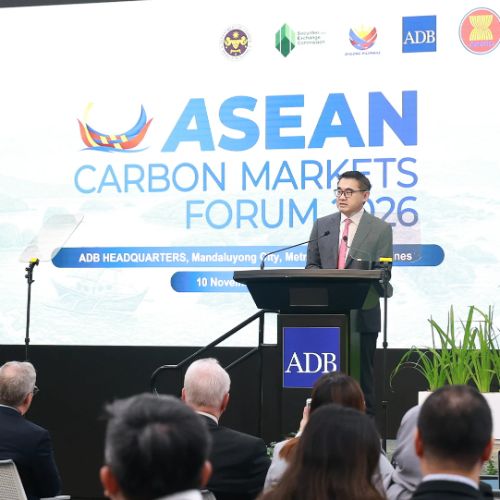
The Philippines is leading regional efforts to develop and harmonise carbon markets across Southeast Asia, with a focus on facilitating cross-border carbon credit trading, aligning national carbon registries and attracting private investment for climate action.
The Department of Finance (DOF), through its Climate Finance Policy Group, co-hosted the ASEAN Carbon Markets Development and Harmonisation Forum 2026 with the Securities and Exchange Commission (SEC), in partnership with the Asian Development Bank (ADB). The forum was held under the Philippines’ 2026 ASEAN chairship and the ASEAN Climate Finance Policy Platform.
The discussions focused on policy coordination, cross-border carbon credit transactions and the alignment of national carbon registries and monitoring systems. The Philippines also explored the possibility of an ADB-supported ASEAN Carbon Market Implementation and Interoperability Study to help member states strengthen their carbon market infrastructure and mobilise private capital.
Finance Secretary Frederick D. Go said:
“Carbon markets are a vital instrument for ASEAN prosperity. By creating a market for trading carbon credits, we can attract investments for climate action. They unlock private capital to reduce emissions. They also channel investments into renewable energy and nature-based solutions,”
ASEAN forum focuses on carbon market development and interoperability
The forum is a flagship initiative under the Philippines’ Priority Economic Deliverable on “Sustainable and Resilient ASEAN Capital Markets”. It is aligned with the ASEAN Capital Markets Forum (ACMF) Action Plan 2026–2030.
The discussions provide ASEAN member states with a platform to consider policies that could support regional carbon market development, including cross-border carbon credit trading and greater consistency between national registries and monitoring systems.
Interoperability between these systems is an important consideration for regional carbon markets. Compatible rules and monitoring arrangements could help countries track carbon credits and facilitate transactions across national jurisdictions.
During the forum, the Philippines, in its capacity as ASEAN Chair, explored the possibility of an ADB-supported ASEAN Carbon Market Implementation and Interoperability Study. The proposed study is intended to help member states advance their carbon market development, strengthen interoperability and mobilise private investment for climate action.
The announcement does not confirm that the study has been formally approved or commissioned.
Philippine carbon market policy framework under development
The regional initiative complements the Philippines’ Sustainable Finance Framework, Philippine Climate Finance Strategy and updated Nationally Determined Contributions (NDCs).
At the national level, Executive Order No. 127, signed on 13 October 2026, directs the formulation of the Philippine Carbon Market Policy Framework. It also establishes an Inter-Agency Committee on Carbon Markets and designates the Department of Environment and Natural Resources (DENR) as the national authority for carbon markets.
The order provides a basis for developing the country’s policy and institutional arrangements for participation in domestic and international carbon markets. Its provisions cover participation in cooperative approaches under Article 6 of the Paris Agreement and voluntary carbon markets.
The detailed framework and its implementation arrangements are to be developed following the executive order. The distinction is important: EO 127 initiates the process of establishing the national framework rather than confirming that all its operational rules and systems are already in place. officialgazette.gov.ph+2
ADB highlights the importance of credible carbon market rules
ADB Vice President for East, Southeast Asia and Pacific Scott Morris highlighted the importance of establishing credible rules, investable projects and interoperable markets to attract carbon finance.
He said:
“The opportunity for ASEAN is significant. Countries that put credible rules, investable projects, and interoperable markets in place now would be best positioned to attract carbon finance in the years ahead. Navigating our future together means ensuring that every ASEAN member state can participate in and benefit from that opportunity. ADB will continue to support ASEAN in making that happen,”
The ADB’s involvement in the regional platform and the proposed interoperability study reflects the importance of institutional coordination in developing carbon markets across Southeast Asia.
For participating countries, the challenge will be to establish systems that support credible carbon credit generation, monitoring and transactions while maintaining consistency with national climate commitments and international market requirements.
Related: Tanzania’s NCMC offers technical support as Carbon Bridge explores carbon market investment