


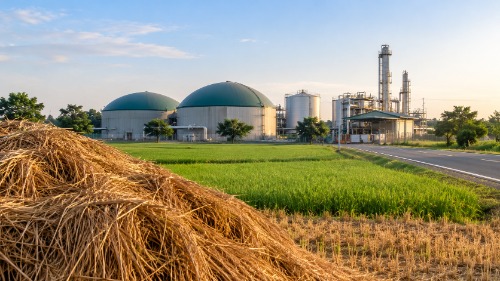
Construction of a ₹69.20 crore biogas plant at the Vellalore dumpyard in Coimbatore, Tamil Nadu, has come under scrutiny after a Right to Information (RTI) response revealed that the Tamil Nadu Pollution Control Board (TNPCB) had received no application seeking consent for the project.
The disclosure raises questions about the project’s environmental compliance, particularly as construction work has reportedly been progressing at the site. The RTI application was filed by K.S. Mohan, secretary of the Kurichi–Vellalore Pollution Prevention Joint Committee. In its response dated 11 November 2026, the TNPCB’s Coimbatore South office stated that no application seeking consent had been received for the proposed facility.
As a result, the pollution control board’s records contained no information on whether consent had been granted or rejected.
₹69.20 crore project designed to process 250 tonnes of biodegradable waste daily
The Coimbatore City Municipal Corporation’s proposed biogas project is designed to process 250 tonnes of biodegradable municipal waste per day and produce compressed biogas (CBG) through anaerobic digestion.
The project has an approved cost of ₹69.20 crore and is being implemented under a public-private partnership (PPP) model on a Design, Build, Finance, Operate and Transfer (DBFOT) basis.
Refex Green Power Limited was selected as the concessionaire, with the Letter of Acceptance issued by the corporation in April 2025. The concession agreement was subsequently executed on 6 August 2025, according to the corporation’s submission to the National Green Tribunal (NGT).
The facility is planned to operate under a 20-year concession period, including operation and maintenance responsibilities.
The foundation stone was laid on 24 August 2025 by then Tamil Nadu Municipal Administration Minister K.N. Nehru. The project is part of the city’s efforts to improve municipal waste processing and recover energy from biodegradable waste.
RTI disclosure raises questions over consent requirements
The RTI response has brought the project’s regulatory approval status into focus. The information provided by the TNPCB indicates that no application for consent had been submitted to the board as of the date covered by its records.
The distinction between Consent to Establish (CTE) and Consent to Operate (CTO) is important in this case. CTE is the prior approval required before construction of a regulated industrial or processing facility, while CTO is required before the facility begins operations.
In its submission to the NGT, the Coimbatore Corporation’s project documentation itself describes CTE as the statutory approval required before construction and CTO as necessary before commercial operations.
However, the corporation’s submission also states elsewhere that the required statutory clearances would be obtained before commissioning. The difference between these statements makes the project’s actual approval position an important issue requiring clarification from the corporation and TNPCB.
Vellalore dumpyard faces wider environmental compliance concerns
The proposed facility is being developed at the Vellalore dumpyard, a site that has faced longstanding concerns over waste accumulation, air pollution, groundwater contamination and the management of legacy waste.
Local residents and environmental activists have opposed additional waste-processing infrastructure at the location, arguing that existing environmental problems should be addressed alongside any new development.
The project has also been the subject of proceedings before the NGT’s Southern Zone in Chennai. The case concerns environmental management at the Vellalore dumpyard and objections to the proposed Bio-CNG facility.
The corporation has defended the project before the tribunal, describing it as a government-sanctioned waste-to-fuel initiative intended to improve scientific processing of municipal waste.
Solid Waste Management Rules, 2026 add to regulatory scrutiny
The Solid Waste Management Rules, 2026, notified by the Union Ministry of Environment, Forest and Climate Change on 27 January 2026, came into force on 1 April 2026, replacing the 2016 rules.
The revised framework strengthens requirements for scientific management of legacy waste dumpsites, including time-bound biomining and bioremediation plans, monitoring and environmental safeguards.
Rule 15 also states that land-owning agencies may consider using vacant dumpsite land for new solid waste management infrastructure after clearing waste or legacy waste, subject to applicable regulations.
These provisions are relevant to the Vellalore project because of the environmental concerns surrounding the existing dumpyard. However, whether the specific project site and construction activities comply with the applicable requirements needs to be established through official records.
The absence of a TNPCB consent application, as disclosed through the RTI response, therefore raises a significant regulatory question for a project intended to improve municipal waste management.
Clarification from the Coimbatore Corporation and TNPCB on the status of the required approvals will be important in determining whether construction can proceed in accordance with applicable environmental requirements.



