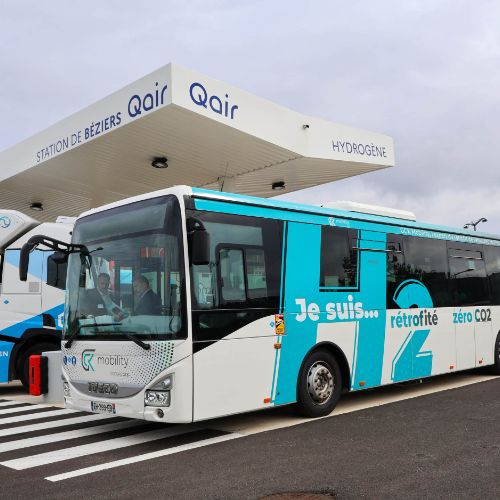
Qair and regional energy agency AREC Occitanie have inaugurated the Hyd’Occ renewable hydrogen production facility at Port-La Nouvelle in southern France. The plant’s first phase has an electrolysis capacity of 20 MW and is designed to produce 2,700 tonnes of renewable hydrogen annually, supporting heavy-duty transport and other regional applications.
The facility was inaugurated on 12 November 2026 in the presence of Occitanie regional president Carole Delga and Aude prefect Alain Bucquet. Qair describes Hyd’Occ as France’s largest renewable hydrogen production facility. According to an AFP report, the plant is expected to reach full operating capacity in the first quarter of 2027.
Hyd’Occ produced its first hydrogen in December 2025 following trials. The facility is now completing final adjustments and the process of obtaining certification under the European Union’s Renewable Fuels of Non-Biological Origin (RFNBO) framework.
Hyd’Occ targets 2,700 tonnes of annual hydrogen production
The first phase of the facility uses water electrolysis powered by renewable electricity. Its 20 MW capacity is designed to deliver 2,700 tonnes of renewable hydrogen annually, with Qair estimating that this could avoid 27,000 tonnes of CO₂ emissions each year.
A second phase is planned to increase the facility’s electrolysis capacity to 40 MW and annual production capacity to 5,400 tonnes. The expansion is part of the project’s longer-term development, although Qair has indicated that securing customers will be important before proceeding.
The facility is located at Port-La Nouvelle in the Aude department, where construction began in June 2023. Its location provides access to port infrastructure and nearby floating offshore wind installations. An AFP report says the plant is supplied by three floating wind turbines located off the Mediterranean coast.
Qair puts the total investment in the Hyd’Occ project at €130 million at full development, including the second phase and associated infrastructure. The company also reports €55 million in bank financing arranged with Crédit Agricole and Bpifrance for the production and refuelling-station ecosystem.
Hydrogen refuelling stations support heavy-duty mobility
Hyd’Occ is connected to a regional hydrogen distribution network, with stations in Béziers and Narbonne inaugurated in April and May 2026, respectively. Each station is designed to dispense up to 600 kg of hydrogen per day.
The Béziers station supports 13 hydrogen-powered buses operated by the Béziers Méditerranée urban community. The Narbonne station is positioned near the A9 and A61 motorways and is intended to serve heavy goods vehicles using the European north–south hydrogen corridor.
Both stations were selected under the Corridor H2 Occitanie programme, supported by the Occitanie Region, the European Investment Bank and the European Union. The Béziers station also received support from France’s Agency for Ecological Transition (ADEME).
The network is intended to serve heavy goods vehicles, buses, coaches, refuse collection vehicles and commercial fleets. These applications are among the project’s initial target markets because they involve intensive vehicle use, substantial loads and regular refuelling requirements.
In spring 2026, trials involving vehicle manufacturer Hyliko and the Occitanie Region enabled transport operators to test a 44-tonne hydrogen-powered truck under real operating conditions. The vehicle used the Béziers and Narbonne stations and travelled along regional motorway routes. The project announcement reported that the truck had covered more than 3,000 km by the halfway point of the trials.
Hyd’Occ supports hydrogen use across road and maritime transport
Beyond road transport, the project is also intended to supply hydrogen to HydrOMer, a dredger operated by the Occitanie Region. The vessel is equipped with a 200 kW fuel cell and is designed to operate partly on hydrogen.
Hyd’Occ says the vessel will receive hydrogen transported in 20-foot storage containers. The project estimates that the arrangement could avoid approximately 700 tonnes of CO₂ emissions annually and enable emissions-free operation while the vessel is docked.
The regional hydrogen ecosystem also includes the HyWayOne Challenge, during which a hydrogen-powered heavy goods vehicle travelling from the Netherlands reached the Narbonne station in October 2026. The truck travelled to Barcelona and back, covering approximately 3,800 km across six European countries.
The journey was intended to demonstrate the potential for hydrogen refuelling infrastructure along a north–south European freight corridor connecting the Iberian Peninsula with northern Europe.
Bioenergy Business Analysis
The inauguration of Hyd’Occ marks a significant addition to France’s renewable hydrogen production infrastructure. Its 20 MW first phase, designed for annual output of 2,700 tonnes, is linked to a regional network of refuelling stations and identified transport applications. This integration of production, distribution and end-use is central to the project’s approach to developing demand for renewable hydrogen.
The initial applications include buses, heavy goods vehicles and maritime equipment. The Narbonne station’s role in the HyWayOne Challenge also illustrates how regional infrastructure could support longer-distance hydrogen freight operations across national borders.
However, the plant’s inauguration should not be confused with full-scale commercial operation. Qair says final adjustments and RFNBO certification are still under way, while AFP reports that the facility is expected to reach full operating capacity in the first quarter of 2027. The second phase, which would double electrolysis capacity to 40 MW, also depends on the development of additional customers, according to local reporting.